
Peruvian primrose
Alert
Be on the lookout for Peruvian primrose and report any sightings within 24 hours.
Reporting options
- Report online.
- Phone Biosecurity Queensland on 13 25 23.
- Phone the Exotic Plant Pest Hotline on 1800 084 881.
- Contact your local government.
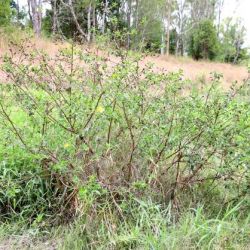
Peruvian primrose plant
© Queensland Government
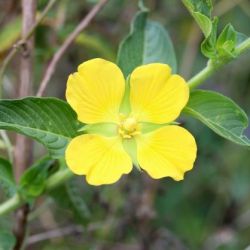
Peruvian primrose flower
© Queensland Government

Peruvian primrose infestation
© Michael Kesl Creative Commons
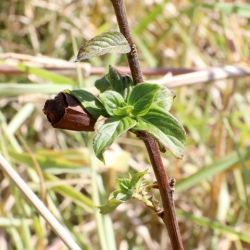
Peruvian primrose leaves and pod
© Queensland Government

Peruvian primrose branches
© Queensland Government
Native to South America, Peruvian primrose is a small shrub that has become a serious invasive plant in wetlands around Sydney. Infestations can exclude native plants and destroy habitat.
Scientific name
Ludwigia peruviana
Other names
- Ludwigia, Peruvian water primrose, Peruvian primrose bush
Similar species
- Long-leaved willow primrose (Ludwigia longifolia)
- Native willow primrose (Ludwigia octovalvis)
- Water primrose (Ludwigia peploides subsp. montevidensis)
Description
- Perennial wetland shrub up to 3m tall.
- Flowers are up to 6cm wide with 4–6 petals, 1–3cm long, 1–3cm wide.
- Leaves are slightly toothed and alternate, 5–12cm long, 1–3cm wide.
- Fruit is reddish or brownish, 10–25mm long, 6–10mm wide.
- Seeds are numerous, light brown, 0.6mm–0.8mm long.
Characteristics of similar species
Peruvian primrose looks similar to several related species. Use the following characteristics to distinguish them.
Long-leaved willow primrose
- Upright (erect) woody herb or small shrub with 4-angled stems.
- Leaves are hairless, glossy and elongated (lanceolate) or linear.
- Flowers usually have 4 large yellow petals.
- Fruit is 10–35mm long, hairless and 4-angled in cross-section.
Native willow primrose
- Upright woody herb or small shrub with rounded stems.
- Leaves are usually covered in hairs, variable shape that can be egg-shaped to very elongated.
- Flowers usually have 4 large yellow petals.
- Fruit is 20–45mm long, hairy and rounded.
Water primrose
- Creeping or floating plant with rounded stems.
- Leaves are mostly hairless, glossy and egg-shaped or elongated.
- Flowers usually have 5 yellow petals.
- Fruit is 10–30mm long, mostly hairless, and rounded in cross-section.
Habitat
- Prefers wetland areas.
- Potential to become a serious problem if planted in aquariums or outdoor ponds.
Distribution
- Detected in South East Queensland.
- Visit Weeds Australia and click on the distribution tab to access the distribution map.
Life cycle
- Germinates readily in spring.
- Grows rapidly in summer.
- Flowers from late summer to autumn.
Plants affected
- Native wetland plants
Impacts
Environmental
- Forms pure stands that exclude native wetland plants and destroy habitat of most native wildlife.
How it is spread
- Seeds spread by birds, water and wind.
Prevention
- Find out how farmers can prevent weed spread.
- Find out how gardeners and outdoor enthusiasts can prevent weed spread.
Control
- Before undertaking any preventative or control actions, contact us online, by phone or in person.
Legal requirements
- Peruvian primrose is a category 2, 3, 4 and 5 restricted invasive plant under the Biosecurity Act 2014. You must not:
- move it
- keep it
- give it away
- sell it
- release it into the environment.
If you do any of these, penalties may apply.
- You must take all reasonable and practical measures that are under your control to minimise the biosecurity risks associated with dealing with Peruvian primrose. This is part of your general biosecurity obligation.
- You must report any sightings within 24 hours using 1 of these methods:
- Report online.
- Phone Biosecurity Queensland on 13 25 23.
- Phone the Exotic Plant Pest Hotline on 1800 084 881.
- Contact your local government.
- Each local government must have a biosecurity plan that covers invasive plants in its area. This plan may include actions to be taken for Peruvian primrose. Some of these actions may be required under local laws. Contact your local government for more information.
Further information
- Contact us online, by phone or in person.
- Read the Peruvian primrose fact sheet.
- Find out more from Weeds Australia's profile of Peruvian primrose.