
Bitterweed
Alert
Be on the lookout for bitterweed and report any sightings within 24 hours.
Reporting options
- Report online.
- Phone Biosecurity Queensland on 13 25 23.
- Phone the Exotic Plant Pest Hotline on 1800 084 881.
- Contact your local government.
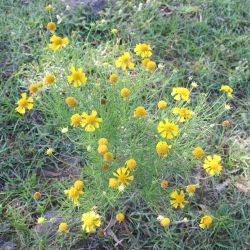
Bitterweed flowers
© Queensland Government
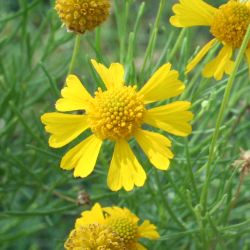
Bitterweed flowers close up
© Queensland Government
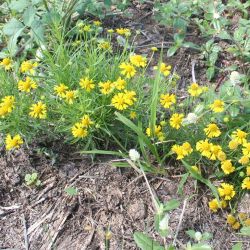
Bitterweed infestation
© J Michael Raby Creative Commons
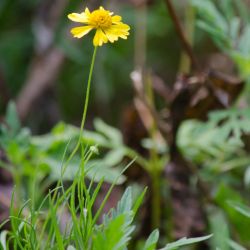
Bitterweed stem and flower
© Suzanne Cadwell Creative Commons
Native to south-eastern USA and Mexico, bitterweed is a compact annual with small yellow flowers.
Bitterweed is poisonous to livestock and competes with pasture and native vegetation. In Queensland, it has been found at only 1 location, near Mount Tarampa in the Lockyer Valley.
You must take reasonable action to minimise the risk of spreading bitterweed to ensure the situation isn't worsened.
Scientific name
Helenium amarum
Description
- Annual herb up to 60cm tall, compact and bushy under favourable conditions.
- Stems are smooth and branching with numerous leaves.
- Leaves are smooth, narrow, thread-like, light green to grey-blue.
- Flowers are yellow, daisy-like, about 2cm in diameter.
- Unnoticed when competing with other plants, producing a single flower on plants as small as 5cm tall.
Habitat
- Prefers open fields, roadsides and disturbed areas in subhumid, warm temperate and subtropical areas where annual rainfall does not exceed 1,000mm.
Distribution
- Only known to exist at a single location near Mount Tarampa in the Lockyer Valley in South East Queensland.
Life cycle
- Flowers mostly over spring and summer.
- Scented flowers are pollinated by insects such as bees and butterflies.
- Mature seeds are non-dormant and germinate readily in sunlight.
Plants affected
- Native plants
Animals affected
- Sheep
- Horses
- Cattle
Impacts
Environmental
- Competes with native vegetation.
Economic
- Potential weed of pastures.
- Poisonous to stock, including sheep, horses and cattle.
- Taints milk of dairy cattle.
How it is spread
- Seeds in hay, silage and on vehicles.
Prevention
- Find out how farmers can prevent weed spread.
- Find out how gardeners and outdoor enthusiasts can prevent weed spread.
Control
Before undertaking any preventative or control actions, contact us online, by phone or in person.
Physical control
- Hand-pull, ensuring entire root system is pulled up.
Herbicide control
- Broad-leaf herbicides such as 2,4-D or Grazon P+D® can be effective.
Biological control
- No known biological control agents.
Legal requirements
- Bitterweed is a category 2, 3, 4 and 5 restricted invasive plant under the Biosecurity Act 2014. You must not:
- move it
- keep it
- give it away
- sell it
- release it into the environment.
If you do any of these, penalties may apply.
- You must take all reasonable and practical measures that are under your control to minimise the biosecurity risks associated with dealing with bitterweed. This is part of your general biosecurity obligation.
- You must report any sightings within 24 hours using 1 of these methods:
- Report online.
- Phone Biosecurity Queensland on 13 25 23.
- Phone the Exotic Plant Pest Hotline on 1800 084 881.
- Contact your local government.
- Each local government must have a biosecurity plan that covers invasive plants in its area. This plan may include actions to be taken for bitterweed. Some of these actions may be required under local laws. Contact your local government for more information.
Further information
- Contact us online, by phone or in person.
- Read the bitterweed fact sheet.
- Find out more from the bitterweed risk assessment (PDF, 713KB).