
Cochineal nopal cactus
Alert
Be on the lookout for cochineal nopal cactus and report any sightings within 24 hours.
Reporting options
- Report online.
- Phone Biosecurity Queensland on 13 25 23.
- Phone the Exotic Plant Pest Hotline on 1800 084 881.
- Contact your local government.
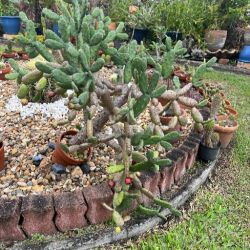
Cochineal nopal cactus plant
© Queensland Government
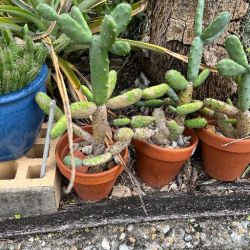
Cochineal nopal cactus in pots
© Creative Commons
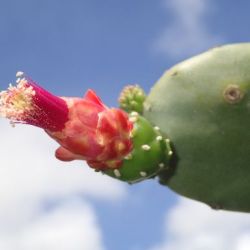
Cochineal nopal cactus flower
© Creative Commons
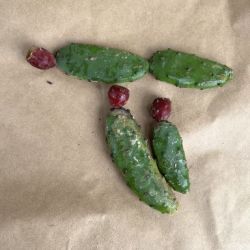
Cochineal nopal cactus cladodes and fruit
© Queensland Government
Cochineal nopal cactus is a multibranched tree-like shrub that is native to Mexico.
It can form dense infestations that compete with native vegetation, limiting the growth of small shrubs and groundcover species. It can impact ecosystems, waterways and agriculture.
If left unchecked, cochineal nopal cactus could spread over considerable areas of Queensland.
Scientific name
Opuntia cochenillifera
Other names
- Nopalea cactus
Similar species
- Drooping tree pear (Opuntia monacantha)
Description
- This multibranched tree-like shrub grows up to 4m high.
- The cladodes (flattened to rounded paddle-shaped stems) are 8–40cm long, up to 7cm wide, thick, smooth and green. They have raised white spots called areoles from which clusters of barbed bristles called glochids grow.
- Spines are usually absent as they are bred out in cultivated specimens, but if present are 1–2cm long and may be straight or curved.
- The pink flowers are tubular and 3–10cm in diameter. The filaments (thread-like stalks that support the pollen-bearing anthers) are pink and extend beyond the petals.
- The fruit is 3–5cm long and has areoles bearing glochids. As the fruit matures, it changes from green to yellow to red.
Habitat
- Prefers tropical and subtropical regions but can persist in arid to semi-arid areas.
- Tolerates a range of environmental conditions, provided the soil is well-drained.
Distribution
- Has been detected as an ornamental plant in backyards throughout Queensland.
Life cycle
- The shrub primarily reproduces asexually through vegetative propagation.
- Segments (cladodes or pads) fall off or are planted intentionally, taking root in the soil to form new plants.
- New cladodes grow from the original pad. Over time, the plant becomes a multipadded shrub.
Animals affected
- Livestock
Impacts
Environmental
- Can displace native vegetation and hinder movement of animals and people.
Economic
- Invades and replaces pasture, including improved pasture.
How it is spread
- Birds and animals eat the fruit and excrete seed.
- Animals and floods can move broken pads long distances.
- Plants are bought and sold through the ornamental trade.
Prevention
- Find out how farmers can prevent weed spread.
- Find out how gardeners and outdoor enthusiasts can prevent weed spread.
Control
- Before undertaking any preventative or control actions, contact us online, by phone or in person.
Legal requirements
- Cochineal nopal cactus is a category 2, 3, 4 and 5 restricted invasive plant under the Biosecurity Act 2014. You must not:
- move
- keep it
- give it away
- sell it
- release it into the environment.
If you do any of these, penalties may apply.
- You must take all reasonable and practical measures that are under your control to minimise the biosecurity risks associated with dealing with cochineal nopal cactus. This is part of your general biosecurity obligation.
- You must report any sightings within 24 hours using 1 of these methods:
- Report online.
- Phone Biosecurity Queensland on 13 25 23.
- Phone the Exotic Plant Pest Hotline on 1800 084 881.
- Contact your local government.
- Each local government must have a biosecurity plan that covers invasive plants in its area. This plan may include actions to be taken on cochineal nopal cactus. Some of these actions may be required under local laws. Contact your local government for more information.
Further information
- Contact us online, by phone or in person.
- Read the cochineal nopal cactus fact sheet.