
Climbing asparagus fern
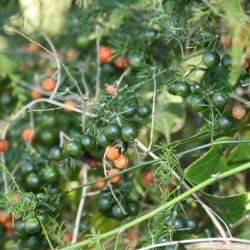
Climbing asparagus fern fruit
© Queensland Government
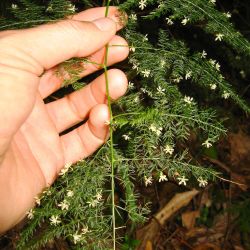
Climbing asparagus fern flower and leaves
© Queensland Government
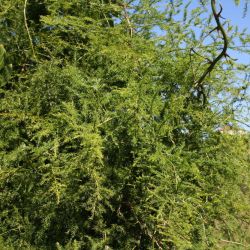
Climbing asparagus fern plant
© Queensland Government
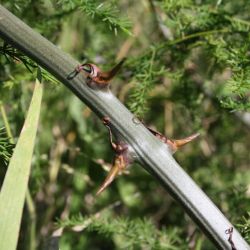
Climbing asparagus fern thorn
© Queensland Government
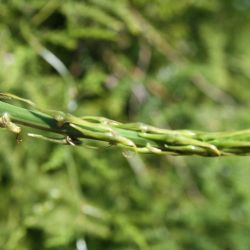
Climbing asparagus fern
© Queensland Government
Native to the Western Cape region of South Africa, bridal veil has been present in Australia as an ornamental plant since 1870. Naturalised populations were recorded on Kangaroo Island in 1954 and it has since naturalised in coastal and inland regions of South Australia, Western Australia and Victoria.
Bridal veil is very similar to bridal creeper and has become a highly invasive and aggressive invasive plant. Both these invasive species are listed as Weeds of National Significance.
This invasive plant is part of a group of ferns known collectively as ‘asparagus ferns’:
- asparagus fern (Asparagus scandens)
- basket asparagus fern (A. aethiopicus)
- bridal veil (A. declinatus)
- climbing asparagus fern (A. africanus)
- feathered asparagus fern (A. plumosus).
All these asparagus ferns are category 3 restricted matter in Queensland. Due to these plants’ invasive properties and the difficulty of removing them from bushland, gardeners should avoid planting all types of asparagus ferns.
Scientific name
Asparagus africanus
Similar species
Description
- Fast-growing plant with stems up to 12m long; can climb trees.
- Leaves and stems are very fine and thorny.
- Flowers are green-white, bell-shaped, 5–7mm wide.
- Berries are green when young, ripening to orange, 5mm wide.
- Roots appear swollen and thick, do not produce tubers.
- Similar in appearance and impact to A.plumosus, except A. africanus has orange berries while A. plumosus has black berries.
- Without a host, can grow as scrambling low shrub.
Habitat
- Prefers bushland and rainforests.
Distribution
- Naturalised in several coastal regions of Queensland.
Life cycle
- Flowers mostly in spring, producing berries that contain 1 seed.
Impacts
Environmental
- Smothers trees and damages rainforests, vine scrubs and riparian vegetation.
How it is spread
- Berries dispersed by birds.
Prevention
- Find out how farmers can prevent weed spread.
- Find out how gardeners and outdoor enthusiasts can prevent weed spread.
Control
Physical control
- Prevent birds from accessing berries.
- Dig out roots and dispose of them at your local waste facility.
- Remove entire crown and underground stem to prevent regrowth. This requires digging underneath the central growing point and lifting it out of the ground. Any regrowth that occurs can be kept under control by regular mowing or digging out.
Herbicide control
- Herbicides are effective.
Read the asparagus ferns fact sheet for herbicide control and application rates.
Biological control
- No known biological control agents.
Legal requirements
- Climbing asparagus fern is a category 3 restricted invasive plant under the Biosecurity Act 2014.
You must not:- give it away
- sell it
- release it into the environment.
- You must take all reasonable and practical measures that are under your control to minimise the biosecurity risks associated with dealing with climbing asparagus fern. This is part of your general biosecurity obligation.
- Each local government must have a biosecurity plan that covers invasive plants in its area. This plan may include actions to be taken on climbing asparagus fern. Some of these actions may be required under local laws. Contact local government for more information.
Further information
- Contact us online, by phone or in person.
- Read the asparagus ferns fact sheet.
- Find out more about the similar species basket asparagus fern and feathered asparagus fern.