
Siam weed
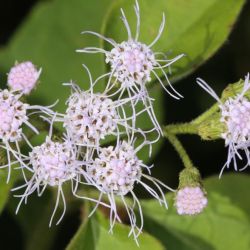
Siam weed flowers close-up
© Queensland Government
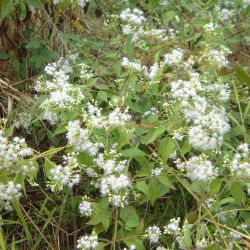
Siam weed in flower
© Queensland Government
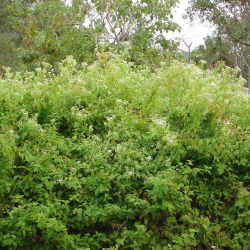
Siam weed infestation
© Queensland Government
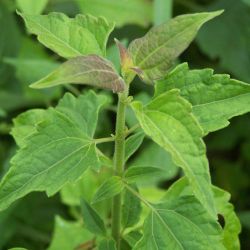
Siam weed new growth on seedlings
© Queensland Government
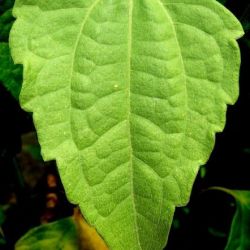
Siam weed leaf
© Queensland Government
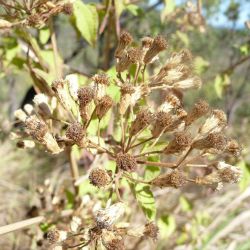
Siam weed seeds close-up
© Queensland Government
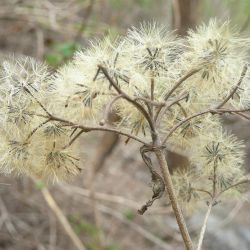
Siam weed windborne seeds
© Queensland Government
Native to Central and South America, Siam weed is a dense, tangling bush, considered one of the world's most invasive plants. It quickly invades and smothers native vegetation.
Scientific name
Chromolaena odorata
Other names
- Armstrong's weed, baby tea, bitter bush, butterfly weed
Description
- This dense, tangling bush grows up to 2–3m tall.
- It can scramble up trees to a height of 20m.
- Root systems are fibrous and shallow in most soils.
- Enlargements at the junctions of stems and roots are called basal balls.
- Leaves are soft, green, hairy and roughly triangular. They have a distinctive 'pitchfork' 3-vein pattern.
- New leaf growth can have purple colouration.
- Leaves emit a distinctive odour when crushed.
- Stems are smooth, round and fairly brittle. Their base becomes woody when old.
- Flowers are pale lilac, appearing white from a distance.
3D model
- View the 3D model to help you identify this plant. You can magnify the image and manipulate the view to inspect the plant from every angle.
Habitat
- Suited to highly productive land types.
- Grows easily along watercourses, foreshores and swamps.
- Generally found in areas with rainfall over 600mm per annum.
Distribution
- Visit the Weeds Australia website and click on the distribution tab to view the distribution map.
Life cycle
- Grows 20mm per day or 5m per year.
- Dies back in the dry season but reshoots after rain.
- Grows back quickly after fire, slashing or chemical pruning.
- Germinates after rain, although some seeds appear to remain dormant for several years.
Plants affected
- Pasture
- Crops
- Native plants
- Native trees
- Native shrubs
Impacts
Environmental
- Quickly invades and smothers native vegetation.
- Outcompetes native vegetation.
- Increases frequency and intensity of bushfires.
Economic
- Outcompetes pastures and crops.
- Has been reported to poison stock.
Social
- Causes skin problems and asthma in allergy-prone people.
How it is spread
- Seeds are spread by wind, by attaching to animals, by moving down waterways and by people.
- Plants produce large numbers of windborne seeds (more than 80,000 seeds per plant per season).
Prevention
- Find out how farmers can prevent weed spread.
- Find out how gardeners and outdoor enthusiasts can prevent weed spread.
Control
Physical control
- Remove the basal/root ball for smaller infestations.
- Ensure vegetative pieces are not left in contact with the ground, as they can reshoot.
Herbicide control
- Regularly apply herbicide at the correct rates, and before flowering. Incorrect application can lead to chemical pruning, which will allow plants to reshoot. Always read the label before using any herbicide.
- Read the Siam weed fact sheet for herbicide control and application rates.
Biological control
One biological control agent, Cecidochares connexa (stem-galling fly), has been released in northern Queensland and the Northern Territory since late 2019. Stem-galling fly was being mass-reared at the Tropical Weeds Research Centre in Charters Towers.
Legal requirements
- Siam weed is a category 3 restricted invasive plant under the Biosecurity Act 2014. You must not:
- give it away
- sell it
- release it into the environment.
- You must take all reasonable and practical measures that are under your control to minimise the biosecurity risks associated with dealing with Siam weed. This is part of your general biosecurity obligation.
- Each local government must have a biosecurity plan that covers invasive plants in its area. This plan may include actions to be taken on Siam weed. Some of these actions may be required under local laws. Contact your local government for more information.
If you do any of these, penalties may apply.
Further information
- Contact us online, by phone or in person.
- Read the Siam weed fact sheet.
- Watch a video about how to identify Siam weed.
- View the Siam weed 3D model.