
Thunbergia
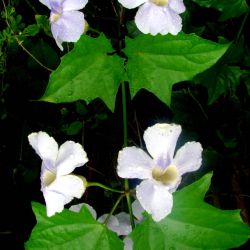
Thunbergia leaves and flowers
© Queensland Government
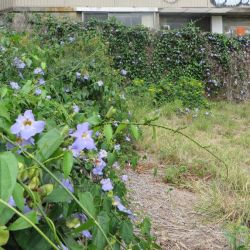
Thunbergia infestation
© Queensland Government

Thunbergia smothering native vegetation
© Queensland Government
Native to India, thunbergia is a small, low vine with slender climbing stems. It can threaten remnant vegetation and degrade the banks of creeks and rivers. Thunbergia is found along coastal streams and rivers in North Queensland.
Scientific name
Thunbergia grandiflora
Other names
- Blue trumpet vine, blue sky vine, laurel clock vine
Similar species
Description
- Vigorous perennial twining vine.
- Leaves are choko-like, up to 15cm long and 10cm wide, pointed tip.
- Flowers are trumpet-shaped with short, broad tube, white on outside, yellow inside, expanding to 5 rounded, pale lavender-blue petals up to 8cm long and 6–8cm wide.
- Seed pods are cone-shaped, 3–5cm long with rounded base.
- Seeds are flat, up to 1cm long covered in brown scales.
- Tuberous root system, some as large as 70kg.
Habitat
- Found along banks of rivers and creeks.
Distribution
- Visit Weeds Australia and click on the distribution tab to access the distribution map.
Life cycle
- Propagation is from stem cuttings or shoots from tuberous roots.
Impacts
Environmental
- Threatens remnant vegetation in Wet Tropics.
- Degrades banks of creeks and rivers.
How it is spread
- Spread primarily via ornamental plant trade.
- Root pieces can spread by floodwater.
Prevention
- Find out how farmers can prevent weed spread.
- Find out how gardeners and outdoor enthusiasts can prevent weed spread.
Control
Physical control
- Dig out small plants.
Herbicide control
- Herbicides are effective.
Read the Thunbergia fact sheet for herbicide control and application rates.
Biological control
- No known biological control agents.
Legal requirements
- Thunbergia is a category 3 restricted invasive plant under the Biosecurity Act 2014. You must not:
- give it away
- sell it
- release it into the environment
If you do any of these, penalties may apply.
- You must take all reasonable and practical measures that are under your control to minimise the biosecurity risks associated with dealing with thunbergia. This is part of your general biosecurity obligation.
- Each local government must have a biosecurity plan that covers invasive plants in its area. This plan may include actions to be taken for thunbergia. Some of these actions may be required under local laws. Contact your local government for more information.
Further information
- Contact us online, by phone, or in person
- Read the thunbergia fact sheet
- Read the Weeds Australia's profile of blue trumpet vine