
Ivy gourd
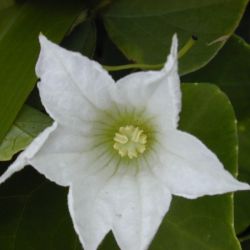
Ivy gourd flower
© F & K Starr Creative Commons
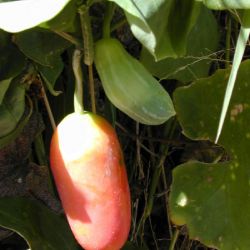
Ivy gourd fruit
© F & K Starr Creative Commons
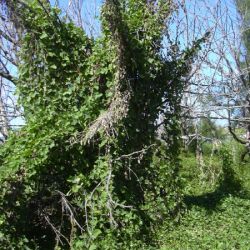
Ivy gourd infestation
© F & K Starr Creative Commons
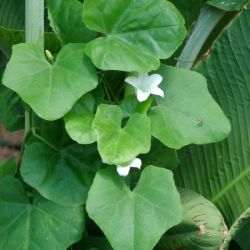
Ivy gourd leaves and flower
© F & K Starr Creative Commons
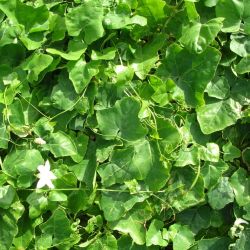
Ivy gourd mass of leaves
© F & K Starr Creative Commons
Thought to be native to India, Asia and central Africa, ivy gourd is a smothering vine. It is recorded as an invasive weed on the Pacific islands of Saipan, Fiji, Guam, Tongatapu, the Solomons and Hawaii.
In Australia, ivy gourd is found in the Kimberley region of Western Australia, and in Arnhem Land, Darwin and the Gulf region in the Northern Territory. North Queensland currently has small, scattered populations. Ivy gourd can smother vegetation and other objects, forming a dense canopy. It has the potential to spread if not controlled.
Scientific name
Coccinia grandis
Description
- Perennial vine up to 13m tall, which forms dense, hanging mats that cover shrubs and small trees.
- Stems are green, slender when young, becoming succulent and thick with age.
- Stems develop roots where nodes contact soil.
- Leaves are alternate, heart- to pentagon-shaped, up to 10cm wide and long.
- Flowers are white, star-shaped, have 5 narrow sepals 6–8mm long that join at base.
- Male flowers have 3 convoluted stamens.
- Female flowers have 3 hairy stigmas.
- Fruit is red, ovoid to elliptical, 25–60mm long, 15–35mm in diameter, hairless, on stalks 10–40mm long.
- Seeds are tan, 6–7mm long.
Habitat
- Native range habitat is deciduous bush, savanna, dry evergreen forest and thickets.
- Prefers open, disturbed sites and riparian habitats in dry tropics of North Queensland.
Distribution
- Found near Townsville, Cairns and other parts of coastal northern Queensland.
Life cycle
- Seeds do not show dormancy, and usually germinate in 2–4 weeks.
- Flowers August–September.
Plants affected
- native plants
Impacts
Environmental
- Smothers vegetation and other objects, forming dense canopy.
Economic
- Hosts melon fly (crop pest) and, possibly, ring spot virus.
How it is spread
- Spread from seeds and broken pieces of roots and stems.
- Seeds can be dispersed by birds and feral pigs.
Prevention
- Find out how farmers can prevent weed spread.
- Find out how gardeners and outdoor enthusiasts can prevent weed spread.
Control
Physical control
- Very difficult to control, as all roots and stem fragments must be removed or plants will regrow from tuberous root system.
Herbicide control
- No herbicide is currently registered for control of ivy gourd in Queensland. An off-label use permit (permit PER11463) allows use of various herbicides to control invasive plants in non-agricultural areas, bushland, forests, wetlands, and coastal and adjacent areas.
- In Hawaii, foliar application has proved successful only on small, young plants.
- Cut-stump application of herbicides will be more effective.
- Read the ivy gourd fact sheet to learn about herbicide control and application rates.
Biological control
- No known biological control agents.
- However, 2 weevils (Acythopeus burkhartorum and A. cocciniae) are being trialled in Hawaii.
Legal requirements
- Ivy gourd is a category 3 and 5 restricted invasive plant under the Biosecurity Act 2014. You must not:
- keep it
- give it away
- sell it
- release it into the environment.
If you do any of these, penalties may apply.
- You must take all reasonable and practical measures that are under your control to minimise the biosecurity risks associated with dealing with ivy gourd. This is part of your general biosecurity obligation.
- Each local government must have a biosecurity plan that covers invasive plants in its area. This plan may include actions to be taken on ivy gourd. Some of these actions may be required under local laws. Contact your local government for more information.
Further information
- Contact us online, by phone or in person.
- Read the ivy gourd fact sheet.
- Find out more from the ivy gourd pest risk assessment (PDF, 557KB).