
Kidneyleaf mudplantain
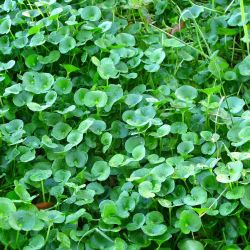
Kidneyleaf mudplantain close-up
© Queensland Government
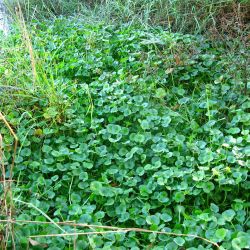
Kidneyleaf mudplantain infestation
© Queensland Government
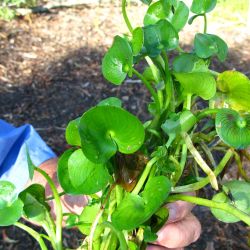
Kidneyleaf mudplantain plant
© Queensland Government
Native to North, Central and South America, kidneyleaf mudplantain is an invasive aquatic flowering plant that thrives in shallow, freshwater wetlands.
It is popular as an ornamental pond plant, and escaped plants have established in parts of South East Queensland. It can form dense mats that smother native aquatic plants.
Scientific name
Heteranthera reniformis
Description
- Aquatic annual or perennial 20–50cm tall.
- Stems are submerged or floating and root at any node when in soil.
- Flowering stems are 1–9cm long.
- Leaves are 5cm long, 3cm wide, rounded or kidney-shaped, arranged alternately along stems.
- Flowers are very small, white to pale blue, 3–6.5mm, open only for 3 hours after sunrise.
- Fruit is capsule with 8–14 seeds.
- Seeds are winged, 0.5–0.9mm long, 0.3–0.5mm wide.
Habitat
- Prefers open, sunny sites with nutrient-rich soil and water less than 15cm deep.
- Found in roadside ditches, on edges of freshwater streams, rivers and ponds, and on freshwater tidal mudflats.
Distribution
- Naturalised populations found in coastal South East Queensland.
Life cycle
- Seed banks can exist in soil for many years.
Impacts
Environmental
- Forms dense mats that smother native aquatic plants.
Economic
- Serious invasive plant of flooded rice fields overseas.
- Provides good habitat for mosquitoes.
How it is spread
- Fragments of stems can spread by water and wind.
Prevention
- Find out how farmers can prevent weed spread.
- Find out how gardeners and outdoor enthusiasts can prevent weed spread.
Control
Physical control
- Plants in ponds or small dams can be removed by physical and mechanical means, taking care to remove all root mass. Follow-up will be required.
Herbicide control
- Herbicide control is effective.
- Use the foliar and spot spray application methods.
Read the kidneyleaf mudplantain fact sheet to learn about herbicide control and application rates.
Legal requirements
- Kidneyleaf mudplantain is a category 3 and 5 restricted invasive plant under the Biosecurity Act 2014. You must not:
- keep it
- give it away
- sell it
- release it into the environment.
- You must take all reasonable and practical measures that are under your control to minimise the biosecurity risks associated with dealing with kidneyleaf mudplantain. This part of your general biosecurity obligation.
- Each local government must have a biosecurity plan that covers invasive plants in its area. This plan may include actions to be taken on kidneyleaf mudplantain. Some of these actions may be required under local laws. Contact your local government for more information.
If you do any of these, penalties may apply.
Further information
- Contact us online, by phone or in person.
- Read the kidneyleaf mudplantain fact sheet.
- Find out more kidneyleaf mudplantain risk assessment (PDF, 1MB).