
Miconia
Alert
Be on the lookout for miconia and report any sightings immediately.
Reporting options
- Report online.
- Phone Biosecurity Queensland on 13 25 23.
- Phone the Exotic Plant Pest Hotline on 1800 084 881.
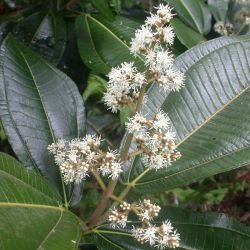
Miconia flowers
© Queensland Government

Miconia fruit panicle
© Queensland Government

Miconia plant form
© Queensland Government
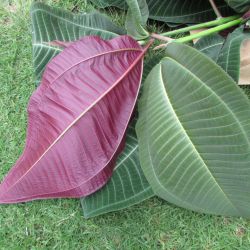
Miconia top and underside of leaves
© Queensland Government
Native to tropical America, miconia are small trees or sprawling shrubs with large leaves. In Queensland there are currently 3 species of miconia:
- Miconia calvescens
- Miconia nervosa
- Miconia racemosa.
All pose a significant threat to local rainforests.
These species and M. cionotricha are targeted for eradication in Queensland by the National Tropical Weeds Eradication Program.
M. calvescens is well suited to the coastal northern Queensland climate and could cause irreversible ecological damage to our subtropical and Wet Tropics rainforests, including World Heritage areas. M. calvescens has also been found in northern New South Wales.
M. nervosa and M. racemosa are shrubs native to Central America and South America. They have naturalised at single locations in northern Queensland.
Cultivated specimens of M. cionotricha have been removed from northern Queensland.
Scientific name
Miconia calvescens, M. nervosa and M. racemosa
Other names
- Velvet tree
- Bush currant
- Purple plague
Similar species
- Fusion discolour Faux cissus
- Persian shield Strobilanthes dyerianus
- Mountain ardisia Ardisia pachyrrhachis
Description
- Miconia are small trees up to 15m tall or sprawling shrubs.
- Leaves are large, opposite and generally 60–70cm long, sometimes growing larger in ideal situations.
- Leaves have 3 prominent veins and a distinctive purple underside.
- Flowers are small and white or pinkish. They occur on panicles.
- Fruit are small berries that are 6–7mm across when mature. Berries are green when young and turn purplish/darker as they mature. A single panicle can contain hundreds of berries.
- A mature tree with 200 fruiting panicles can produce over 8.9 million seeds per fruiting season. This enables 1 parent plant to build aggressively invading populations.
3D model
- View the 3D model to help you identify this plant. You can magnify the image and manipulate the view to inspect the plant from every angle.
Habitat
- Wet forests, particularly rainforest gullies and forested creek lines
- Tropical and subtropical areas
- Domestic gardens
Distribution
- Visit the Weeds Australia website and click on the distribution tab to view the distribution map.
Life cycle
- Trees take 4 years or more to mature.
- Initial flowering and fruiting of mature M. calvescens trees in Australia generally occurs between March and October.
- Fruit production begins about 2 months after flowering.
Plants affected
- Rainforest
- Native plants
Animals affected
- Native animals
Impacts
- Invades rainforest areas. The most at-risk species include understorey plants (growing below the tree line) such as rare orchids and ferns, shrubby species and small trees.
- Invades landscapes by creating barren understoreys (areas below the tree line).
- Significantly reduces the amount of light available to plants underneath the canopy. This reduces the growth of ground cover and accelerates erosion in high-rainfall catchments and tropical reef catchments.
- Causes hillside instability and erosion due to its shallow root system, with potential run-off damage to tropical coral reefs.
- Because of its superficial and tentacular rooting system, contributes to landslides after heavy rain, leading to further losses of wildlife and native vegetation, and silting of streams.
How it is spread
- Plants are spread by gardeners (for ornamental purposes).
- Seeds are primarily spread by water, birds and other animals.
- Contaminated vehicles, machinery and footwear can spread seeds and plants.
Prevention
- Find out how farmers can prevent weed spread.
- Find out how gardeners and outdoor enthusiasts can prevent weed spread.
Control
Before undertaking any preventative or control actions, contact us online, by phone or in person.
Biological control
- There are no known biological control agents.
- Research for an agent is underway.
- No herbicides are registered to specifically control miconia.
Legal requirements
- Miconia is a category 2, 3, 4 and 5 restricted invasive plant under the Biosecurity Act 2014.
- You must not:
- give it away
- sell it
- release it into the environment.
- You must take all reasonable and practical measures that are under your control to minimise the biosecurity risks associated with dealing with miconia. This is part of your general biosecurity obligation.
- You must report any sightings immediately using 1 of these methods:
- Report online.
- Phone Biosecurity Queensland on 13 25 23.
- Phone the Exotic Plant Pest Hotline on 1800 084 881.
- Each local government must have a biosecurity plan that covers invasive plants in its area. This plan may include actions to be taken on miconia. Some of these actions may be required under local laws. Contact your local government for more information.
If you do any of these, penalties may apply.
Further information
- Contact us online, by phone or in person.
- Watch a video about how to identify miconia.
- Watch a video to learn about keeping an eye out for miconia.
- Read the miconia fact sheet.
- Read the miconia risk assessment (PDF, 1.4MB).
- Listen to a podcast about miconia's threat to the Daintree.
- Read Weeds Australia's—miconia profile.
- Check the WeedScan app.
- View the miconia 3D model.