
Amazon frogbit and frogbit

Amazon frogbit infestation
© Queensland Government
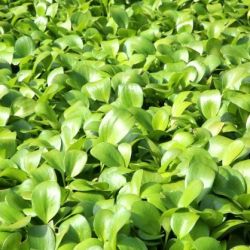
Amazon frogbit close-up
© Queensland Government
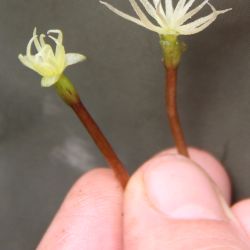
Amazon frogbit flower
© Queensland Government
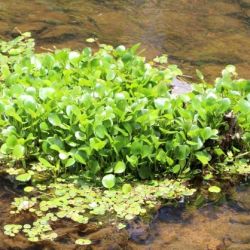
Amazon frogbit plant
© Queensland Government
Amazon frogbit is native to Central America and South America. Frogbit is native to eastern Asia.
Both species are perennial floating aquatic plants similar to a large duckweed (Lemna minor). Their leaves generally float on the water surface but can become emergent when a plant is crowded. Adult plants can develop very quickly.
Amazon frogbit and frogbit are often found in fish ponds, aquariums and water features. They invade and smother waterways, forming large dense mats of runners. They can also block waterways and irrigation channels, limiting recreational activities.
Frogbit species have been sold as aquarium plants for some time. Their occurrence in waterways near urban areas is likely a result of escapes or releases from aquariums or garden water features.
Scientific name
Hydrocharis laevigata, syn. Limnobium laevigatum (Amazon frogbit) and Hydrocharis dubia (frogbit)
Description
- Amazon frogbit and frogbit are very similar in appearance when not in flower.
- These perennial invasive floating aquatic plant can grow up to 50cm tall.
- Leaves are bright green and up to 4cm wide. They are either floating or emergent and are arranged in basal rosettes along runners (stolons).
- Amazon frogbit flowers are greenish white to pale yellow with underdeveloped petals. They are male or female.
- Frogbit flowers are white to pale yellow with 3 rounded petals. They are male or female.
- For both species, flowers emerge upright, and subsequent fruit develop on the underside of the plant, in the water. Both fruit and flowers are hard to see.
- Fruit are 4–13mm long and 2–5mm wide. Each contains up to 100 highly viable seeds, which are less than 1mm diameter and spherical with a rough surface.
- Fruit are retained on the plant. They split when mature, releasing seeds, which mostly sink.
3D model
- View the 3D model of Amazon frogbit to help you identify this plant. You can magnify the image and manipulate the view to inspect the plant from every angle.
Habitat
- Amazon frogbit and frogbit prefers tropical to subtropical climates.
Distribution
Amazon frogbit
- The first detection in the Queensland environment was in March 2011. Established plants were found in a Redlands waterway adjoining an urban area.
- It has also been detected in Gold Coast and Sunshine Coast waterways and a major infestation has occurred in the Barron River catchment in North Queensland.
- This plant is also found in other rivers and creeks. It may become naturalised in dams, lakes and freshwater wetlands throughout Queensland.
Frogbit
- The first detection in the Queensland environment was in the 1840s in the Wide Bay Burnett region.
- The plant was initially recorded as native to Australia, but further investigation revealed it to be a non-native species that naturalised.
- It has since been detected in waterways in the Darling Downs, Moreton and North Kennedy local government areas.
Life cycle
- Amazon frogbit and frogbit seed banks can exist in soil for at least 3 years.
- Plants grow from seed and through vegetative reproduction, which is the most important method of propagation.
Impacts
Both Amazon frogbit and frogbit have environmental and economic impacts.
Environmental
- Form dense mats that smother native aquatic plants.
- Reduce oxygenation of water.
Economic
- Interfere with watercraft when infestations are large.
- Degrade quality of swimming and fishing.
- Interfere with infrastructure used for water treatment, water management and hydroelectricity (such as on the Barron River).
How it is spread
- Amazon frogbit and frogbit spread by seeds and stem fragments. Floating rosettes produce runners (stolons), the ends of which grow into juvenile plants.
- They can also be spread by careless dumping of unwanted plants into urban drains leading into waterways. Young plants can easily and quickly be carried along by water.
Prevention
- Find out how farmers can prevent weed spread.
- Find out how gardeners and outdoor enthusiasts can prevent weed spread.
Control
- The best approach is to combine herbicide and physical control methods. The control methods should suit the specific plant and particular situation.
Physical control
- Remove plants in ponds or small dams by physical or mechanical means, taking care to remove all root mass. Apply follow-up herbicide treatment.
Herbicide control
- The Australian Pesticides and Veterinary Medicines Authority has registered a herbicide for the control of Amazon frogbit in Queensland.
- Read the Amazon frogbit fact sheet for herbicide control and application rates.
Legal requirements
- Amazon frogbit and frogbit are category 3 and 5 restricted invasive plants under the Biosecurity Act 2014. You must not:
- keep them
- give them away
- sell them
- release them into the environment.
If you do any of these, penalties may apply.
- You must take all reasonable and practical measures that are under your control to minimise the biosecurity risks associated with dealing with Amazon frogbit and frogbit. This is part of your general biosecurity obligation.
- Each local government must have a biosecurity plan that covers invasive plants in its area. This plan may include actions to be taken on Amazon frogbit and frogbit. Some of these actions may be required under local laws. Contact your local government for more information.
Further information
- Contact us online, by phone or in person.
- Read the Amazon frogbit fact sheet.
- Read the Amazon frogbit pest risk assessment.
- View the Amazon frogbit 3D model.