
Water hyacinth
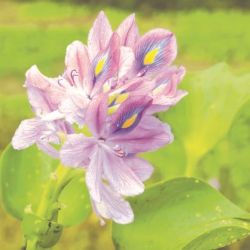
Water hyacinth flower
© Queensland Government
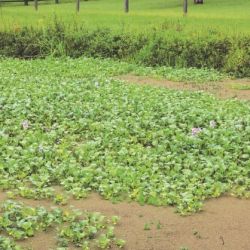
Water hyacinth infestation
© Queensland Government
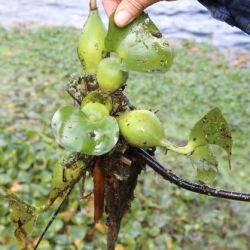
Water hyacinth plant
© Queensland Government
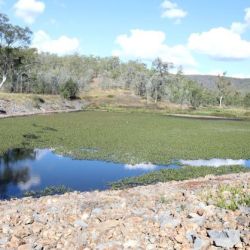
Water hyacinth smothering a creek
© Queensland Government
Native to Brazil, water hyacinth was introduced to Australia in the early 1900s as an aquatic ornamental plant. Valued for its floral presentation, water hyacinth was released into ponds and lagoons in public parks throughout Queensland.
Today, water hyacinth is one of the world's worst invasive aquatic plants, causing serious problems in Asia, Africa, North America and Papua New Guinea. In Australia, infestations are mostly in coastal Queensland and New South Wales.
Water hyacinth is a major invasive plant of creeks, rivers and dams. It chokes wetlands and waterways, killing native wildlife and interfering with recreational use.
Scientific name
Pontederia crassipes (formerly Eichhornia crassipes)
Similar species
Description
- This floating waterweed grows up to 65cm tall.
- Root systems are extensive (up to 1m), feathery and black to purple.
- Leaves are round, bright to dark green and 5–10cm in diameter.
- Leaf stalks of young plants are swollen into spongy, bulbous structures; mature plants have elongated leaf stalks.
- Flowers are light purple with darker blue/purple and yellow centres, 4–6cm long and 3.5–5cm wide.
- Flowers are in dense spikes above plants.
- Fruit capsules are 10–15mm long and each contains up to 300 seeds.
- Seeds are egg-shaped and 0.5–1.5mm long.
3D model
- View the 3D model to help you identify this plant. You can magnify the image and manipulate the view to inspect the plant from every angle.
Habitat
- Prefers static or slow-flowing water with high nutrient concentrations.
- Used illegally as ornamental plant in garden ponds.
Distribution
- Found mostly in coastal Queensland.
Life cycle
- The plant grows slowly during cooler winter months, then starts rapid growth once temperatures rise.
- It grows from seed and through vegetative reproduction, with vegetative reproduction the most important method of propagation.
- Seeds are produced in capsules at the base of each flower.
- Flowering can begin as early as October and continues through summer.
- Each flower stays open 1–2 days before beginning to wither.
- When all flowers have withered, the stalk gradually bends to the water. After about 18 days, seeds are released from the capsules.
- Seeds sink to the substrate and persist there for at least 15 years.
Plants affected
- Native aquatic plants
Animals affected
- Native aquatic animals
- Humans
Impacts
Environmental
- Destroys native wetlands and waterways, killing native fish and other wildlife.
- Depletes water bodies of oxygen.
- Increases water loss.
- Provides breeding grounds for mosquitoes.
Social
- Stops movement of boats when large infestations clog engine water-cooling systems.
- Degrades quality of swimming and makes fishing impossible.
- Interferes with and damages infrastructure.
How it is spread
- Seeds and stem fragments spread mostly by water movement.
Prevention
- Find out how farmers can prevent weed spread.
- Find out how gardeners and outdoor enthusiasts can prevent weed spread.
Control
Mechanical control
- For small areas or when numbers are low, remove by hand or machine before plants flower and seeds set.
- Control large areas with harvesters.
Herbicide control
- If you spray an entire infestation, water hyacinth can sink and lead to pollution from the rotting plants. To avoid this, spray strips of plants or mechanically remove most of the plant or plants before spraying.
- Destroy scattered plants when they appear—do not delay treatment until the entire water body has been choked.
- Diquat is the only herbicide registered for use in water-storage areas used for human consumption. However, you must wait until at least 14 days after treatment before consuming the water.
- In non-potable water bodies, you can treat water hyacinth with 2,4D, Diquat, Amitrole and Glyphosate.
See the water hyacinth fact sheet for more about herbicide control and application rates.
Biological control
- Biological control is effective on large areas of water hyacinth but may take years to achieve satisfactory control.
- Four insect species have been introduced from South America and released by CSIRO since 1975. The 2 weevil species (Neochetina eichhorniae and Neochetina bruchi) and the 2 moth species (Niphograpta albiguttalis and Xubida infusella) are present in Queensland.
- To establish an effective breeding population of biological control agents, place infested plants in an area where water hyacinth is concentrated. To find out more about these agents and protocols, contact your local government or contact us online, by phone or in person.
- Having these biocontrol agents on your property does not remove your general biosecurity obligation regarding declared plants.
Legal requirements
- Water hyacinth is a restricted category 3 invasive plant under the Biosecurity Act 2014. You must not:
- give it away
- sell it
- release it into the environment.
- You must take all reasonable and practical measures that are under your control to minimise the biosecurity risks associated with dealing with water hyacinth. This is part of your general biosecurity obligation.
- Each local government must have a biosecurity plan that covers invasive plants in its area. This plan may include actions to be taken on water hyacinth. Some of these actions may be required under local laws. Contact your local government for more information.
If you do any of these, penalties may apply.
Further information
- Contact us online, by phone or in person.
- Read the water hyacinth fact sheet.
- View the water hyacinth 3D model.