
Sagittaria
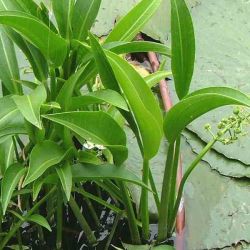
Group of sagittaria plants
© Queensland Government
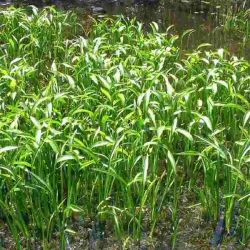
Sagittaria plants
© Queensland Government
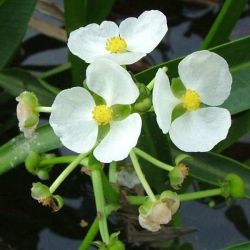
Sagittaria flowers
© Queensland Government
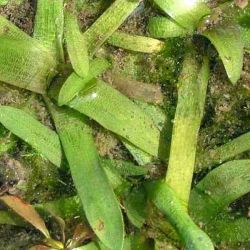
Sagittaria leaves
© Queensland Government
Native to North America, sagittaria is an invasive aquatic perennial introduced to Australia as an aquarium plant. In the wild, it invades and degrades natural wetlands.
The first Australian infestation of sagittaria was found in Brisbane in 1959; another was found in Victoria in 1962. It is now widely distributed in the Murray Irrigation District, Sydney, Newcastle, Melbourne, Perth, Canberra and Adelaide. Sagittaria is a weed of national significance.
Scientific name
Sagittaria platyphylla
Other names
- Delta arrowhead, arrowhead, slender arrowhead
Description
- This emergent aquatic perennial grows up to 1.5m tall.
- Leaves are an oval/linear shape with pointed tips, up to 25cm long and 10cm wide, growing at the top of each leaf stalk. The plant also has narrow strap-like submerged leaves up to 50cm long.
- Stems have a triangular cross-section.
- Flowers appear in whorls or coils.
- Male flowers are 3cm across with 3 white petals and yellow centres.
- Female flowers have no petals and resemble flattened green berries.
- Flowers appear below the height of the leaves.
- Seeds are clustered, consisting of flattened and winged segments 0.15–0.3cm long. There is 1 seed in each segment.
- There are 3 morphological growth forms: submerged rosette, broad-leaved emergent and narrow-leaved emergent. These forms play an important role in the life cycle, allowing the species to adapt to varying environmental conditions.
3D model
- View the 3D model to help you identify this plant. You can magnify the image and manipulate the view to inspect the plant from every angle.
Habitat
- Grows in irrigation channels, drains, creeks, rivers, lagoons, dams and wetlands.
- Establishment is favoured by slow moving or static shallow water.
Distribution
- Visit the Weeds Australia website and click on the distribution tab to view the distribution map.
Life cycle
- Sagittaria can reproduce via several methods:
- vegetatively by stem or root fragments
- from underground rhizomes and corms.
- It is a prolific seeder—each plant can produce hundreds of thousands of seeds.
- Seed production occurs from September to May.
- Germination can occur any time the conditions are favourable.
Impacts
Environmental
- Forms floating mats, blocking irrigation ditches, shallow dams and waterways.
- Invades and degrades natural wetlands.
- Competes with native water plants.
Economic
- Blocks irrigation of crops.
How it is spread
- Cultivation and sale as an aquarium or ornamental water plant.
- Dumping of aquarium contents into waterways.
- Movement of broken stems, leaf fragments and seeds via:
- water
- soil on vehicle tyres
- animals and birds.
Prevention
- Find out how farmers can prevent weed spread.
- Find out how gardeners and outdoor enthusiasts can prevent weed spread.
Control
For best results, carry out control when water levels are low. Apply appropriate hygiene and containment measures to prevent further spread downstream.
Mechanical control
- Place all removed plant material in sealed plastic bags, leave the bags in sunlight for the plant material to decompose, then dispose of the bags at a council-approved landfill tip. Alternatively, leave the material in the sun to dry, then burn it.
- Do not leave broken plant pieces in growth areas.
Herbicide control
- Biosecurity Queensland has a minor use permit from the Australian Pesticides and Veterinary Medicines Authority for suitable herbicides.
Biological control
- There are no known biological control agents.
Legal requirements
- Sagittaria is a category 3 restricted invasive plant under the Biosecurity Act 2014. You must not:
- give it away
- sell it
- release it into the environment.
- You must take all reasonable and practical measures that are under your control to minimise the biosecurity risks associated with dealing with sagittaria. This is part of your general biosecurity obligation.
- Each local government must have a biosecurity plan that covers invasive plants in its area. This plan may include actions to be taken on sagittaria. Some of these actions may be required under local laws. Contact your local government for more information.
If you do any of these, penalties may apply.
Further information
- Contact us online, by phone or in person.
- Read the sagittaria fact sheet.
- View the sagittaria 3D model.