
Koster's curse
Alert
Be on the lookout for Koster’s curse and report any sightings within 24 hours.
Reporting options
- Report online.
- Phone Biosecurity Queensland on 13 25 23.
- Phone the Exotic Plant Pest Hotline on 1800 084 881.
- Contact your local government.

Koster's curse leaf and berry
© Queensland Government
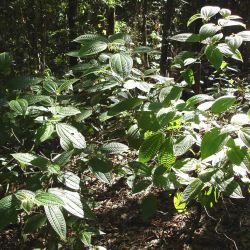
Koster's curse habitat
© Queensland Government
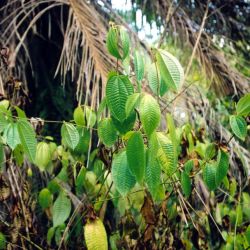
Koster's curse plant
© Queensland Government

Koster's curse seedling
© Queensland Government
Native to tropical America, Koster's curse is a highly invasive shrub that generally grows to about 2m but can reach up to 5m tall. It forms dense thickets that can smother plantations, pastures and native vegetation. It is a serious invasive plant in at least 16 countries, including the United States (Hawaii), Fiji and Indonesia, and is a category 2, 3, 4 and 5 restricted invasive plant under the Biosecurity Act 2014.
An infestation of Koster's curse was found near Julatten in 2001, and another infestation was found in the Misty Mountains, west of Innisfail, in 2015.
Koster's curse has the potential to spread rapidly over many areas of Australia where conditions are suitable, including the Northern Territory, northern New South Wales and much of north-eastern Queensland.
Scientific name
Miconia crenata, syn Clidemia crenata
Description
- This perennial shrub is generally 50–200cm tall.
- Leaves are elliptical, 8–10cm long and arranged in opposite pairs. Their distinctive veins give a 'quilted' appearance.
- Leaves and stems are covered in stiff, reddish-brown hairs.
- Flowers are small, white and 1–1.5cm in diameter. They are produced in clusters in leaf forks.
- Berries are hairy and turn dark purple when mature.
3D model
- View the 3D model to help you identify this plant. You can magnify the image and manipulate the view to inspect the plant from every angle.
Habitat
- Prefers humid tropical lowlands and waterways.
Distribution
- Visit the Weeds Australia website and click on the distribution tab to view the distribution map.
Life cycle
- Can produce thousands of purple berries from a mature bush.
- Produces seeds all year.
- Flowers throughout the year.
- Reproduces vegetatively (from cuttings, detached leaves and stems).
- Tolerates a range of environmental conditions and reaches full maturity in less than 12 months.
Plants affected
- Native vegetation
- Pasture
- Plantations
Impacts
Environmental
- Forms dense thickets that smother native vegetation.
- Could cause irreversible damage to sensitive habitats and native plant communities.
Economic
- Smothers plantations and pastures.
- Could cause millions of dollars of damage to primary production.
How it is spread
- Spreads via fruit-eating birds and mammals.
- Is also spread by water, machinery and vehicles.
Prevention
- Find out how farmers can prevent weed spread.
- Find out how gardeners and outdoor enthusiasts can prevent weed spread.
Control
- Before undertaking any preventative or control actions, contact us online, by phone or in person.
Legal requirements
- Koster's curse is a category 2, 3, 4 and 5 restricted invasive plant under the Biosecurity Act 2014 . You must not:
- move it
- keep it
- give it away
- sell it
- release it into the environment.
If you do any of these, penalties may apply.
- You must take all reasonable and practical measures that are under your control to minimise the biosecurity risks associated with dealing with Koster's curse. This is part of your general biosecurity obligation.
- You must report any sightings immediately using 1 of these methods:
- Report online.
- Phone Biosecurity Queensland on 13 25 23.
- Phone the Exotic Plant Pest Hotline on 1800 084 881.
- Contact your local government.
- Each local government must have a biosecurity plan that covers invasive plants in its area. This plan may include actions to be taken on Koster’s curse. Some of these actions may be required under local laws. Contact your local government for more information.
Further information
- Contact us online, by phone or in person.
- Read the Koster's curse fact sheet.
- View the Koster's curse 3D model.