
Bridal creeper
Alert
Be on the lookout for bridal creeper and report any sightings immediately.
Reporting options
- Report online.
- Phone Biosecurity Queensland on 13 25 23.
- Phone the Exotic Plant Pest Hotline on 1800 084 881.
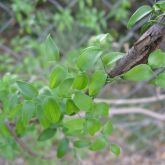
Bridal creeper leaves
© Queensland Government

Bridal creeper infestation
© Queensland Government
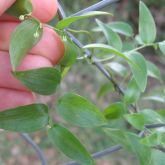
Bridal creeper leaves and buds
© Queensland Government
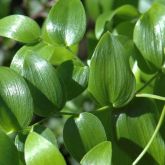
Bridal creeper leaves
© Queensland Government
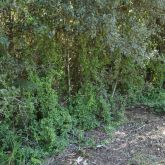
Bridal creeper smothering native plants
© Queensland Government
Native to southern Africa, bridal creeper is a glossy green plant that can smother native vegetation and form a thick mat of underground tubers. It is a category 2, 3, 4 and 5 restricted invasive plant under the Biosecurity Act 2014. It is also a weed of national significance and is widespread in south-western Western Australia, southern South Australia and eastern Victoria.
Although it is not climatically suited to most of Queensland, bridal creeper could become an invasive plant in cooler parts of southern Queensland such as around Stanthorpe and Warwick.
Scientific name
Other names
- Bridal veil creeper, gnarboola
Description
- This creeping plant has twisting stems up to 3m long.
- Leaves are glossy green, solitary, alternate, broadly ovate, 10–70mm long and 8–30mm wide.
- Numerous shoots grow from 1 patch of roots and entwine with native vegetation.
- Berries are pea-sized and green when young. They ripen to be red, sticky and 6–10mm in diameter, and usually contain 2–3 black seeds.
- Flowers are white, dainty and 8–9mm in diameter.
- Stems are covered with heart-shaped green leaves.
- Seeds are black, shiny and 3–4mm in diameter.
3D model
- View the 3D model to help you identify this plant. You can magnify the image and manipulate the view to inspect the plant from every angle.
Habitat
- Grows well in citrus orchards and pine plantations.
- Can grow in most soils but is most common near the coast, where it invades woodlands and open coastal vegetation.
- Thrives in areas high in nutrients such as drainage lines and roadsides next to farms.
- Tolerates frost and drought.
Distribution
- Visit Weeds Australia and click on the distribution tab to view the distribution map.
Life cycle
- Seeds germinate in autumn to early winter.
- Plants produce more than 1,000 berries per square metre.
- Plants become dormant in November.
- New growth begins in February–March.
- Flowering occurs in August–September.
Impacts
Environmental
- Smothers native plants.
- Forms a thick mat of underground tubers, impeding root growth of other plants and preventing seedling establishment.
- Invades undisturbed habitats.
- Threatens low shrubs and ground-cover plants in mallee, dry sclerophyll forest and heath vegetation.
Economic
- Causes losses to primary industries (for example by shading citrus and avocado trees and interfering with fruit picking).
How it is spread
- Seeds are spread by birds, rabbits and foxes that eat the fruit.
- Spread is also by movement of soil containing roots.
Prevention
Control
Physical control
- This plant is difficult to control.
Herbicide control
- Herbicides are the most effective method of control.
Biological control
- Biological control agents have been released in southern Australia. These agents are giving good control in many areas.
Legal requirements
- Bridal creeper is a category 2, 3, 4 and 5 restricted invasive plant under the Biosecurity Act 2014. You must not:
- give it away
- sell it
- release it into the environment.
- You must take all reasonable and practical measures that are under your control to minimise the biosecurity risks associated with dealing with bridal creeper. This is part of your general biosecurity obligation.
- You must report any sightings immediately using 1 of these methods:
- Report online.
- Phone Biosecurity Queensland on 13 25 23.
- Phone the Exotic Plant Pest Hotline on 1800 084 881.
- Each local government agency must have a biosecurity plan that covers invasive plants in its area. This plan may include actions to be taken on bridal creeper. Some of these actions may be required under local laws. Contact your local government for more information.
If you do any of these, penalties may apply.
Further information
- Contact us online, by phone or in person.
- Read the asparagus ferns fact sheet.
- Read Weeds Australia's bridal creeper profile.
- View the bridal creeper 3D model.