
Prickly pear
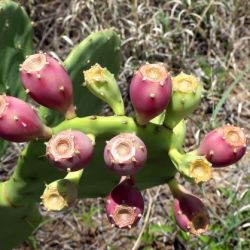
Prickly pear fruit
© Queensland Government
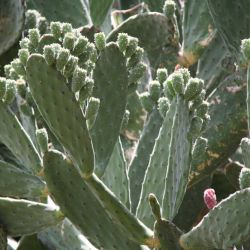
Prickly pear plant close-up
© Queensland Government
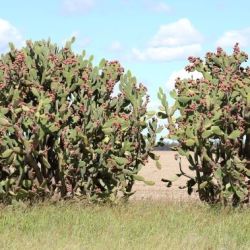
Prickly pear infestation
© Queensland Government

Prickly pear leaf close-up
© Queensland Government
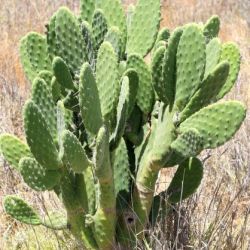
Prickly pear plant form
© Queensland Government
Prickly pear is a general term used to describe the Opuntia species, members of the Cactaceae family. Native to the Americas, prickly pear is a spiny, drought-resistant succulent that rapidly invades pastures and natural areas and overwhelms other vegetation.
Scientific name
Opuntia spp. other than O. ficus-indica
Other names
- Common prickly pear, spiny pest pear, tiger pear, drooping tree pear, velvety tree pear, Westwood pear
Similar species
- Cylindropuntia spp., Austrocylindropuntia spp.
Description
- Perennial, leafless, succulent shrub, usually 50–100cm tall.
- Stems are spiny, flattened, leafless, divided into segments (pads or joints).
- Skin is thick, tough, drought-resistant.
- Fruit is pear-shaped, bristly, varies from red to purple, orange, yellow and green.
- Flowers are large, 6cm wide, range from yellow, orange, red, pink and purple to white form seen during spring.
- Seeds are 5mm long, have hard seed coats that allow them to survive heat and lack of water.
- Most internal tissues are used for water storage.
- Outer parts are used to reduce water loss and damage by animals.
- Some species develop underground bulbs that enable them to resist fire and mechanical damage.
- Read the Opuntioid cacti fact sheet for more information on Opuntia species descriptions.
Habitat
- Prefers subhumid to semi-arid areas in warm temperate and subtropical regions.
- Varies depending on species and can range from streams, banks and roadsides to woodlands.
Distribution
- Read the Opuntioid cacti fact sheet for more information on Optunia species distribution.
Life cycle
- Reproduces sexually and asexually.
- Asexual reproduction (cloning) occurs when pads (joints, segments) or fruits on ground take root and produce shoots. Pads can survive long periods of drought before weather conditions allow them to set roots.
- Flowers late spring to summer.
Plants affected
- Native plants
- Native shrubs
- Pasture
Impacts
Environmental
- Vigorous in hot, dry conditions, causing other plants to lose vigour or die.
Economic
- Competes with and invades pastures.
- Impedes stock movement and mustering.
Social
- Can harm animals and prevent them from eating.
How it is spread
- Spread by birds and animals eating fruit and excreting viable seed.
- Also spread by animals and floods moving broken pads long distances.
Prevention
- Find out how farmers can prevent weed spread.
- Find out how gardeners and outdoor enthusiasts can prevent weed spread.
Control
Mechanical control
- Using machinery is unsatisfactory because prickly pear pads can easily re-establish.
- Fire is an effective control method for dense prickly pear infestations. Before burning, consult Biosecurity Queensland to see if this practice is suitable for your pasture and land management practices.
Herbicide control
- Herbicides are effective.
Read the Opuntioid cacti fact sheet for herbicide control and application rates.
Biological control
- Investigations into biological control agents began in 1912. Over 150 insect species were studied throughout the world, with 18 insects and 1 mite released in Queensland.
- Today, 8 insects and the mite remain established in Queensland. These species are:
- Cactoblastis cactorum, a stem-boring moth
- Dactylopius ceylonicus, a cochineal scale insect
- Dactylopius opuntiae, a cochineal scale insect
- Dactylopius confusus, a cochineal scale insect
- Dactylopius austrinus, a cochineal scale insect
- Chelinidea tabulata, a cell-sucking bug
- Tucumania tapiacola, a stem-boring moth
- Archlagocheirus funestus, a stem-boring beetle
- Tetranychus opuntiae, prickly pear red spider mite.
- These biological control agents continue to keep several prickly pears under control. Not all of them attack all prickly pears.
- Most successful of these species were the Cactoblastis stem-boring moth and the 4 cochineal mealybugs. The other agents remain but not in sufficient numbers to provide control.
Legal requirements
All species of prickly pear (Opuntia spp.) except for O. ficus-indica (Indian fig) are either prohibited invasive plants or restricted invasive plants.
Prohibited
- All species of prickly pear (Opuntia spp.) except for O. aurantiaca, O. bonariensis, O. cochenillifera, O. ficus-indica, O. microdasys, O. monacantha, O. rufida, O. streptacantha, O. stricta, O. sulphurea and O. tomentosa are prohibited invasive plants under the Biosecurity Act 2014. You must not:
- keep them
- move them
- give them away
- sell them
- release them into the environment.
If you do any of these, penalties may apply.
- You must not take any action that is reasonably likely to exacerbate the biosecurity threat posed by prohibited Opuntia spp.
- You must take any action that is reasonably likely to minimise the biosecurity threat posed by prohibited Opuntia spp.
- You must report any sightings of prohibited Opuntia spp. immediately using 1 of these methods:
- Report online.
- Phone Biosecurity Queensland on 13 25 23.
- Phone the Exotic Plant Pest Hotline on 1800 084 881.
Restricted
- Opuntia aurantiaca, O. bonariensis, O. cochenillifera, O. microdasys, O. monacantha, O. rufida, O. streptacantha, O. stricta, O. sulphurea and O. tomentosa are restricted invasive plants under the Biosecurity Act 2014. You must not:
- give them away
- sell them
- release them into the environment.
If you do any of these, penalties may apply.
- You must take all reasonable and practical measures that are under your control to minimise the biosecurity risks associated with dealing with restricted Opuntia spp. This is part of your general biosecurity obligation.
- Each local government must have a biosecurity plan that covers invasive plants in its area. This plan may include actions to be taken for restricted Opuntia spp. Some of these actions may be required under local laws. Contact your local government for more information.
Further information
- Contact us online, by phone or in person.
- Find out more about prohibited and restricted cacti in Queensland.
- Read a factsheet about:
- Watch a video about:
- Read Weeds Australia's profile of prickly pair.