
Gamba grass
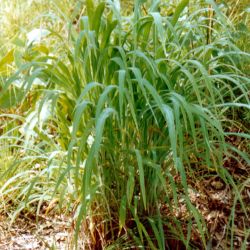
Gamba grass plant form
© Queensland Government
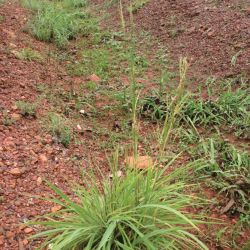
Gamba grass plants
© Queensland Government
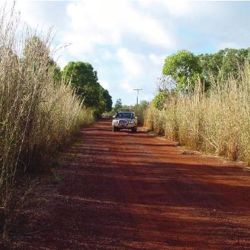
Gamba grass roadside infestation
© Queensland Government
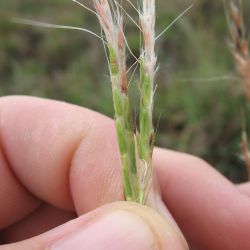
Gamba grass seed head
© Queensland Government
Native to Africa's tropical and subtropical savannas, gamba grass is a perennial tussock grass that has been introduced to many parts of the world as an improved pasture plant. It was imported into Queensland as a pasture grass in 1942, but was not planted on a large scale until about 1983.
Gamba grass is a useful cattle feed in parts of Far North Queensland, but also has significant negative impacts, including replacing native plants and increasing fire risk.
Scientific name
Andropogon gayanus
Description
- This large perennial grass grows up to 4m tall in tussocks up to 70cm in diameter.
- Leaves are 30–60cm long, up to 3cm wide and covered in soft hairs. They have a distinctive white midrib.
- Stems are robust and covered in soft hairs.
- The root system spreads up to 1m from the tussock, close to the soil surface.
- Seeds are contained in a fluffy V-shaped seed head consisting of up to 6 groups of branches, each containing 2–18 primary branches.
3D model
- View the 3D model to help you identify this plant. You can magnify the image and manipulate the view to inspect the plant from every angle.
Habitat
- Almost all known locations are in areas below 980m altitude that receive 400–1500mm annual rainfall.
Distribution
- Visit Weeds Australia and click on the distribution tab to view the distribution map.
Life cycle
- Reproduces by seed and spreads rapidly where natural vegetation has been disturbed.
- Grows actively in the wet season and flowers in April.
- Develops seed from May to June and sets seed in July and August.
- Can produce up to 244,000 seeds per plant each year, with 65% viability.
Plants affected
- Native vegetation
- Native grasses
- Native shrubs
- Native trees
Animals affected
- Livestock
Impacts
Environmental
- Replaces native grasses, reducing natural biodiversity on non-grazed land.
- Can fuel intense bushfires (because of high biomass), leading to loss of tree cover and long-term environmental damage.
- Is recognised (with 4 other tropical grasses) as a key threatening process.
Economic
- Invades non-grazed parcels of land such as conservation areas, semi-urban residential land and mining leases.
Social
- Through high-intensity fires, can threaten human safety and property.
How it is spread
- Seeds are light and easily spread by wind, although 90% fall within 5m of the parent plant.
- Seeds are also spread by water movement and in mud on vehicles.
Prevention
- Find out how farmers can prevent weed spread.
- Find out how gardeners and outdoor enthusiasts can prevent weed spread.
Control
Physical control
Hand weeding
- Hand-pull or dig out isolated plants.
- Shake excess soil from roots to prevent regrowth.
Fire
- Remember that gamba grass tolerates fire at any time of year.
- Avoid burning gamba grass in the dry season. It can be hazardous to property, people and livestock due to high fuel loads and fire intensity.
- Use low-intensity burns early in the wet season to remove old rank growth and promote new growth suitable for herbicide application. These fires can also control young gamba grass seedlings, reducing establishment of new plants.
- Do not burn gamba grass when plants have mature seeds, as fire updrafts may spread its light, fluffy seeds large distances.
Plant management
- Graze with enough stock to keep grass below 90cm to limit seed production and potential spread. This prevents plants becoming tall and rank in the dry season and reduces fire hazard. Stocking rates to achieve this may be as high as 5 animals per hectare during the peak wet season.
- Maintain pasture in good condition with high crown and foliage cover to resist gamba grass invasion and spread of existing infestations. Overgrazed or poor pastures are at greater risk of gamba grass invasion due to bare soil and reduced vigour of existing grass species.
Mechanical control
Slashing
- Slash to reduce seed set or remove old rank growth either before seeding or after seeds have dropped to reduce the risk of seed spread. This will also improve herbicide effectiveness and reduce fire hazards.
Herbicide control
- Spray early in the wet season (when leaves are at least 40cm long) or well before May to prevent seeding and potential spread.
- Spray every part of the plant to ensure adequate herbicide uptake. Slash or burn old rank plants to promote fresh growth, enabling more effective herbicide application.
- Take care to limit overspray, as glyphosate is non-selective and can damage non-target plants.
- Read the gamba grass fact sheet to learn about herbicide control and application rates.
Biological control
- There are no known biological control agents.
Legal requirements
- +Gamba grass is a category 3 restricted invasive plant under the Biosecurity Act 2014.
- You must not:
- give it away
- sell it
- release it into the environment.
- You must take all reasonable and practical measures that are under your control to minimise the biosecurity risks associated with dealing with gamba grass. This is part of your general biosecurity obligation.
- Each local government agency must have a biosecurity plan that covers invasive plants in its area. This plan may include actions to be taken on gamba grass. Some of these actions may be required under local laws. Contact your local government for more information.
If you do any of these, penalties may apply.
Further information
- Contact us online, by phone or in person.
- Read the gamba grass fact sheet.
- Read the gamba grass risk assessment (PDF, 2.1MB).
- View the gamba grass 3D model.
- Read the Weeds Australia – Gamba grass (Andropogon gayanus).