
Cabomba
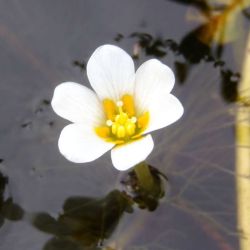
Cabomba flower close-up
© Queensland Government

Cabomba plant close-up
© Queensland Government
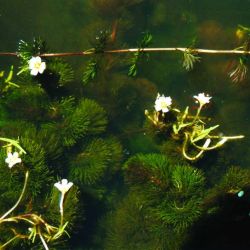
Cabomba flowers
© Queensland Government
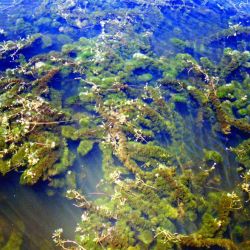
Cabomba infestation
© Queensland Government
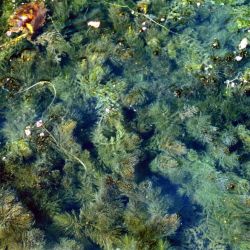
Cabomba plant
© Queensland Government
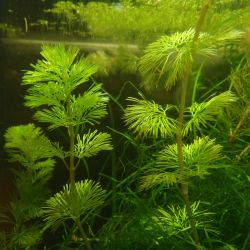
Cabomba in tank
© Queensland Government
Native to North and South America, cabomba is a fully submerged aquatic plant, originally introduced to Australia as an aquarium plant. While 5 species of cabomba are recognised, only 1 of these, Cabomba caroliniana, is known to be naturalised in Australia and it is a category 3 restricted invasive plant. All other Cabomba species are prohibited invasive plants.
Cabomba is an aggressive perennial that can form dense canopies below the water surface. Infestations displace native plants and animals, affect water quality, and impede recreational water users.
Scientific name
Cabomba caroliniana
Other names
- Fanwort
Description
- This perennial submerged aquatic plant has multiple stems up to 10m long.
- Submerged leaves and stems have a thin gelatinous coating.
- Leaves are opposite and repeatedly divided to form feathery, fan-shaped structures.
- Flowers are white, produced above the surface, and preceded by a few narrow floating leaves.
- Plants can form dense canopies below the water surface.
3D model
- View the 3D model to help you identify this plant. You can magnify the image and manipulate the view to inspect the plant from every angle.
Habitat
- Grows in ponds, lakes and quiet streams.
- Generally rooted in water 1–3m deep (sometimes up to 6m deep) but continues to grow free-floating if uprooted.
- Thrives in cool and warm waters.
- Grows in shade and full sun.
Distribution
- Visit Weeds Australia and click on the distribution tab to view the distribution map.
Life cycle
- Grows and flowers predominantly in summer.
- Spreads from stem fragments. (Regeneration by seeds has so far only been observed in the Northern Territory and Victoria.)
Plants affected
- Native aquatic plants
Animals affected
- Humans
- Native aquatic animals
Impacts
Environmental
- Aggressively invades native freshwater systems.
- Transforms aquatic ecosystems.
- Displaces native plants.
- Affects native wildlife.
Economic
- Affects water quality.
- Increases siltation in lakes.
- Obstructs creeks, lakes and dams.
- Interferes with infrastructure (such as irrigation).
Social
- Impedes aquatic recreational activities.
- Endangers swimmers who can become entangled.
How it is spread
- Fragments spread by water flow, floods, watercraft, trailers, fishing gear and animals.
- Spread is mainly by humans.
Prevention
- Find out how farmers can prevent weed spread.
- Find out how gardeners and outdoor enthusiasts can prevent weed spread.
Control
Mechanical control
- Hand-pull small infestations, taking care to remove entire plants to prevent re-infestation.
- Use harvesters on larger areas for temporary control.
Herbicide control
- Carfentrazone is currently the only herbicide registered for control of cabomba.
- Read the cabomba fact sheet to learn about herbicide control and application rates.
Biological control
- There are no known biological control agents.
Legal requirements
- Cabomba caroliniana is a category 3 restricted invasive plant under the Biosecurity Act 2014.
- You must not:
- give it away
- sell it
- release it into the environment.
- You must report any sightings immediately using 1 of these methods:
- Report online.
- Phone Biosecurity Queensland on 13 25 23.
- Phone the Exotic Plant Pest Hotline on 1800 084 881.
- You must take all reasonable and practical measures that are under your control to minimise the biosecurity risks associated with dealing with Cabomba caroliniana. This is part of your general biosecurity obligation.
- Each local government agency must have a biosecurity plan that covers invasive plants in its area. This plan may include actions to be taken on Cabomba caroliniana. Some of these actions may be required under local laws. Contact your local government for more information.
If you do any of these, penalties may apply.
Further information
- Contact us online, by phone or in person.
- Read the cabomba fact sheet.
- View the cabomba 3D model.
- Read Weeds Australia's cabomba profile.