
Spongy moth complex
Alert
Be on the lookout for spongy moth complex and report any sightings immediately.
Reporting options
- Report online.
- Phone Biosecurity Queensland on 13 25 23.
- Phone the Exotic Plant Pest Hotline on 1800 084 881.
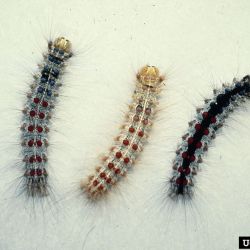
The overall colour of spongy moth larvae can vary
© USDA APHIS PPQ - Oxford, North Carolina, Bugwood.org
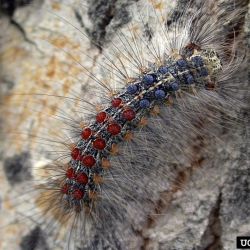
Asian spongy moth late instar larvae have 2 rows of dots along their back: 5 pairs of blue dots and 6 pairs of red dots (these are inconspicuous or not present in earlier instar larvae)
© John Ghent, Bugwood.org
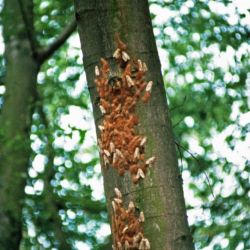
Infestation of Asian spongy moths laying eggs on a tree trunk
© Manfred Mielke, USDA Forest Service, Bugwood.org
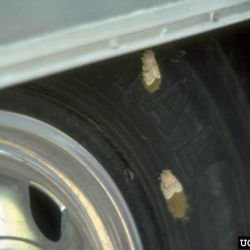
Spongy moth females laying eggs on a car tyre
© Rusty Haskell, University of Florida, Bugwood.org
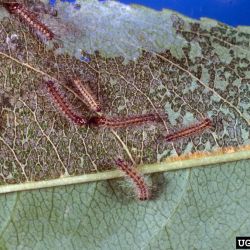
Young spongy moth larvae grazing on leaves
© Daniel Herms, The Ohio State University, Bugwood.org
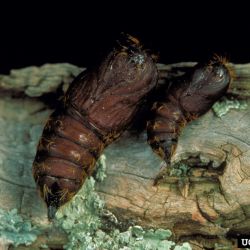
Spongy moth pupae are 2–4cm long
© USDA APHIS PPQ, Bugwood.org
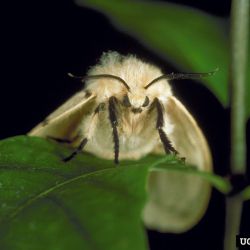
Female Asian spongy moth antennae are different to that of the male which has larger, feathery antennae (see previous image)
© USDA APHIS PPQ, Bugwood.org
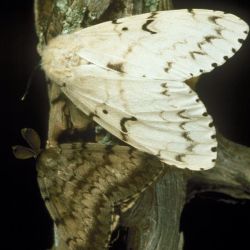
Asian spongy moth males are brown and females are whitish
© USDA APHIS PPQ, Bugwood.org
Spongy moth complex (previously called exotic spongy moth or gypsy moth) is an insect and is not present in Australia. Spongy moth complex is one of Australia's national priority plant pests. This pest is highly invasive, with a preference for temperate climates.
There are several important subspecies of spongy moth complex (Lymantria dispar), including European spongy moth (L. d. dispar), Asian spongy moth (L. d. asiatica) and Japanese spongy moth (L. d. japonica).
The larvae feed on the leaves and flowers of a wide variety of plants including Australian native species (e.g. Eucalyptus), and forest, orchard and ornamental trees. Severe infestations can cause significant damage, as the larvae can strip plants of foliage.
Scientific name
Lymantria dispar
Cause
Spongy moth complex (Lymantria dispar) is an insect.
There are several important exotic spongy moth sub-species, including European spongy moth (L. d. dispar), Asian spongy moth (L. d. asiatica) and Japanese spongy moth (L. d. japonica).
Other names
- Exotic spongy moth
- Asian gypsy moth
- European gypsy moth
- Exotic gypsy moth
- Gypsy moth
- Japanese gypsy moth
- North American gypsy moth
Description
Adults
- Male and female moths look quite different to each other.
- Males are grey-brown with darker wing markings, and have feather-like antennae. They have a wingspan of 3–4cm.
- Females are whitish with black markings on the wings, and have finer antennae than the males. They are also larger, with a wingspan of 4–7cm.
- Unlike most other moths, spongy moths are active during the day.
Eggs
- Usually laid on hard surfaces such as tree trunks or branches, or rocks, but also on human-made objects such walls, fences, vehicles and shipping containers.
- Laid in masses of 50 to 1,200 eggs.
- Egg masses are 2–5cm long and buff coloured with a dense, yellowish coating of hair sloughed off from the female abdomen.
Larvae
- All larval stages are very hairy.
- The colour of different subspecies can vary.
- Early growth stages (instars) are grey-black and about 3mm long.
- Later growth stages vary in colour, with black, yellow, blue and red patterns, but all have a characteristic double row of dots along their back with 5 pairs of blue dots followed by 6 pairs of red dots (see image).
- Males grow to 40–50mm and females to 60–70mm long.
Pupae
- Dark brown, 2–4cm long.
- Are positioned in bark crevices and other cryptic locations.
- Adult moths emerge from pupae.
Plant stage and plant parts affected
All stages of plant growth (seedlings to mature plants) can be affected.
Larvae feed on leaves and flowers.
Plant damage
The main damage is caused by feeding larvae. Severe infestations of larvae can defoliate plants. Feeding damage can make plants more susceptible to secondary pests or diseases.
May be confused with
There are a number of other hairy larvae or caterpillars that can resemble spongy moth larvae, including several Australian native or naturalised Lymantria species such as L. antennata, L. lunata, L. nephrographa and L. pelopsila.
Find out more about native Lymantriidae moths and their hairy caterpillars.
Larvae of exotic spongy moth complex are distinctive from native species as they have a high reproductive rate resulting in severe infestations that can defoliate plants, and the larvae have a distinctive double row of dots along their back.
Hosts
Spongy moth complex has an extremely broad host range. It can complete its life cycle on over 1000 plant species worldwide.
Hosts include Australian native species (including Eucalyptus), and forest, orchard and ornamental trees.
View a detailed host list for spongy moth complex.
Life cycle
- There is usually 1 generation per year.
- The specific timing of each life cycle stage is dependent on environmental conditions.
- In the summer, female moths produce a pheromone to attract males for mating.
- After mating, the female moth lays 50–1,200 eggs on a host plant or a wide variety of other surfaces.
- Both the male and female moths live for about 1 week, dying after mating and egg laying.
- Egg masses typically remain dormant over winter (diapause).
- In spring, when plants are flushing with new growth, the larvae emerge from the eggs.
- The larvae climb to the canopy to find young leaves to feed on.
- Young larvae can spin and suspend their bodies on a silk thread and be carried by the wind to new host plants.
- The first 3 growth stages (instars) feed during the day. Later growth stages (4th instar onwards) mainly feed at night and tend to hide during the day on the trunk or in leaf litter.
- During severe infestations, feeding can continue during the day and night.
- The larval stage lasts about 6 to 8 weeks (5 instars for males, 6 for females).
- In summer, the larvae develop into pupae.
- The pupae mature for 7–14 days before adult moths emerge to start the next generation.
Plants affected
- Multiple hosts
Impacts
- Spongy moth complex could cause environmental and economic damage to our native bushland, forests, tree crops and gardens.
- Severe infestations can defoliate trees and shrubs, increasing their susceptibility to secondary plant pest and disease attack.
- Nursery, tree crop (fruit and nut crops) and forestry industries would be most affected by this pest.
- Additionally, some people are allergic to the hairs on the larvae of spongy moth complex.
How it is spread
Adults can lay their eggs on plants and plant-related material, and on human-made objects. As a result, eggs and/or larvae could be introduced to Australia on imported goods, shipping containers, crates, machinery and motor vehicles, as well as on plant material.
To minimise this risk, the Australian Government regulates imports of plant material and other risk items that could carry spongy moth complex.
Once established in an area, spongy moth complex can spread short distances effectively. Young larvae can 'balloon' on silk threads in the wind, and adult moths can fly (except for female European spongy moth adults, which cannot fly).
Monitoring and action
Inspect your plants regularly for the presence of severe leaf damage and defoliation.
Look for:
- larval droppings on leaves
- very hairy larvae feeding on fresh growth
- older life stage larvae with a characteristic double row of 5 pairs of blue dots followed by 6 pairs of red dots on their back
- larvae with silk strands
- buff egg masses with a yellowish coating
- dead adult moths.
If you suspect you have seen spongy moth complex, take photos of moths, larvae and egg masses and record the location. Report suspected spongy moth complex immediately using 1 of these methods:
- Report online.
- Phone Biosecurity Queensland on 13 25 23.
- Phone the Exotic Plant Pest Hotline on 1800 084 881.
Prevention
- Protect your farm from emergency plant pests
- Understand good farm biosecurity
- Biosecurity manual for the plantation timber industry (PDF, 1.9MB)
- Biosecurity manual for the nursery production industry (PDF, 3MB)
- Visit the farm biosecurity website
Control
Call Biosecurity Queensland on 13 25 23 if you suspect you have found spongy moth complex to seek advice on control options.
Legal requirements
Spongy moth complex (Lymantria dispar) is prohibited matter affecting plants under the Biosecurity Act 2014.
You must report suspected spongy moth complex immediately using 1 of these methods:
- Report online.
- Phone Biosecurity Queensland on 13 25 23.
- Phone the Exotic Plant Pest Hotline on 1800 084 881.
If you think you have found spongy moth complex, you must take all reasonable and practical steps that are under your control to minimise any associated risks. This is part of your general biosecurity obligation.
The Australian Department of Agriculture, Fisheries and Forestry has import conditions in place for importing plants and plant products.