
Asian citrus psyllid
Alert
Be on the lookout for Asian citrus psyllid and report any sightings immediately.
Reporting options
- Report online.
- Phone Biosecurity Queensland on 13 25 23.
- Phone the Exotic Plant Pest Hotline on 1800 084 881.

Characteristic feeding posture of adult Asian citrus psyllid
© Andrew Beattie, University of Western Sydney

Asian citrus psyllid nymphs
© Andrew Beattie, University of Western Sydney

Asian citrus psyllid nymphs secreting honeydew
© Andrew Beattie, University of Western Sydney

Asian citrus psyllid nymphs secreting honeydew
© Andrew Beattie, University of Western Sydney
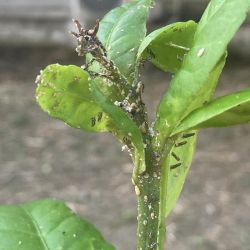
Leaf distortion and sooty mould from heavy infestation of Asian citrus psyllid
© Félix Morán (IVIA) via EPPO
Like the African citrus psyllid (Trioza erytreae), the Asian citrus psyllid (Diaphorina citri) is a sap-sucking insect that can transmit one of the world's most serious bacterial diseases of citrus, huanglongbing, also known as 'citrus greening'. The disease is caused by Candidatus Liberibacter bacteria.
Asian citrus psyllid can transmit all 3 strains of the bacterium.
Asian citrus psyllid, African citrus psyllid and huanglongbing are not found in Australia.
Scientific name
Diaphorina citri
Other names
- Asiatic citrus psyllid
- Oriental citrus psyllid
- Citrus psylla
- Citrus psyllid
Description
Adult
- Adults are small (2–4 mm long).
- Bodies are yellowish brown, abdomens are greenish brown or pinkish brown, and legs are greyish brown.
- Forewings are distinctively patterned with mottled brown and white patches.
- Abdomens have a pointed shape when viewed from above.
- Feeding posture is distinctive, with head down (almost touching the plant surface) and body lifted at a 45° angle.
Nymphs
- There are 5 tiny nymphal instars ranging from 0.25mm to 1.7mm long.
- Nymphs are light yellow, orange or green, with red eyes.
- They can secrete white, string-like honeydew that may melt to form droplets at temperatures above 36°C.
- They can be difficult to see because they are small, flat and close to the surface of twigs and leaves.
- They are mainly found on buds, leaves and stems of young flushing growth less than 50mm long.
Eggs
- Eggs are bright yellow-orange and almond-shaped.
- They are laid in groups on buds and young flushing tips.
- They are about 0.31mm long and 0.15mm wide.
Plant stage and plant parts affected
- Psyllids are found mostly on young flushing leaves and shoots of host plants.
Plant damage
- High numbers of feeding nymphs can cause leaves and shoots to distort, giving them a twisted or curled appearance.
- Leaves can also appear to have notches.
- The honeydew produced by nymphs can lead to sooty mould growth on plants.
- Death of new plant growth has been reported in the Americas.
May be confused with
- Adults may be confused with citrus leaf miner and winged aphids. If you find leaf distortion and sooty mould, look for the insect causing the damage. Psyllids are active insects and will jump if disturbed.
- Asian citrus psyllid nymphs could be confused with soft scale insects or mealybugs.
Distribution
Asian citrus psyllid prefers tropical and subtropical conditions. It occurs throughout Asia, in parts of the Americas and in Africa. Closer to Australia, it is found in Indonesia, East Timor, Fiji and Papua New Guinea.
Asian citrus psyllid was detected near Darwin in 1915 and was eradicated. There have been no detections in Australia since then.
Hosts
Hosts of Asian citrus psyllid include all citrus cultivars (such as orange, grapefruit, mandarin, tangelo, lemon, lime, kumquat, pomelo, trifoliate orange and native citrus species).
Favoured hosts include common backyard plants such as Murraya spp. (native and ornamental forms of mock orange, orange jasmine and curry leaf).
Asian citrus psyllid can also feed on:
- Afraegle spp. (Gabon powder-flask, Nigerian powder-flask)
- Atalantia buxifolia (Chinese box-orange)
- Balsamocitrus dawei (Uganda powder-flask)
- Citropsis spp. (West African cherry-orange, Gillet's cherry-orange)
- Limonia acidissima (wood apple, elephant apple)
- Merrillia caloxylon (Malay lemon)
- Naringi crenulata (hesperethusa)
- Pamburus missionis
- Swinglea glutinosa (tabog)
- Triphasia trifolia (lime berry)
- Clausena spp. (such as wampee)
- Toddalia asiatica (orange-climber, forest pepper)
- Vepris lanceolata (white ironwood).
Life cycle
- Females lay eggs exclusively on young flushes or the growing tips of young host plants.
- The eggs hatch into wingless nymphs.
- The nymphs moult 4 times, gradually getting bigger with each moult as they transition through the 5 nymphal stages (instars) over 11–40 days.
- After the fifth instar, the nymph develops into a winged adult.
- The complete life cycle takes 14–50 days. However, through winter, adults can live for up to 6 months when no new growth or young flushes are available.
Plants affected
- Citrus and citrus relatives
Impacts
Citrus is an important crop in Australia—there are about 33,000 hectares of commercial citrus orchard (Source: Citrus Australia, Australian citrus tree census 2024 (PDF, 1.7MB)). Citrus production for the 2024–25 financial year was valued at $1,234.8 million, with Queensland the second-largest producer (Source: Hort Innovation | Australian horticulture statistics handbook 2024/25).
The economic impact of the Asian citrus psyllid primarily results from the transmission of the serious citrus disease huanglongbing. Once a tree is infected with huanglongbing, there is no cure except for removal of infected trees and chemical control of the vectors.
Home gardeners would also be affected as citrus and Murraya spp. are common backyard plants.
How it is spread
Adults are capable flyers, covering at least 2km when seeking new hosts. Strong winds or cyclones could cause them to spread further.
Nymphs and eggs can be moved over much larger distances on infested plant material (such as budwood, grafted trees, rootstock and seedlings).
Like the African citrus psyllid, the Asian citrus psyllid and huanglongbing could be introduced into Australia through the illegal importation of infested plant material.
The Australian Government closely regulates imports of citrus plant material and monitors for illegal plant movement.
Monitoring and action
Regularly monitor common host plants, such as citrus.
- Inspect new flushing growth for leaf distortion, string-like honeydew and sooty mould.
- Closely monitor plants during the citrus flushing season for nymphs, adults and eggs.
Report suspected Asian citrus psyllid immediately using 1 of these methods:
- Report online.
- Phone Biosecurity Queensland on 13 25 23.
- Phone the Exotic Plant Pest Hotline on 1800 084 881.
Prevention
Use these resources to help protect your farm from plant pests and diseases:
- Protecting your farm from plant pests and diseases
- My property biosecurity
- Farm biosecurity
- Biosecurity manual for citrus producers (PDF, 4MB).
Legal requirements
Asian citrus psyllid is a prohibited plant pest under the Biosecurity Act 2014.
If you think you have found Asian citrus psyllid, you must report it immediately using 1 of these methods:
- Report online.
- Phone Biosecurity Queensland on 13 25 23.
- Phone the Exotic Plant Pest Hotline on 1800 084 881.
You must also take all reasonable and practical steps that are under your control to minimise any associated risks. This is part of your general biosecurity obligation.
Further information
- To learn how to protect your orchard, read the Biosecurity manual for citrus producers (PDF, 4MB).
- To understand more about citrus industry biosecurity planning, check the Biosecurity plan for the citrus industry (PDF, 4MB).
- Be part of the CitrusWatch program.
- Find out more from the Threat specific contingency plan: huanglongbing and its vectors (PHA 20215) (PDF, 2.7MB).