
Sharka
Alert
Be on the lookout for sharka.
Report sightings
- Report online
- Phone Biosecurity Queensland on 13 25 23
- Phone the Exotic Plant Pest Hotline on 1800 084 881.
Early detection and reporting are key elements in controlling sharka.
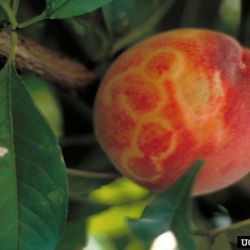
Fruit symptoms of sharka
European and Mediterranean Plant Protection Organization, Bugwood.org
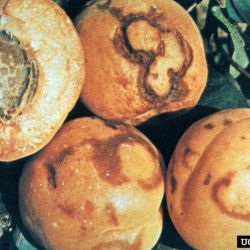
Fruit symptoms of sharka
Ministry of Agriculture and Regional Development, Bugwood.org
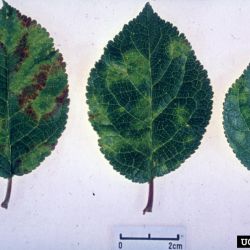
Leaf symptoms of sharka
Biologische Bundesanstalt für Land und Forstwirtschaft, Bugwood.org
Sharka (also known as plum pox) is the most destructive disease of stone fruit worldwide, and a major threat to the Queensland stone fruit industry.
Scientific name
Potyvirus plumpoxi
Other names
- Plum pox disease
- PPV
Description
Symptoms
- Symptoms can be localised, such as on a single branch or part of a tree, or the whole tree may be affected.
Leaves
- Symptoms are most likely to develop on younger leaves in spring, including:
- chlorotic (yellow) spots and blotches
- vein banding, rings and line patterns
- necrotic spots
- leaf deformation (some peach cultivars).
Fruit
- Develop discoloured rings, spots, or bands on the skin.
- External pitting, grooving, sunken or bumpy areas.
- Deformation of the fruit, including the internal flesh.
- Discolouration and marking on the stone.
- Premature fruit fall.
- Loss of flavour or a bitter taste.
Flowers
- Develop streak patterning or colour variation, particularly on peach flower petals.
Trunk
- Bark splitting has been reported in susceptible varieties.
Plant stage and plant parts affected
Plants affected by sharka can show a variety of symptoms depending on the strain of Potyvirus plumpoxi they are infected with. The age and general health of the host plant, environmental conditions (season, temperature) and other factors can also influence the severity of symptoms present.
It is important to note that not all infected plants develop symptoms, and that symptom expression can also be transient – with plants appearing to recover.
May be confused with
Many sharka symptoms are distinctive (i.e. leaf and fruit banding and patterning); however, some of the milder symptoms can be confused with nutritional deficiencies and physical injuries, such as frost damage or insect attack (bark splitting).
Hosts
Important commercial hosts of sharka (Potyvirus plumpoxi) include:
- apricot (Prunus armeniaca)
- cherry (P. avium and P. cerasus)
- peach (P. persica)
- plum (P. domestica, P. salicina, and P. cerasifera)
- nectarine (P. persica var. nectarina).
Almond (P. dulcis) can be infected, but may not develop symptoms.
It is thought that a number of ornamental Prunus species and weed species can also carry the virus. The ability of sharka to infect Australian native plants is unknown.
Life cycle
Sharka virus is usually transmitted from plant to plant, either through the use of infected root or scion stock, or vectored by aphids. In either case, the diseased plants act as the source of the virus.
Aphids such as Aphis spiraecola and Myzus persicae pick up the virus by probing or feeding on infected leaves, flowers or fruit. Aphids then transfer the virus to healthy plants for a short period of time. The aphids are most effective at transferring the virus to healthy plants 1–3 hours after they have fed on an infected plant.
Newly infected plants may take several months to develop disease symptoms.
Plants affected
- Stonefruit and almonds
Impacts
Stone fruit (fresh apricots, nectarines, peaches and plums) and cherry crops are valuable contributors to the Australian economy.
Sharka is extremely damaging to fruit production. Tree yields can be severely affected and up to 100% premature fruit drop has been reported in some plum varieties. Even if fruit is produced from infected trees, it is usually unsightly and misshapen, and generally unmarketable.
Excluding indirect trade costs, the economic impact associated with Potyvirus plumpoxi management worldwide in the last 30 years is estimated to be 10 billion euros (Cambra et al. 2006).
Home gardeners who grow stone fruit and cherries would also be affected.
How it is spread
The movement of infected plant material such as budwood, rootstock and young plants is the main cause of long-distance spread and introduction of sharka to new regions. The discovery of sharka in several European countries was associated with introduction of infected nursery stock.
The Australian Government closely regulates and approves importation of sharka host plant material, and monitors for illegal plant movement. This helps to prevent the introduction of diseases such as sharka into Australia.
Several species of aphids (Aphis spiraecola and Myzus persicae) that are widespread in Australia have been reported to be efficient vectors of Potyvirus plumpoxi overseas. Other aphid species can pick up sharka, but are reported to be less effective at spreading the disease from plant to plant.
Seed transmission of the virus is mentioned in older scientific literature; however, in recent years this has been demonstrated to be untrue. Although the virus is detectable in seed coats, plants resulting from germination of this seed are not infected (Pasquini and Barba, 2016).
Monitoring and action
The greatest risk period for sharka symptom development and disease spread is in spring and summer, when plants are actively growing and aphid populations are likely to be high.
Refer to the summerfruit orchard biosecurity manual (PDF, 2.5MB) for specific advice on how to monitor for exotic stone fruit pests and diseases.
Read the integrated pest and disease management guide for Australian summerfruit for advice on how to recognise and manage endemic stone fruit pests and diseases.
Report suspected sharka immediately using 1 of these methods:
- Report online.
- Phone Biosecurity Queensland on 13 25 23.
- Phone the Exotic Plant Pest Hotline on 1800 084 881.
Prevention
Protect your farm from plant pests and diseases:
- Protect your farm from emergency plant pests
- Understand good farm biosecurity
- Visit the farm biosecurity website
Control
There is no cure for sharka – once infected, plants/trees are infected for life. The most effective means of control is prevention.
Legal requirements
In Queensland, sharka (Potyvirus plumpoxi) is a prohibited matter affecting plants under the Biosecurity Act 2014.
Report suspected sharka immediately using 1 of these methods:
- Report online.
- Phone Biosecurity Queensland on 13 25 23.
- Phone the Exotic Plant Pest Hotline on 1800 084 881.
Further information
- Read the summerfruit industry biosecurity plan.