
Longhorn beetles (Anoplophora spp.)
Alert
Be on the lookout for longhorn beetles (Anoplophora spp.) and report any sightings.
Reporting options
- Report online.
- Phone Biosecurity Queensland on 13 25 23.
- Phone the Exotic Plant Pest Hotline on 1800 084 881.

Characteristic long, banded antennae of longhorn beetles
© Steven Valley, Oregon Department of Agriculture, Bugwood.org

Longhorn beetle boring in wood
© Michael Bohne, USDA Forest Service, Bugwood.org

Borer holes 10–20mm in diameter caused by Asian longhorn beetle, from which adult beetles emerge
© Dennis Haugen, USDA Forest Service, Bugwood.org
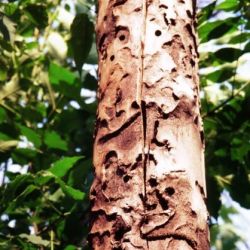
Serious wood-boring damage caused by Asian longhorn beetle
© Dennis Haugen, USDA Forest Service, Bugwood.org
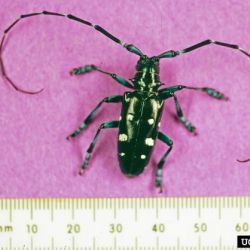
Adult Asian longhorn beetle
© Linda Haugen, USDA Forest Service, Bugwood.org

Longhorn beetle larvae
© Steven Katovich, Bugwood.org
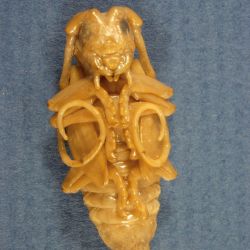
Asian longhorn beetle pupa
© Michael Bohne, USDA Forest Service, Bugwood.org
Longhorn beetles that are Anoplophora spp. are not found in Australia. These exotic species are national priority plant pests.
There are 3 species of particular concern:
- Asian longhorn beetle (Anoplophora glabripennis)
- citrus longhorn beetle (Anoplophora chinensis)
- white-spotted longhorn beetle (Anoplophora malasiaca).
Longhorn beetles are large wood-boring insects, predominantly of hardwoods. Their larvae feed internally on woody plant tissue, reducing plant vigour. Heavy infestations in susceptible host trees can result in tree death.
Exotic longhorn beetles could hitchhike to Australia as adults, eggs, larvae or pupae in illegally imported plants (such as bonsai), timber, and wood used in pallets and packaging.
In Australia, these pests pose a risk to tree crop industries (including apple, citrus, pear, stone fruit and tree nut crops), as well as nurseries, ornamental plants and amenity trees in urban landscapes. Forestry plantations and our native trees and bushland may also be affected.
Scientific name
Other names
- Asian longhorned beetle
- White-spotted longicorn beetle
- Starry sky beetle
- Citrus longicorn beetle
- Black and white citrus longicorn
Description
Adults
- Adults are a typical elongate longhorn beetle (cerambycid) shape.
- They are shiny black and have white spots on their back.
- Their body length ranges from 20–37mm. Females are larger than males.
- Their antennae have whitish blue rings and are longer than their bodies (1.7–2 times length of body for males and 1.2 times length of body for females).
Eggs
- Eggs are similar in shape to rice grains (oblong), 5–7mm long and creamy white.
- Each egg is laid singly under the bark of the lower trunk, a low branch or an exposed root.
- Eggs turn a yellowish brown before hatching.
Larvae
- Larvae are elongated and cylindrical in shape.
- They are creamy or yellowish white legless grubs with an amber-coloured diffuse band behind the head and black mouthparts.
- They range from 10–60mm in length (young to mature larvae).
Pupae
- Pupae are off-white to yellowish in colour.
- They have legs and long coiled antennae and are 24–38mm long.
- They are usually surrounded by wood shavings.
Plant stage and plant parts affected
- All stages of plant growth (seedlings to mature trees) can be affected.
- Longhorn beetles can feed on leaves, the plant stem or trunk, branches and roots.
Plant damage
Severe infestations of the wood-boring larvae can damage a tree’s vascular tissue, structurally weakening the tree. During severe winds and storms, affected trees are more likely to drop branches or fall over. These trees are also predisposed to attack by secondary pests or diseases.
Feeding by the adult beetles can cause defoliation and shoot damage. Damage to fruit shoots can reduce fruit production, leading to economic loss.
May be confused with
There are a number of native longhorn beetles in Australia. Of these, only Glenea spinifera (13–25mm long) is dark blue with white spots. However, Glenea spinifera does not have the banded pattern on its antennal rings.

Read more about common wood-boring beetles of trees and timber in Australia.
Exotic longhorn beetles that are Monochamus spp. are prohibited matter affecting plants under the Biosecurity Act 2014.
Hosts
Longhorn beetles attack over 100 woody plant species, especially hardwoods. These species include alder, apple, ash, avocado, birch, blueberry, citrus, elm, fig, guava, lychee, maple, mulberry, pear, plane tree, poplar, oak, olive, stone fruit, robinia, roses and willow.
Native Australian plants such as Acacia decurrens (green wattle), Acacia mearnsii (black wattle), Allocasuarina verticillata (drooping she-oak), Casuarina equisetifolia and C. stricta (coast she-oak) can also be affected (EPPO Global Database).
Life cycle
- Newly emerged adults feed on leaves, petioles and bark of host trees for 10–15 days before mating.
- They are active during the day. Adults usually survive for about a month.
- Egg-laying commences a week after mating, usually on susceptible host tree trunks about 60cm above the soil.
- Each female lays 30–70 eggs. They lay them singly under the bark.
- Depending on environmental conditions, the eggs hatch after 1.5–2 weeks.
- Larvae initially feed on the inner bark layer in branches and the trunk, moving deeper into the heartwood and sapwood as they mature.
- As the larvae feed, they form tunnels or galleries in tree trunks and branches. Frass (larval waste products) and sawdust accumulate near the original oviposition holes and at the base of infested trunks and branches.
- Larvae continue feeding and growing for several months before pupation.
- Pupation occurs in chambers in the heartwood.
- After emerging from their pupae, adult beetles emerge from circular holes that are 10–20mm in diameter.
- Depending on climatic and feeding conditions, there is usually a generation every 1–2 years.
Plants affected
- Multiple hosts
Impacts
Economic impacts
Longhorn beetles have the potential to cause significant damage to a number of tree crops including apple, avocado, citrus, pear, stone fruit and tree nuts. Production nurseries may also be affected.
In forestry plantations, this pest can cause yield reduction. Timber may be downgraded, reducing its value, and export markets for timber products may be disrupted.
Overseas, the cost of removing, treating and destroying affected urban street trees has also been significant.
Environmental impacts
Some Acacia, Allocasuarina and Casuarina species are known to be hosts for longhorn beetles. However, for all Australian native species the true host range for longhorn beetles is unknown. Australian native forests and bushland could be impacted.
How it is spread
Long-distance spread of longhorn beetles can occur through the movement of eggs, larvae, pupae and adults in woody planting material, such as nursery stock or bonsai plants. Spread can also be via timber, timber products and wood used in pallets and packaging made from host species.
Adults can fly short distances, so the beetles may disperse locally when searching for host plants.
Monitoring and action
Check newly imported host plants, timber products and wooden pallets and packaging for:
- insect frass and wood shavings
- larval tunnels (up to 15mm wide) containing whitish grubs (up to 60mm long)
- round to oval exit holes where the adults have emerged
- live beetles, larvae, pupae or eggs.
If you see signs of longhorn beetles that you think may have travelled to Australia, report it using 1 of these methods:
- Report online.
- Phone Biosecurity Queensland on 13 25 23.
- Phone the Exotic Plant Pest Hotline on 1800 084 881.
Prevention
Use these resources to help protect your farm from plant pests and diseases:
- Protecting your farm
- Farm biosecurity
- Biosecurity plan for the plantation forests industry (PDF, 1.9MB).
Legal requirements
- Longhorn beetles that are Anoplophora spp. are not listed as prohibited or restricted matter under the Biosecurity Act 2014. However, they are national priority plant pests.
- By law, everyone has a general biosecurity obligation to take reasonable and practical steps that are under their control to minimise the risks associated with plant pests.
Further information
- Read more about how to identify longhorn beetles.
- Find out more about citrus longhorn beetles and Asian longhorn beetles.
- Read about Australian native longhorn beetles.