
Black sigatoka of banana
Alert
Be on the lookout for black sigatoka of banana and report any sightings within 24 hours.
Reporting options
- Report online.
- Phone Biosecurity Queensland on 13 25 23.
- Phone the Exotic Plant Pest Hotline on 1800 084 881.
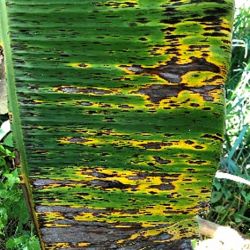
Various stages of leaf spot development of black sigatoka of banana, including thin streaks, streaks with yellow halos, and advancing spots with grey centres
© Queensland Government
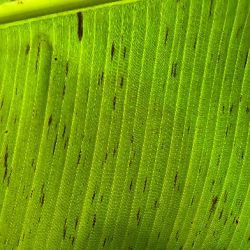
Dark leaf streaks, an early stage of infection with black sigatoka of banana
© Queensland Government
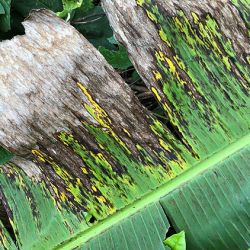
Advancing symptoms of black Sigatoka can cause leaf death
© Queensland Government
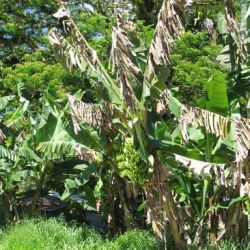
Severe infection with black sigatoka of banana, which can kill large areas of banana leaf (on Cavendish banana plants, Solomon Islands)
© Queensland Government
Black sigatoka of banana is a leaf spot disease. Economically, it is an important banana disease in many countries around the world. Severely infected leaves can die, significantly reducing fruit yield, and causing mixed and premature ripening of fruit bunches. It is not present in mainland Australia.
Restrictions on moving plants, including fruit from the far northern biosecurity zones (PDF, 334KB), are in place to prevent black sigatoka of banana and other serious far northern pests from spreading.
Scientific name
Pseudocercospora fijiensis (syn. Mycosphaerella fijiensis )
Cause
Black sigatoka of banana is a foliar disease of banana caused by the fungus Pseudocercospora fijiensis (syn. Mycosphaerella fijiensis).
Other names
- Black leaf streak (BLS)
Description
On leaves
- Early leaf symptoms are tiny reddish to–rusty-brown flecks that are most evident on the underside of leaves.
- These gradually lengthen, widen and darken to form reddish-brown or dark-brown or black leaf streaks.
- The early streaks run parallel to the leaf veins and are more evident on the underside of the leaf.
- The streaks broaden and become visible on both leaf surfaces.
- The streaks expand and become more oval-shaped, and the centre of the lesion becomes sunken and turns grey over time. At this stage, a yellow halo may develop around the edge of the lesion.
- In susceptible banana cultivars, high levels of disease can cause large areas of the leaf to die, which can lead to total leaf collapse.
- As leaves die, fruit yield is reduced and ripening of bunches can be uneven.
Plant stage and plant parts affected
Black sigatoka of banana affects banana leaves.
The unfurling and youngest fully expanded leaves on plants and suckers are the most susceptible to infection. The leaves become more resistant as they mature.
May be confused with
Mature leaf symptoms of black sigatoka of banana are similar to those caused by yellow sigatoka of banana (Pseudocercospora musae), a closely related fungus that is present in Australia. Early leaf spots of black sigatoka are reddish to rusty-brown and longer and broader than those of yellow sigatoka. The spots are noticeable on the lower leaf surface.
In contrast, the early leaf spots of yellow sigatoka are yellow-green leaf streaks that are narrower and shorter, and more prominent on the upper leaf surface than those of black sigatoka. Both diseases can be present on the same plant. Yellow sigatoka is not known to occur in the far north of Cape York Peninsula or the Torres Strait Islands.
Mature symptoms of eumusae leaf spot (Pseudocercospora eumusae) are also very similar to those caused by both black sigatoka and yellow sigatoka. Eumusae leaf spot is not known to be present in Australia. Laboratory testing is required to reliably distinguish between these diseases.
If you are in doubt, report suspected sigatoka symptoms using 1 of these methods:
- Report online.
- Phone Biosecurity Queensland on 13 25 23.
- Phone the Exotic Plant Pest Hotline on 1800 084 881.
Distribution
Black sigatoka of banana is present in all major banana-exporting countries.
The disease is widespread in South-East Asia, India, China, the southern Pacific islands, East and West Africa, the USA (Hawaii), Grenada (Caribbean), Trinidad, and Central and South America. It also occurs in Papua New Guinea and on several islands in the Torres Strait.
Mainland Australia is free of black sigatoka of banana.
Hosts
Hosts are susceptible varieties of bananas such as Cavendish, Lady Finger, Red or Green Dacca and Pacific Plantain.
To prevent the spread and establishment of the disease, only banana varieties that are resistant to black sigatoka of banana may be grown in the far northern biosecurity zones (PDF, 334KB). For further information, refer to the Queensland biosecurity manual (PDF, 430KB).
Life cycle
- Lesions of black sigatoka of banana can produce 2 spore types: conidia and ascospores.
- The conidia are produced in the leaf streak stage, whereas ascospores are produced once the lesions become mature and have an obvious grey centre.
- Water is required, either as rain or dew, for conidia to be dislodged or ascospores to be released.
- Both conidia and ascospores can then be dispersed by rain splash or by air currents.
- Windborne ascospores are thought to be responsible for longer distance disease dispersal, whereas conidia are linked to spread within a plantation (e.g. mature plants to suckers).
- Once spores land on susceptible banana leaves, high relative humidity or the presence of water is required for their germination.
- Depending on environmental factors and host susceptibility, the development of disease symptoms can be as short as 27 days.
- Lesions can be present on all leaves on a banana plant; however, new leaves (between emergence and unfurling) are most susceptible to infection.
Plants affected
- Banana
Impacts
Black sigatoka of banana can cause large areas of the leaf surface to die, compromising fruit size, quality (taste) and shelf life. In extreme cases, fruit does not mature at all. Fruit loss varies from 30 to 50%, depending on climatic conditions and the severity of the disease.
The number of fungicide applications required to control black sigatoka—up to 55 applications per year in the Philippines and 60–70 fungicide applications per year in Costa Rica (Pattison, 2014)—would result in significant increases in cost of production, should the disease become established in Australia.
The estimated economic damage of black sigatoka establishing in Australia is around $60 million annually. This includes production losses to growers and the costs of eradication attempts shared by industry and government. The eradication of black sigatoka from the Tully area in 2001–2005 cost $17 million (Cook et al., 2013).
Bananas are a major Australian horticultural crop with over 94% of the crop produced in North Queensland. In 2021–2022, the wholesale value of the Australian banana crop was valued at $607.8 million.
An outbreak of black sigatoka in mainland Australia would have a significant economic impact on industry and the community.
How it is spread
The greatest risk of disease spread is by people moving infected plant material such as banana suckers for plant propagation or banana leaves used for wrapping and packaging food.
Localised disease spread can occur from rain splash and windborne spores, particularly during wet, humid, windy conditions. Tropical storm events could transport spores or infected leaf debris further afield.
Dead plant material can also pose a risk. Infected dead leaf material can continue to produce viable spores for months.
Spores of black sigatoka of banana can also be carried on banana packaging materials and equipment.
Monitoring and action
Inspect your banana plants regularly for the presence of unusual pests and disease symptoms.
For black sigatoka of banana, look for rusty-brown or dark-brown or black streaks or leaf spots. Plants with advanced black sigatoka disease will have dying or dead leaves.
Report suspected black sigatoka of banana within 24 hours using 1 of these methods:
- Report online.
- Phone Biosecurity Queensland on 13 25 23.
- Phone the Exotic Plant Pest Hotline on 1800 084 881.
Prevention
Banana plants propagated from tissue culture under the Quality Banana Approved Nursery (QBAN) Scheme are recommended as the safest disease-free source of planting material to use. QBAN plants are now widely available from nurseries for both commercial and backyard use.
The Biosecurity code of practice for sourcing and planting of banana plants in an area where serious pests are present (PDF, 1.5MB) provides detailed guidance to growers on the use of planting material and outlines reasonable and practical steps to minimise associated biosecurity risks and protect the industry.
Banana best management practices for on-farm biosecurity and the Banana industry biosecurity guideline (PDF, 621KB) have been developed to help growers prevent and minimise biosecurity risks on their farms.
You can also use these resources to help protect your farm from plant pests and diseases, such as black sigatoka of banana:
Legal requirements
Black sigatoka of banana is category 1 restricted matter affecting plants under the Biosecurity Act 2014.
The disease has previously been detected on some northern (Boigu, Dauan and Saibai) and eastern (Ugar, Erub and Mer) islands in the Torres Strait. Regulations are in place to prevent its spread.
Under Queensland legislation, if you suspect the presence of black sigatoka of banana on any other Torres Strait Island or in mainland Queensland, you must report it within 24 hours using 1 of these methods:
- Report online.
- Phone Biosecurity Queensland on 13 25 23.
- Phone the Exotic Plant Pest Hotline on 1800 084 881.
If you think you have found the disease, you must take all reasonable and practical steps that are under your control to minimise any associated risks. This is part of your general biosecurity obligation.
The far northern biosecurity zones (PDF, 334KB) have been established to prevent the spread of far northern pests like black sigatoka of banana.
Movement restrictions apply to black sigatoka of banana, and to pest carriers such as banana plant material, soil and other growing media, and pieces of equipment or machinery (appliances) that have been in contact with banana plants. You need a biosecurity instrument permit to move any of these:
- out of the far northern biosecurity zone 1 into the far northern biosecurity zone 2
- out of either far northern biosecurity zones 1 or 2 into the rest of Queensland or Australia.
You must observe movement restrictions if you are travelling to or around the Cape York Peninsula, or if you live there.
For information about biosecurity instrument permits, phone Biosecurity Queensland on 13 25 23 or email qld.plantquarantine@dpi.qld.gov.au.
There are restrictions on planting bananas in the far northern biosecurity zones. Plants must be cultivars that are resistant to black sigatoka of banana and planting is restricted to 10 banana plants or 30 banana pseudostems per property. There is also a requirement to remove any unwanted unmanaged plants.
These requirements are in place to reduce the risk of new outbreaks of black sigatoka of banana potentially infecting susceptible varieties, which occurred in the 1980s and 1990s.
Residents can apply for a biosecurity instrument permit to grow additional banana plants and the newer varieties that are resistant to black sigatoka of banana.
Your cooperation in complying with these restrictions will help protect Queensland from black sigatoka.
If you are unsure about the legal requirements, quarantine or movement restrictions, contact Biosecurity Queensland on 13 25 23.
Further information
- Cook, D.C., Liu, S., Edwards, J., Villalta, O.N., Aurambout, J.P., Kriticos, D.J., and Drenthe, A. 2013. Predicted economic impact of black Sigatoka on the Australian banana industry. Crop Protection 51: 48–56.
- Pattison, T. (2014). Changing times for global banana trade. Australian Bananas 41:36–37.