
Ghost snail
Alert
Be on the lookout for ghost snails and report any sightings immediately.
Reporting options
- Report online.
- Phone Biosecurity Queensland on 13 25 23.
- Phone the Exotic Plant Pest Hotline on 1800 084 881.

Ghost snail
© silviolamothe, iNaturalist Creative Commons
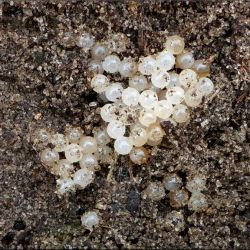
Spherical eggs of ghost snail
© Jacksonville Shells jaxshells.org
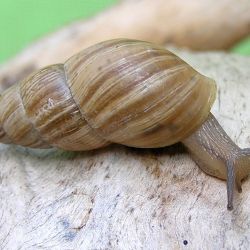
Ghost snail adult
© Jacksonville Shells jaxshells.org
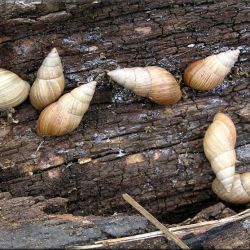
Ghost snails clustering
© Jacksonville Shells jaxshells.org
Ghost snail is a serious pest of many fruit and vegetable crops. Adult ghost snails can eat plants, reduce yields, clog irrigation, and carry bacteria and parasites that can harm animals and humans.
An infestation of ghost snail was detected at the Port of Brisbane in March 2025.
Scientific name
Bulimulus sporadicus (synonym Bulimulus bonariensis)
Other names
- Peanut snail
Description
Body
- Snail bodies are pale brown to off-white, with darker colouring near the eyestalks.
- Newly hatched snails are tiny.
- Adults are usually 20–25mm long but can grow up to 30mm long.
Shells
- Shells are conical (slim and pointed) with 5–7 whorls/spirals.
- They are tan to light brown with faint banding and sometimes have darker markings.
- Newly hatched snails have soft, fragile shells.
Eggs
- Eggs are small, shiny, white and spherical (about 1mm in diameter).
- They are buried 1–2cm below the soil surface.
Plant stage and plant parts affected
Ghost snails, being detritivores, generally feed on dead plant matter. However, they can also feed on and affect live plants, especially seedlings and previously damaged trees.
Plant damage and symptoms
- Feeding marks on leaves, fruit and stems such as:
- irregular holes, chewed edges and the appearance of etched or scraped/rasped areas
- scarring on the rind of citrus fruit
- Clustering of snails around feeding sites, for example on host plants, sometimes with visible slime trails
- Snails climbing up trees in response to wet or humid conditions
- In severe cases, defoliation and noticeable decline in plant health
Distribution
Ghost snail is native to South America and has spread to south-eastern areas of the United States.
Although ghost snail is not established in Australia, an infestation was detected at the Port of Brisbane in March 2025.
Hosts
Ghost snails are detritivores, but they can also feed on live host plants, especially seedlings and damaged trees. Host plants include:
- blueberry
- citrus
- cotton
- soybean
- peanut.
Life cycle
Reproduction
- Adult snails are hermaphroditic (have both male and female reproductive organs), so any 2 adults can mate. Self-fertilisation is also possible, though less common.
- Multiple generations are possible per year in warm, humid climates.
Eggs
- Egg-laying occurs in moist soil or protected leaf litter, usually under plants or debris or in shaded areas.
- Eggs are laid in clusters of 10–50, depending on the snail size and conditions.
- Eggs hatch in 2–4 weeks, depending on temperature and humidity.
Juveniles
- Newly hatched snails are tiny but grow quickly in humid environments with abundant food.
- Their shells gradually develop adult colouration.
Adults
- Adults reach sexual maturity in 3–6 months under favourable conditions.
- They usually live for 1–2 years, although some can live longer in ideal conditions.
Plants affected
- Multiple hosts
Impacts
Ghost snails do not typically consume healthy plant tissue, but can feed on seedlings or areas of plants already damaged by other factors. Long-term feeding can significantly reduce host health.
The presence of ghost snails can also lead to:
- contamination of crops with bacteria or parasites that are harmful to animals and humans
- feeding marks on fruit or vegetables that make them unsaleable
- clogging of irrigation systems, which affects crop health and yield.
How it is spread
Ghost snails reproduce rapidly with 20–50 eggs per clutch and adults can self-fertilise. Because of this, small introductions can quickly become large established populations.
The snails can be moved long distances via:
- shipping containers
- freight
- soil, mulch and plants
- farm equipment
- vehicles and machinery
- the illegal pet trade.
The tiny eggs are easily carried to new sites in soil or mulch. Adults climb plants, structures and equipment, which increases the chance of dispersal.
Monitoring and action
If you suspect the presence of ghost snail, report it using 1 of these methods:
- Report online.
- Phone Biosecurity Queensland on 13 25 23.
- Phone the Exotic Plant Pest Hotline on 1800 084 881.
Prevention
Use these resources to protect your farm from plant pests and diseases:
Legal requirements
Under the Biosecurity Act 2014, everyone in Queensland has a general biosecurity obligation to report biosecurity risks (such as ghost snail) and take action to prevent or minimise them.
Further information
- Read about the rapid response to the Port of Brisbane detection.
- Contact us online, by phone or in person.