
Huanglongbing
Alert
Be on the lookout for huanglongbing and report any sightings immediately.
Reporting options
- Report online.
- Phone Biosecurity Queensland on 13 25 23.
- Phone the Exotic Plant Pest Hotline on 1800 084 881.
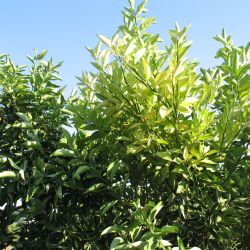
Yellow shoots caused by huanglongbing on an otherwise healthy tree
© Andrew Miles
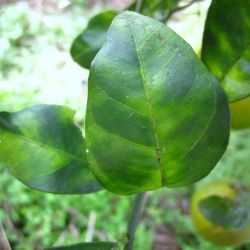
Blotchy leaf mottling that is not uniform across the midrib
© Queensland Government
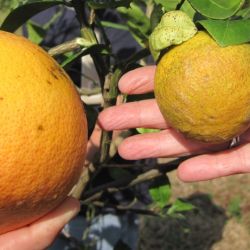
Small lopsided and misshapen fruit—a result of huanglongbing
© Queensland Government
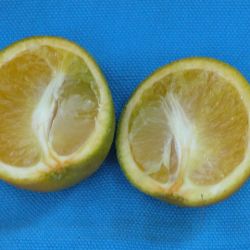
Lopsided fruit with small brown aborted seeds
© Australian Government
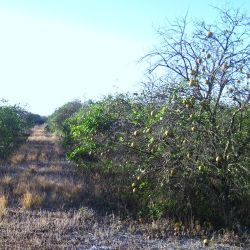
Symptoms of severe huanglongbing: dieback and fruit drop; yellow or mottled leaves; small and misshapen fruit
© Queensland Government
Huanglongbing, also known as 'citrus greening', is a bacterial disease that is lethal to citrus. The disease is a serious threat to citrus production areas worldwide.
Huanglongbing is transmitted by 2 phloem sap-sucking insects: the Asian citrus psyllid (Diaphorina citri) and the African citrus psyllid (Trioza erytreae).
Huanglongbing and the psyllid insects that transmit the disease are not present in Australia.
Help protect Australia from these pests by looking for and reporting any suspicious symptoms.
Scientific name
Candidatus Liberibacter asiaticus
Candidatus Liberibacter africanus
Candidatus Liberibacter americanus
Other names
- Citrus greening
- Yellow shoot disease
- Leaf mottling
- Citrus dieback
- Citrus vein-phloem degeneration
- Yellow dragon disease
- Blotchy mottle
- Yellow branch
Description
Citrus leaves
- Blotchy mottling that is not uniform across the leaf
- Yellowing of leaves and growing shoots that stands out from the normally green canopy
- Small, upright yellowish leaves with thickened leaf midribs and veins, sometimes resembling symptoms of nutrient deficiencies (such as zinc or boron deficiency)
- Unseasonal leaf flushing that is out of phase with healthy trees
- Leaf drop and dieback of branches
Citrus flowers and fruit
- Out-of-season heavy flowering and fruiting on diseased branches
- Small lopsided fruit with small, dark aborted seeds
- Unevenly coloured mature fruit (particularly sweet oranges and mandarins in temperate and subtropical regions)
- Premature and excessive fruit drop
- Bitter-tasting fruit
Whole citrus trees
- Progressive unthriftiness
- Leaf and fruit drop
- Branch dieback and root rot, leading to eventual tree death
Plant stage and plant parts affected
All growth stages of citrus plants, from young to mature, are affected; however, young plants may be more susceptible because their young flushing growth attracts the psyllids that carry the disease.
Some non-citrus hosts of huanglongbing may not develop visible symptoms.
May be confused with
The following conditions may show symptoms similar to those of huanglongbing. If you are unsure of the cause of suspect symptoms, report them.
Australian citrus dieback
Australian citrus dieback can cause symptoms that are very similar to those of huanglongbing. These include yellowing and mottling of leaves, reduced fruit size on the affected limb, and dieback of foliage.
However, Australian citrus dieback causes drooping branches while huanglongbing dieback occurs on upright or vertical branches.
Laboratory tests are required to distinguish Australian citrus dieback from huanglongbing, so any suspect symptoms need to be reported.
Winter yellowing
The sudden onset of cold temperatures in autumn can cause yellowing of the most recent leaf flush (usually the late summer or autumn flush). In young trees, leaves across the whole tree may become yellow.
Generally, winter yellowing leaves will become green again with the return of warmer weather in spring.
Nutrient deficiencies
Nutrient deficiencies can often cause yellowing or mottling of leaves and shoots; however, these symptoms are typically uniform (symmetrical) on each side of the leaf midrib. Huanglongbing, in comparison, causes asymmetrical yellowing or mottling of leaves.
Also, symptoms of nutrient deficiencies tend to appear uniformly across the canopy on shoots of the same age, whereas huanglongbing symptoms tend to first appear on single shoots or branches.
Root rots
Citrus trees with yellowing leaves, leaf fall and tree dieback may be suffering from root or collar rot. These conditions can be caused by:
- Phytophthora (fungus), especially in poorly drained soils
- 'wet feet' during periods of prolonged wet weather or overwatering (characterised by blackened, rotted roots).
Check the roots and trunk for signs of tissue browning and root death.
Citrus tristeza virus (stem-pitting strains)
On grapefruit and oranges, stem-pitting strains of citrus tristeza virus (Closterovirus tristezae) can cause:
- yellowish mottling on leaves
- leaf symptoms similar to those of nutrient deficiency
- shoot yellowing
- production of small lopsided fruit
- stunting and twig dieback.
Distribution
Huanglongbing occurs in many parts of the world.
The Asian strain (Candidatus Liberibacter asiaticus) is known to occur in Asia, the Middle East, the Americas, the Caribbean and Papua New Guinea.
The African strain (Candidatus Liberibacter africanus) is known to occur in Africa and the Middle East.
The American strain (Candidatus Liberibacter americanus) is known to occur in Brazil.
Hosts
Most commercial species and cultivars of citrus are affected. These include:
- sweet and sour orange
- grapefruit
- mandarin
- calamandarin
- tangelo
- kumquat
- lemon
- lime
- pomelo
- tangelo
- yuzu
- citron
- trifoliate orange
- citrange.
The following Australian native citrus species have shown varying levels of resistance to huanglongbing:
- Australian finger lime (Citrus australasica)
- Australian native orange (Citrus australis, syn. Microcitrus australis)
- Australian desert lime (Citrus glauca, syn. Eremocitrus glauca).
Non-citrus ornamental hosts such as curry plants (Murraya koenigii) and orange jasmine (Murraya paniculata) have shown varied susceptibility and may not develop symptoms.
Life cycle
The bacterium lives in the host plant's food-conducting tissue (phloem), where it impedes the movement of nutrients.
There can be a time lag between infection and when the first symptoms appear, and the type of symptoms that develop can vary. This can be due to a number of factors including:
- the strain of bacteria
- the species/cultivar
- the age of the plant
- the growth stage of the plant
- environmental conditions such as temperature.
The Asian strain can be transmitted by both the Asian citrus psyllid and African citrus psyllid. The Asian strain is acclimatised to hot climates, and so it is able to survive in subtropical and tropical climates as well as in cooler areas.
The African strain appears to be sensitive to hot climates and is only known to occur in cooler climates. It can be transmitted by both the African and Asian citrus psyllids.
The American strain has only been reported from Brazil, and so its ability to survive in different climates is unclear. It is known to be transmitted by the Asian citrus psyllid. The African citrus psyllid is not present in Brazil, and so its ability to transmit the American strain of huanglongbing is unknown.
Plants affected
- Citrus and citrus relatives
Impacts
Citrus is an important crop in Australia—there are about 33,000 hectares of commercial citrus orchard (Source: Citrus Australia, Australian citrus tree census 2024 (PDF, 1.7MB)). Citrus production for the 2024–25 financial year was valued at $1,234.8 million, with Queensland the second-largest producer (Source: Hort Innovation | Australian horticulture statistics handbook 2024/25).
Significant economic damage would occur if huanglongbing were to arrive in Australia. The disease causes serious decline in affected trees, leading to significant losses in productivity. Young trees may never produce marketable fruit, while more mature trees gradually become unproductive and may die. If fruit is produced, the flavour can be affected and can taint extracted juice products. The life span of an affected orchard is markedly reduced as tree deaths take their toll.
Home gardeners would also be affected, as citrus is a common backyard plant.
Once a tree is infected with huanglongbing there is no cure except for removal of infected trees and chemical control of the vectors (if present).
How it is spread
Huanglongbing is transmitted from plant to plant by Asian and African citrus psyllids or through grafting and marcotting with infected plant material.
Long-distance spread occurs through the movement of infected psyllids and infected plant propagating material (such as budwood, grafted trees, rootstock and seedlings).
The Australian Government closely regulates imports of citrus plant material and monitors for illegal plant movement.
Monitoring and action
Regularly monitor citrus plants for signs of huanglongbing:
- Examine unthrifty trees, or trees with unexplained leaf and fruit drop, or dieback.
- Look for Asian citrus psyllids and African citrus psyllids.
- Look for leaves with asymmetrical blotchy mottling, particularly when the plant's nutritional status is known (such as when citrus-specific fertiliser with trace elements has been regularly applied).
- Look for out-of-season heavy flowering and fruiting on sick-looking branches and/or small lopsided fruit with small, dark aborted seeds.
There is currently no cure for huanglongbing infection.
If you suspect huanglongbing or the citrus psyllids that can spread the disease, report this using 1 of these methods:
- Report online.
- Phone Biosecurity Queensland on 13 25 23.
- Phone the Exotic Plant Pest Hotline on 1800 084 881.
Prevention
Use these resources to help protect your farm from plant pests and diseases:
- Protecting your farm from plant pests and diseases
- My property biosecurity
- Farm biosecurity
- Biosecurity manual for citrus producers (PDF, 4MB).
Legal requirements
Huanglongbing and the Asian citrus psyllid are prohibited plant pests under the Biosecurity Act 2014.
If you think you have found either of them, you must report this immediately using 1 of these methods:
- Report online.
- Phone Biosecurity Queensland on 13 25 23.
- Phone the Exotic Plant Pest Hotline on 1800 084 881.
You must also take all reasonable and practical steps that are under your control to minimise any associated risks. This is part of your general biosecurity obligation.
Further information
- To learn how to protect your orchard, read the Biosecurity manual for citrus producers (PDF, 4MB).
- To understand more about citrus industry biosecurity planning, check the Biosecurity plan for the citrus industry (PDF, 4MB).
- Be part of the CitrusWatch program.
- Find out more from the Threat specific contingency plan: huanglongbing and its vectors (PHA 20215) (PDF, 2.7MB).