
Asian honey bee
Alert
Be on the lookout for Asian honey bees.
The Department of Primary Industries (Queensland) is responding to reports of Asian honey bees in south-western Brisbane. You must report suspect bees to Biosecurity Queensland within 24 hours and take all reasonable steps to minimise the risk of spreading Asian honey bees.
Reporting options
- Report online.
- Contact us online, by phone or in person.
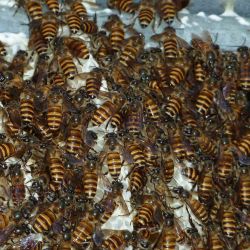
Asian honey bees on comb
© Queensland Government
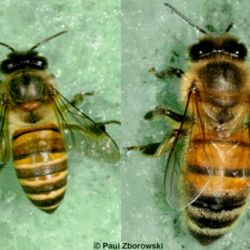
Asian honey bee (left) compared to European honey bee (right)
© Paul Zborowski
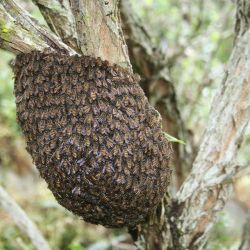
Asian honey bee swarm in a tree
© Queensland Government
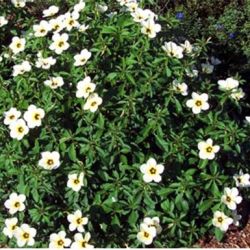
Asian honey bees are attracted to morning star flowers
© Queensland Government
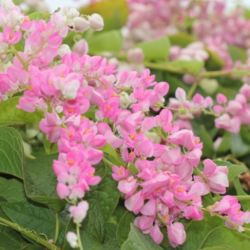
Asian honey bees are attracted to coral vines
© Queensland Government
The Asian honey bee is native to South-East Asia. Although it can be easily confused with the European honey bee (Apis mellifera), it is smaller, has less hair and has pronounced black/brown and yellow stripes.
The Asian honey bee is a carrier of bee diseases and pests, and is the natural host of Varroa jacobsoni, which is a prohibited matter under the Biosecurity Act 2014. Feral infestations could also compete with other bees for resources.
The Asian honey bee is prohibited matter under the Biosecurity Act 2014.
Scientific name
Apis cerana
Similar species
- European honey bee, little black bush bee, halictidae family, blue banded bee, leafcutter bee, resin bee
Description
- Bee approximately 10mm long.
- Body is smaller and less hairy than that of European honey bee.
- Abdomen has pronounced black/brown and yellow stripes.
- Aggressive, protects nesting sites and may sting when threatened.
Habitat
- Found nesting in tree hollows, under eaves, in walls, under floorboards, and in letterboxes, cable reels, compost bins, and various other urban locations.
- Tend to abscond or 'move' from nest sites. Absconding colonies may travel up to 10km.
- Asian honey bees that have been detected in North Queensland have relatively small colonies of up to 5,000 bees.
Distribution
- Asian honey bees can be found throughout Asia, Papua New Guinea, Solomon Islands, Vanuatu and Far North Queensland in Australia.
- Asian honey bee (Apis cerana javana) is known to infest the far northern Queensland area around Cairns.
- The Asian honey bee known infested area spreads north to Cape Tribulation, west of Southedge, Dimbulah and Ravenshoe, and south to Cardwell. An extension to this area to the north, including Rossville and Cooktown, was confirmed in September 2025.
- Asian honey bees were previously detected and eradicated in the Port of Townsville and the Port of Brisbane. Surveillance activities are ongoing in both locations as part of the National Bee Pest Surveillance Program (PDF, 444KB) at these priority ports.
- Asian honey bees have been reported in south-western Brisbane in June 2026 and are currently being investigated.
Life cycle
- Reproduces slightly more quickly than European honey bee.
- Workers develop in 19 days, drones in 23 days, and queens in 13–16 days (compared to 21 days, 24 days and 13 days respectively for European honey bees).
Impacts
Environmental
- Can transmit bee diseases and pests.
- May compete with other bees for floral resources.
Social
- Stings may cause anaphylactic reactions in allergy-prone people.
Control
- Early detection is essential to prevent Asian honey bees from establishing in new areas.
- Report all suspect bees (including any swarms or nests you have destroyed).
- Provide a sample of the bees (where possible) to the Biological Sciences Laboratory.
- If you suspect a new incursion of bees in an international airport or seaport, call the Australian Government on 1800 798 636.
- Check your vessel, vehicle or trailer before travelling long distances.
- Have a licensed pest control operator remove any bees that are swarming or nesting on your property.
European honey bees and other local native bees
- Asian honey bees are easily confused with European honey bees and other local native bees, which should not be destroyed—these bees are important for pollination and honey production.
- Confirm the identity of the bees before taking any action.
- Swarms of European honey bees should be referred to a local beekeeper who can remove the swarm before it establishes a nest.
Legal requirements
- Some species of Asian honey bee (Apis dorsata, A. florea and A. cerana other than A. cerana javana) are listed as prohibited matter affecting plants under the Biosecurity Act 2014.
- The Queensland Biosecurity Manual (PDF, 1.4MB) requires that a person must not keep, in the person's possession or under the person’s control, a live Asian honey bee, and must not move a live Asian honey bee.
- Apis cerana javana is listed as category 1 restricted matter affecting plants under the Biosecurity Act 2014.
- All sightings must be reported to Biosecurity Queensland within 24 hours. Please phone 13 25 23.
- Under Queensland legislation everyone has a general biosecurity obligation to take all reasonable and practical steps to minimise the risks of Asian honey bee spreading.