
Freshwater gold clam
Alert
Be on the lookout for freshwater gold clam and report any sightings within 24 hours.
Reporting options
- Report online.
- Phone Biosecurity Queensland on 13 25 23.
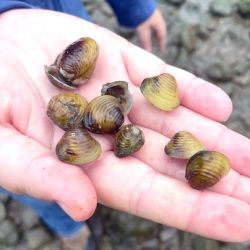
Close-up of multiple freshwater gold clams showing colour, shape and size
© Queensland Government
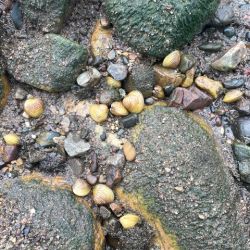
Multiple freshwater gold calms amongst rocks on river bank
© Queensland Government
The freshwater gold clam is a freshwater invasive clam that was detected at Colleges Crossing (west of Brisbane) and other sites along the Brisbane River.
It had not been positively identified in Australia before this detection. Surveillance undertaken has confirmed that the freshwater gold clam is present from the upper reaches of the Brisbane River to below Colleges Crossing.
The freshwater gold clam is a highly invasive species owing to its:
- rapid growth rate
- high reproductive rate
- ability to broadcast its larvae over a broad area using water flows in rivers.
It is a long-distance hitchhiker in ballast water and through the aquarium trade.
Scientific name
Corbicula fluminea
Other names
- Asian clam
- Asian golden clam
- Pygmy clam
Similar species
- Native freshwater bivalves that inhabit waterways throughout South East Queensland.
Description
- Inflated, round to triangular shell, yellowish brown to black with evenly spaced ridges.
- Can grow to a shell length of 50–65mm, although it is usually less than 25mm.
Habitat
- Tolerates a wide variety of substrate/habitat types.
Distribution
- Limited locations along the Brisbane River catchment in the Ipswich region.
- Established in New Zealand, and North and South America.
- Spreads when it is:
- attached to boats or carried in ballast water
- used as bait
- accidentally or inadvertently sold through the aquarium trade
- carried with water currents.
Life cycle
- Fertilised eggs form larvae, which exist in plankton for up to 55 days before settling.
- Generally thought to reproduce twice a year, but this may depend on climatic and ecological factors.
Impacts
Environmental
- Is highly invasive.
- Can displace native clams and diminish water quality.
Economic
- Can block plumbing, heat exchangers and other water infrastructure.
Control
Slipway operators, vessel inspectors and vessel owners should thoroughly check, clean and, where possible, dry vessel hulls and niche areas such as internal bilge systems.
If you think you have seen a freshwater gold clam, report it to Biosecurity Queensland. Take reasonable and practical measures to prevent freshwater gold clams from spreading until an authorised officer contacts you.
Legal requirements
The freshwater gold clam is a category 2, 3, 4 and 5 restricted noxious fish under the Biosecurity Act 2014. You must not:
- move it
- keep it
- feed it
- give it away
- sell it
- release it into the environment.
If you do any of these, penalties may apply.
You must take all reasonable and practical measures that are under your control to minimise the biosecurity risks associated with dealing with freshwater gold clams. This is part of your general biosecurity obligation.
You must report any sightings within 24 hours to Biosecurity Queensland using 1 of these methods:
- Report online.
- Phone Biosecurity Queensland on 13 25 23.
Further information
- Read the freshwater gold clam fact sheet.
- Contact us online, by phone or in person.