
Suminoe oyster
Alert
Be on the lookout for Suminoe oysters and report any sightings within 24 hours.
Reporting options
- Report online.
- Phone Biosecurity Queensland on 13 25 23.
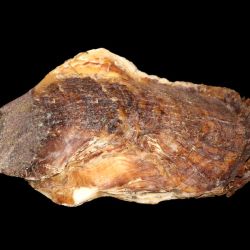
Suminoe oyster top view of outer shell
© Queensland Government
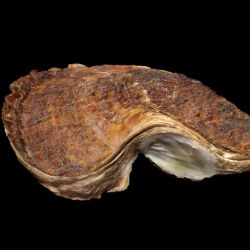
Suminoe oyster side view of entire oyster
© Queensland Government

Suminoe oyster top view in a hand indicating size
© Queensland Government
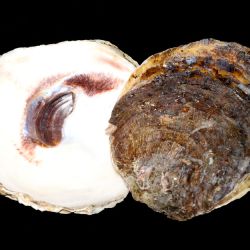
Suminoe oyster inside and outside the shell
© Queensland Government
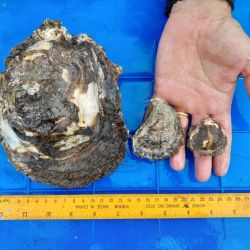
A juvenile Suminoe oyster (left), native Sydney rock oyster (middle) and mature Suminoe oyster (right)
© Queensland Government

Suminoe oyster growing on rock amongst rocks and mud
© Queensland Government
Suminoe oyster (Magallana ariakensis) is an introduced marine pest which has been detected in a number of locations including Bribie Island, Boggy Creek and Kedron Brook, Brisbane. It has also been detected in the Noosa River. It was first detected in 2023 and before that had not been detected in Australia.
Scientific name
Magallana ariakensis
Other names
- Chinese river oyster
- Formerly Crassostrea ariakensis
Description
- Suminoe oyster is a fast-growing large rock oyster belonging to the Ostreidae family of saltwater bivalve molluscs.
- It is large and flat in appearance and the shell can grow to up to 240mm long.
- Colours of the lamellae on the outer surface vary from grey and yellowish to brown to purple, while the inner surface of the valves is smooth and greyish white, with purple on the edges.
- It has unequal valves and an irregular shape.
- Suminoe oysters are difficult to distinguish from native rock oysters until they grow to a size larger than other species.
- The muscle scar on the inner surface of the valves is large and purplish.
- The internal shell lacks chomata (small ridges on the inside of the shell around its margin).
- Suminoe oyster is very similar in appearance to the black scar oyster (Magallana bilineata), another introduced marine pest (found in Far North Queensland).
Habitat
- The Suminoe oyster can grow attached to hard objects in brackish shallow intertidal or subtidal waters, as well as muddy creeks of warm estuaries.
Distribution
- Has been detected in the Brisbane River, Boggy Creek, Kedron Brook, Cabbage Tree Creek, the Pine Rivers system, Scarborough Harbour, Caboolture River, Pumicestone Passage (Bribie Island) and the Noosa River.
- It is thought to be native to the coasts of China, but was introduced very early to Arakie Bay, in southern Japan, and is also known from India and Pakistan and possibly Malaysia and Borneo.
Life cycle
- Females release eggs and males release sperm into the water column, where fertilisation occurs.
- Spawning is related to water temperature and salinity and occurs at a bottom water temperature of 22–26°C.
- Suminoe oysters can reach sexual maturity in 2–3 months at a size of 40–60mm.
- Each oyster is a protandric hermaphrodite, maturing first as a male, and often becoming female in subsequent seasons.
- A fertilised egg develops first into a ciliated trochophore larva, and then into a shelled veliger larva. The larva feeds on phytoplankton and grows, eventually developing a foot and becoming a pediveliger, competent for settlement after approximately 14 days.
Animals affected
- Native aquatic animals
Impacts
- The Suminoe oyster can foul submerged and floating infrastructure including pylons, pontoons and boats. It can occupy disturbed habitats including shallow subtidal sites and muddy creeks. However, little is known about the potential invasiveness and impacts.
- Biosecurity Queensland continues to investigate the extent of the incursions, which may inform future control, monitoring or treatment measures.
Environmental
- Competes with native species for space.
- May carry exotic diseases and parasites.
Economic
- Fouls wharf pylons, pontoons, marinas and marine aquaculture farms.
- Could introduce disease or parasites to commercial oyster farms.
Control
- Slipway operators, vessel inspectors and vessel owners should regularly and thoroughly check and clean vessel hulls, looking out for the pests. Pay particular attention to the nooks and crannies of vessels including internal seawater systems.
- Inspect, clean and dry equipment and gear before moving to a different location. This includes pots, nets, fishing or diving gear, anchors and ropes.
- Report any suspected marine pests.
- Feasibility of targeted treatment options are being assessed. However, the oysters cannot be distinguished from native rock oysters in the field until they reach their distinctive large size, making selective treatment potentially unviable.
- If you think you have seen Suminoe oysters, take a photo if it is safe to do so, record the location and report it online or phone Biosecurity Queensland on 13 25 23.
Legal requirements
- The Suminoe oyster is a category 2, 3, 4 and 5 restricted invasive animal under the Biosecurity Act 2014. You must not:
- keep it
- move it
- give it away
- sell it
- release it into the environment.
If you do any of these, penalties may apply.
- You must take all reasonable and practical measures that are under your control to minimise the biosecurity risks associated with dealing with Suminoe oysters. This is part of your general biosecurity obligation.
- You must report any sightings within 24 hours using 1 of these methods:
- Report online.
- Phone Biosecurity Queensland on 13 25 23.
Further information
- Contact us online, by phone or in person.
- Read the Suminoe oyster fact sheet.