
Navel orangeworm
Alert
Have you seen Navel orangeworm?
Be on the lookout and report it.
Under Queensland legislation if you suspect the presence of Navel orangeworm, you must report it to Biosecurity Queensland on 13 25 23 or contact the Exotic Plant Pest Hotline on 1800 084 881.
Early detection and reporting are key elements in controlling Navel orangeworm.
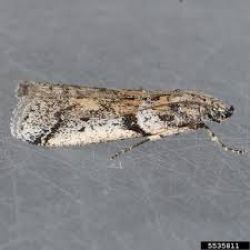
Adult navel orangeworm (Amyelois transitella) moth
© Mark Dreiling, Bugwood.org
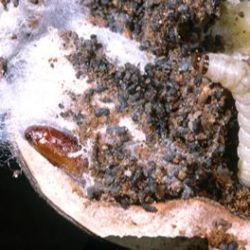
Feeding damage, frass (excrement), larva (right), pupa (left), and webbing of navel orangeworm.
© Jack Kelly Clark, courtesy of the University of California Statewide IPM Program
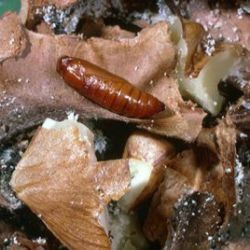
Pupa of navel orangeworm.
© Jack Kelly Clark, courtesy of the University of California Statewide IPM Program
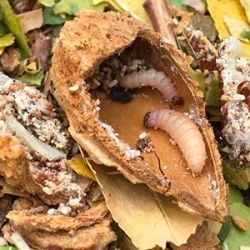
Navel orangeworm larvae infesting almond
© David Haviland, courtesy University of California Statewide IPM Program
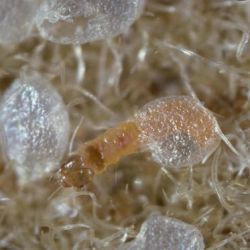
Larva of navel orangeworm emerging from an egg
© Jack Kelly Clark, courtesy of the University of California Statewide IPM Program
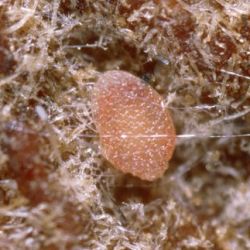
Navel orangeworm egg
© Jack Kelly Clark, courtesy of the University of California Statewide IPM Program
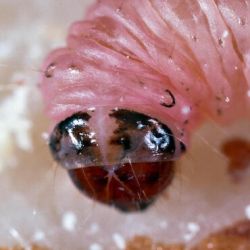
Crescent shaped head of Navel orangeworm
© Jack Kelly Clark, courtesy of the University of California Statewide IPM Program
Navel orangeworm (Amyelois transitella) is an exotic pest that can damage nut crops such as pistachios, almonds and walnuts, and fruit crops such citrus, dates, figs, grapes, apples, pears and stone fruit. Feeding damage and contamination caused by navel orangeworm can reduce fruit and nut yield and render produce unmarketable. In nuts, there is also a risk of contamination by aflatoxin producing fungi which can affect nut quality and food safety.
Navel orangeworm is not found in Australia.
Scientific name
Amyelois transitella
Other names
- NOW (short for navel orangeworm)
Description
Adults
- Adult moths are about 9–11mm long and greyish-brown.
- Wings have silver-grey markings.
- Moths have short, dark projections from the front of the head.
Larvae
- White to pink with a dark reddish-brown head.
- Distinctive pair of crescent-shaped markings on the second segment behind the head.
- Tiny when they first hatch, but as they develop they can grow up to 13–19mm long.
Pupae
- 7–12mm long and dark brown.
Eggs
- Tiny, oval and flattened, with ridge-like marks.
- Initially, eggs are white, but turn pink, then reddish-brown before hatching.
- Laid on mummified or split nuts, on twigs, at the navel end of injured oranges, and in splits and wounds in fruit and nuts.
Plant stage and plant parts affected
Plants are affected during the fruiting stage, as the pest feeds mainly on damaged, overripe and dried fruits and nuts.
Plant damage
- Fruit and nuts damaged by sunburn, other pests or environmental factors are most susceptible.
- In nuts, the first sign can be the presence of small, pin-sized holes that are the start of tunnels into the nut meat where the larvae feed.
- Extensive amounts of webbing and frass (insect excrement) produced by the feeding larvae can be seen on the fruit.
- Navel orangeworm larvae scavenge in splits and wounds of fruit such as citrus, especially navel oranges, and feed in or near the core.
- On grapes, larvae feed in the fruit, particularly dried and decaying clusters of berries.
- Larval feeding can allow decay-causing organisms to enter the fruit and nuts, such as the aflatoxin producing fungus, Aspergillus flavus.
- This damage can lead to fruit drop, contamination and reduction in marketable fruit and nuts.
Distribution
Navel orangeworm occurs in Argentina, Brazil, Costa Rica, Mexico, and the United States of America. It does not occur in Australia.
Hosts
Navel orangeworm feed on a variety of nut and fruit crops including pistachios, almonds, walnuts, citrus, dates, figs, grapes, apples, pears, and stone fruit.
Life cycle
- Larvae hatch from the eggs after 4 to 23 days, depending on environmental conditions.
- There are 5 larval growth stages (instars).
- Larvae develop a cocoon where they pupate (change into adult moths).
- After emergence, adult moths mate and recommence the life cycle.
- Under favourable conditions navel orangeworm can remain active all year round.
- If weather conditions are unfavourable (cold), navel orangeworm can overwinter in the previous season's crop residue (mummified fruit and nuts) as larvae or pupae.
Plants affected
- Multiple hosts
Impacts
Navel orangeworm is an economically significant pest of nut crops overseas, as well as fruit crops such as citrus, grapes and figs. Feeding damage and contamination caused by navel orangeworm reduces yield and results in unmarketable fruit and nuts.
Domestic and international market access could be disrupted.
Backyard growers would also be affected.
How it is spread
Navel orangeworm life stages can be difficult to see as they can be hidden inside nut shells. People moving egg, larvae, or adult moth infested plant material, including nuts, could spread navel orangeworm over long distances and introduce this pest into Australia.
The Australian Government closely regulates approved imports of plant material and nuts, and monitors for illegal plant movement to prevent the introduction of exotic plant pests like navel orangeworm.
The adult moths are capable of flying up to 375–425m to find a new host, so are quite capable of spreading rapidly within an orchard.
Monitoring and action
Look for:
- Larvae in mummified or overripe and dried fruit and nuts left on trees or on the ground.
- Surface scarring and borer damage in fruit and nuts, with webbing and insect frass.
- The presence of larvae that are white to pink with a dark reddish-brown head, or brown pupae, or the presence of moths and eggs associated with the symptoms above.
If you suspect the presence of navel orangeworm, report it immediately using one of these methods:
- Report online.
- Phone Biosecurity Queensland on 13 25 23.
- Phone the Exotic Plant Pest Hotline on 1800 084 881.
Prevention
Protect your farm from plant pests and diseases:
Legal requirements
Navel orangeworm is prohibited matter under the Biosecurity Act 2014.
Report suspected navel orangeworm immediately.
You must take all reasonable and practical steps under your control to minimise any associated risks. This is called a general biosecurity obligation.
Further information
- Find images of navel orangeworm in the Australian biosecurity pest and disease image library.
- For further advice on how to monitor for naval orangeworm, read the Orchard biosecurity manual for the almond industry (PDF, 3.6MB).