
Mango pulp weevil
Alert
Be on the lookout for mango pulp weevil and report any sightings immediately.
Reporting options
- Report online.
- Phone Biosecurity Queensland on 13 25 23.
- Phone the Exotic Plant Pest Hotline on 1800 084 881.
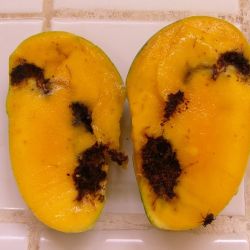
Significant damage to mango fruit flesh, caused by mango pulp weevil
© Queensland Government
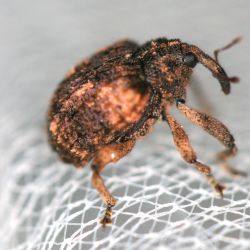
Close-up view of a mango pulp weevil
© Queensland Government
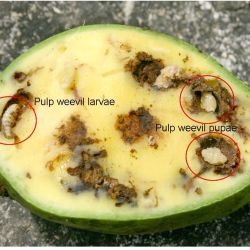
Mango pulp weevil larva and pupae inside mango fruit flesh
© Queensland Government
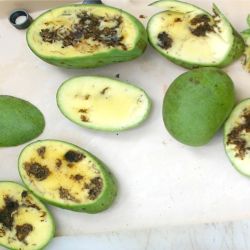
Mango pulp weevil can cause significant damage to green and ripe mango fruit
© Queensland Government
Mango pulp weevil is a serious exotic insect pest that tunnels into the flesh of mangoes, making them unfit to eat. The pest can cause significant fruit damage, resulting in economic loss to the mango industry.
Mango pulp weevil is similar in appearance to mango seed weevil, but eats the fruit flesh rather than the seed.
Scientific name
Cryptorhynchus frigidus
Other names
- Sternochetus gravis
Description
Adults
- Adults are small insects with long snouts.
- They are about 6–9mm long, thick-bodied and mottled brown.
Larvae
- Larvae are plump, whitish legless grubs with a well-defined brown to black head.
- They have 5 growth stages (instars).
Pupae
- Pupae are up to 10mm long and vary from white to pale red.
Eggs
- Eggs are tiny (about 0.6mm by 0.3mm), roughly elliptical and white to pale yellow.
Plant stage and plant parts affected
Flowering and fruiting mango trees are affected, as the mango pulp weevil predominantly feeds on fruit.
Plant damage
Mango pulp weevil causes premature fruit drop and loss of marketable fruit. Infested fruit may have no outward visible signs that the pest is present within, until the adult weevil tunnels its way out of the fruit.
May be confused with
Mango pulp weevil looks very similar to mango seed weevil, which is already present in some parts of Queensland. A trained entomologist is required to tell them apart. The most obvious difference between them is that mango seed weevil feeds on and in the mango seed, while mango pulp weevil feeds inside the flesh, or pulp, of the fruit.
Distribution
Mango pulp weevil is found in South Asia (north-eastern India and Bangladesh) and South-East Asia (Brunei Darussalam, Indonesia, Malaysia, Myanmar, Papua New Guinea, the Philippines, Singapore and Thailand).
It has not been found in Australia.
Hosts
Mango (Mangifera indica)
Life cycle
- The larvae hatch from eggs laid on fruit and tunnel through the flesh, forming a chamber next to the seed.
- From there, each larva continues to tunnel through the mango flesh, leaving brown granular faeces behind.
- The larva eventually develops into a pupa, which remains in a chamber until it develops into the adult weevil.
- The adult weevil emerges from the fruit by boring a hole through the mango skin.
- Mango pulp weevils can produce 1 generation per year. The egg-to-adult life cycle takes 35 to 53 days.
- Adult weevils can survive inside fallen mango fruit. They can overwinter:
- under loose bark
- in crevices in tree trunks
- in leaf litter and other fallen plant material.
Plants affected
- Mango
Impacts
Mangoes are an important crop in Queensland. The Australian mango industry produces about 73,000 tonnes of mango fruit annually, providing a gross value of production at the farm gate of about $232 million per year. About 45% of these mangoes are grown in Queensland. (Source: Australian horticulture statistics handbook 2024/25)
Mango pulp weevil has been reported to have a high economic impact on Asian mango industries because it causes premature fruit drop and loss of marketable fruit. If the mango pulp weevil were established in Australia, domestic and export market access could be disrupted, and costly control measures may be required.
Home gardeners with mango trees would also be affected, as the larvae infest mango fruit, making it unsuitable for people to eat.
How it is spread
Mango pulp weevil completes much of its life cycle within mango fruit, and infested fruit can look normal on the outside. This pest could spread long distances by people moving infested fruit or plant material. The Australian Government closely regulates approved imports and monitors for illegal plant movement to prevent exotic pest entry to Australia.
Where the mango pulp weevil is known to occur, orchard infestations tend to be localised. Adult weevils can fly, but generally do not spread far after they emerge from infested fruit.
Monitoring and action
Look for mango pulp weevil during the fruiting season.
Be suspicious if there are more fruit drops than usual.
You will need to cut the fruit open to expose the inside of the fruit and the seed to look for mango pulp weevils. Signs of mango pulp weevil include burrowing damage, insect faeces, and larvae, pupae and adult weevils in the fruit flesh.
If you suspect mango pulp weevil, report it immediately using 1 of these methods:
- Report online.
- Phone Biosecurity Queensland on 13 25 23.
- Phone the Exotic Plant Pest Hotline on 1800 084 881.
Prevention
Use these resources to learn more about how to protect your farm from plant pests and diseases:
- Protecting your farm from plant pests and diseases
- My property biosecurity
- Farm biosecurity.
Legal requirements
Mango pulp weevil is prohibited matter under the Biosecurity Act 2014.
You must report suspected mango pulp weevil immediately.
You must also take all reasonable and practical steps that are under your control to minimise any biosecurity risks associated with mango pulp weevil. This is part of your general biosecurity obligation.
Further information
- Read more about mango pulp weevil.