
Khapra beetle
Alert
Be on the lookout for khapra beetle and report any sightings immediately.
Reporting options
- Report online.
- Phone Biosecurity Queensland on 13 25 23.
- Phone the Exotic Plant Pest Hotline on 1800 084 881.
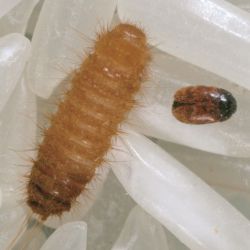
Khapra beetle larva and adult on rice grains
© Department of Agriculture, Fisheries and Forestry
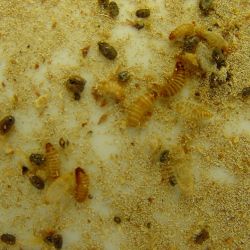
Adult khapra beetle, larvae and cast-off skin
© Department of Agriculture, Fisheries and Forestry
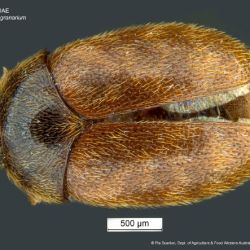
Adult khapra beetle, 3mm in length
© Department of Primary Industries and Regional Development Western Australia
Khapra beetle (Trogoderma granarium) is a destructive exotic pest of stored grain, rice and dry foodstuffs worldwide. The beetle poses a major threat to Queensland's grains, dried fruit, rice and nut industries.
Khapra beetle is difficult to identify because it is almost identical to carpet beetle, hide beetle, warehouse beetle and many similar-looking native species in Australia. Expert microscopic examination or genetic analysis is needed to differentiate the species.
This tiny resilient hitchhiker can spread easily, travelling unnoticed in shipping containers, packaging materials and household furnishings. Early detection and reporting are key elements in responding to the risk posed by khapra beetle.
The Australian Government is currently managing and investigating a detection of khapra beetle in imported cargo. Federal biosecurity officers are undertaking surveillance and monitoring.
Biosecurity Queensland is working with national industries and stakeholders to address the serious threat posed by khapra beetle in Queensland.
Scientific name
Trogoderma granarium
Description
Adults
- Adults are small (2–3mm long and 1–2mm wide) brownish beetles.
- They have smooth, oval-shaped bodies and 3 transverse bands (markings) of pale-coloured hairs on the wing cover.
- Despite having wings, adults do not fly—they walk.
Larvae
- Larvae appear very hairy, with hairs forming distinctive tufts over the body, giving the appearance of a short tail.
- They are 1.6–5mm long and pale yellow but become golden-brown as they mature.
- Larvae go through 4–7 moulting stages, leaving behind numerous cast-off skins.
- They can survive without food for very long periods (over 12 months) and can survive dormant for up to 8 years in varied conditions.
Pupae
- Pupae are 2–3mm long.
- They are initially creamy white to pale yellow and gradually turn light brown.
- They are soft-bodied and have visible appendages.
- This stage lasts 1–2 weeks in warm conditions.
Eggs
- Eggs are white to pale yellow and very small (0.7mm long and 0.25mm wide).
- They are approximately cylindrical and smooth with one side slightly pointed.
- Their incubation period is 3–14 days depending on the temperature.
Identification
- View more images of khapra beetle.
- Read more about identifying khapra beetle.
May be confused with
- Warehouse beetle (Trogoderma variabile)
- Carpet beetle (Reesa vespulae)
- Hide beetle (Dermestes maculatus)
- Similar-looking native Australian species
Distribution
Khapra beetle is well-established in many regions of the world, including parts of Asia, Africa, the Middle East and Europe. It prefers hot, dry conditions and will not usually be present outdoors or in damp areas.
Hosts
Larvae feed on harvested grains, seeds, and processed vegetable and animal products (including spices, herbs, nuts, rice, dried fruits and dried animal skins).
Khapra beetle can be found in:
- grain and food stores
- malthouses
- seed-processing plants
- fodder-production plants
- dried-milk factories
- stores of packing materials (such as used or unused sacks, bags or crates)
- kitchen pantries.
Khapra beetle is not found in fields or orchards of host crops—it strongly prefers the protected environments described above.
Life cycle
- Khapra beetle undergoes a complete metamorphosis with 4 stages: egg, larva, pupa and adult.
- Females lay eggs loosely among stored grain or in crevices of storage containers, silos or other grain facilities.
- The larvae feed on harvested grains and stored products and can survive long periods in dormancy when food is unavailable.
- Fully grown larvae pupate into adults, which then reproduce and disperse to lay eggs.
- The time to complete the life cycle can range from about a month (under ideal conditions) to several months (under cooler conditions or in unfavourable environments).
Plants affected
- Dried food products
- grains
- rice
- oilseeds
- dried fruits
Impacts
- Khapra beetle can cause significant damage to stored products. The larvae crawl over and eat the products, and contaminate them with cast-off skins and frass.
- Up to 30% of a grain store can be damaged before khapra beetle is noticed.
- Cast-off skins and hair from the larvae contaminate grain, which can create a health risk. The skins and hair are difficult to remove from grain storage structures and transport vessels.
- If established, khapra beetle could affect about 100 commodities including dried plant products (such as barley, cotton, maize, millet, pulses, rice, sesame, sorghum, spices, sunflower and wheat) as well as some animal products.
How it is spread
- Khapra beetle spreads through the movement of:
- infested stored grain and products (such as flour and breakfast cereals)
- contaminated items (such as seed, machinery and straw).
- It also spreads by hitchhiking in shipping containers (where it can survive for years) or household furnishings.
Monitoring and action
- Khapra beetle is a stored-grain pest. You may find it in stored products and around places where stored products are kept or transported.
- The presence of larvae is usually the most obvious sign of khapra beetle.
- When examining grain samples, you are most likely to notice the characteristic hairy larvae and cast-off skins first.
- You may also find signs of khapra beetle in cracks and between wall linings of storage containers and buildings.
- If you suspect you have found khapra beetle, report it immediately using 1 of these methods:
- Report online.
- Phone Biosecurity Queensland on 13 25 23.
- Phone the Exotic Plant Pest Hotline on 1800 084 881.
Prevention
Use these resources to help protect your farm from plant pests and diseases:
- Protecting your farm
- On-farm biosecurity
- Farm biosecurity
- National khapra beetle action plan 2021–2031.
Legal requirements
Khapra beetle is prohibited matter under the Biosecurity Act 2014.
Under the Act, everyone in Queensland has a general biosecurity obligation to report biosecurity risks and take action to prevent or minimise them.
Further information
- Find out how we are protecting Australia from khapra beetle.
- Read the fact sheets on khapra beetle for grains and grapes.
- Find out more about identifying khapra beetle.
- View more images of khapra beetle.