
Asiatic citrus canker
Alert
Be on the lookout for Asiatic citrus canker/citrus canker.
Reporting options
- Report online.
- Phone Biosecurity Queensland on 13 25 23.
- Phone the Exotic Plant Pest Hotline on 1800 084 881.
Do not touch suspect Asiatic citrus canker lesions or move plant material off your property. This can spread the disease.

Citrus fruit and leaves with Asiatic citrus canker
© National Citrus Canker Eradication Program, Department of Primary Industries
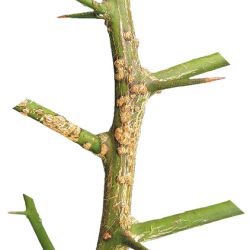
Etched Asiatic citrus canker stem
© National Citrus Canker Eradication Program, Department of Primary Industries
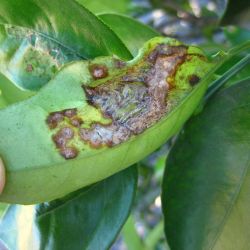
Asiatic citrus canker can follow the leaf mines of citrus leaf miner
© Ceri Pearce, Department of Primary Industries
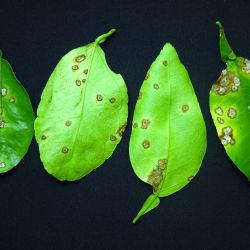
Asiatic citrus canker spots on upper and lower leaf surfaces
© Ceri Pearce, Department of Primary Industries
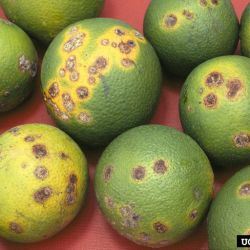
Asiatic citrus canker infected fruit
© Timothy Schubert, Florida Department of Agriculture and Consumer Services, Bugwood.org
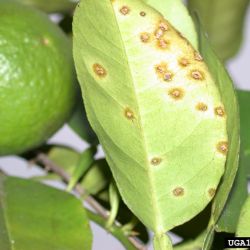
Asiatic citrus canker infected leaf
Asiatic citrus canker is a plant disease caused by the bacterium Xanthomonas citri pv. citri, affecting citrus and some other plant species. Asiatic citrus canker does not pose any risk to human health.
Citrus trees infected with Asiatic citrus canker display unsightly lesions that can form on leaves, fruit and stems. Trees infected with the disease may have poor growth and a reduction in fruit quality and quantity. The disease has serious economic impacts on citrus production.
In Australia, Asiatic citrus canker is an exotic disease. Historically, there have been several outbreaks: in the Northern Territory in 1912, 1991, 1993, and 2018 (the latter including Western Australia) and Queensland in 1984 and 2004. All were successfully eradicated.
Other names
- Citrus canker
- Asiatic canker
- Citrus bacterial canker
- Cancrosis A (A strains)
Description
Symptoms
The bacterium causes the development of blister-like lesions on host leaves, fruit and stems.
Citrus canker lesions
- Usually raised, spongy, and coloured tan to brown, surrounded by an oily, water-soaked margin that can become a yellow ring or halo as the lesions age.
- Gradually increase in size to 5–10mm over several months.
- Large or older lesions may have a crater-like centre, which can fall out to create a 'shot-hole' appearance.
- Occur in clusters where water pools on the leaf (such as along leaf margins or tips).
- Can follow the feeding tracks of citrus leaf miners, where the wound provides an entry point for the bacteria.
- Multiple lesions on fruit stems are typically only seen in cases where the foliage is severely affected.
The lesions can vary in size, shape and appearance depending on:
- the citrus cultivar or host plant affected
- the way the bacteria enter the plant (for example, through stomata or entry wounds)
- the age of the lesions
- climatic conditions.
The disease causes abnormal leaf fall, poor tree health, dieback, blemished fruit and premature fruit drop.
Plant stage and plant parts affected
Leaf, fruit and stem tissue may be infected. Leaf tissue offers more opportunity for infection and, as such, typically displays the most numerous lesions over time.
The disease usually becomes more active in early spring. The highest risk for new infections is during active growing periods when fresh shoots are emerging.
Conditions for the development of the disease are optimal in warm temperatures, and spread is highest in periods of high rainfall and strong winds.
May be confused with
Lemon scab caused by the fungus Elsinoe fawcettii also causes scab-like lesions, predominantly on lemons in coastal regions. Lemon scabs appear drier looking than citrus canker and to not have a yellow halo.
If you suspect Asiatic citrus canker, you must report it immediately.
Distribution
The disease is widespread in many tropical and subtropical citrus-growing areas of the world.
Australia was officially declared citrus canker free in April 2021.
Hosts
Affects orange, mandarin, lemon, lime, grapefruit, kumquat, calamondin, tangelo, pomelo, citrus rootstock and native citrus species such as Citrus australasica (finger lime), C. gracilis (Humptydoo lime) and C. inodora (North Queensland/Johnstone River lime).
All commercial citrus cultivars can be affected.
The Queensland Biosecurity Manual (PDF, 1.4MB) contains a full list of citrus canker carriers, including host plants.
Life cycle
Bacteria ooze from the lesions and are spread predominantly by rain splash. In rain storms, bacteria can be carried between trees over distances up to 100m. The bacteria enter the plant through stomata or through wounds caused by wind-driven rain, mechanical wounds caused by equipment, and wounds caused by insects, such as citrus leaf miner. The disease can become less active (latent) when the weather is dry for long periods, and then become active again in periods of high rainfall and warm weather.
Plants affected
- Citrus and citrus relatives
Impacts
Citrus is a significant crop in Australia, with over 23,000 hectares of citrus planted. For the year ending June 2023, citrus production was valued at $977.1 million, with Queensland the largest producer of mandarins, lemons and limes. The high quality of Australia's citrus fruit results in citrus being Australia's largest fresh fruit exporting industry by volume, with exports of oranges, mandarins, lemons, limes and grapefruit, totalling 231,301 tonnes worth $441.1 million in 2023 (Horticulture Innovation Australia Ltd, 2023).
Asiatic citrus canker causes plant defoliation, unsightly fruit blemishes and premature fruit drop. This leads to a decrease in fruit production and a reduction in saleable fruit. Farmers can experience production losses and trade bans as the presence of citrus canker can affect domestic and international export market access. In order to prevent the disease from spreading, affected growers' properties may be quarantined. Asiatic citrus canker can also have significant economic and emotional impacts on individual growers, their families and the communities that support them.
Home gardeners may also be affected, as citrus is a common backyard plant.
Human health is not affected by infected plants and fruit.
How it is spread
Asiatic citrus canker is easily spread. The canker lesions ooze bacteria when wet. Over short distances, wind-driven rain, air currents, insects, birds, human movement and equipment such as overhead or spray irrigation systems can spread the bacteria.
Asiatic citrus canker can be moved and spread over longer distances on equipment (vehicles, tools, mechanical hedgers, sprayers, gardening equipment) and people (hands, shoes and clothing).
Movement of infected plant material, or airborne movement of bacteria as an aerosol or debris during severe weather events (where strong winds and rain are present), can also spread the disease further.
The disease is not transmitted by seeds.
The illegal importation of infected plant material poses the greatest risk of introducing this disease into Australia. The Australian Government closely monitors for illegal plant movements and regulates approved host plant imports.
Monitoring and action
Asiatic citrus canker is typically recognised by its characteristic symptoms, and can be detected during routine orchard inspections.
If you see symptoms that resemble citrus canker infection, contact Biosecurity Queensland on 13 25 23 for advice on how to act.
Prevention
Legal requirements
Asiatic citrus canker/citrus canker is a prohibited matter affecting plants under the Biosecurity Act 2014.
Report suspected Asiatic citrus canker to Biosecurity Queensland immediately on 13 25 23 or contact the Exotic Plant Pest Hotline on 1800 084 881.
Biosecurity is a shared responsibility and by law everyone has a general biosecurity obligation to take all reasonable and practical steps to avoid introduction or spread of plant pests.