
Freckle disease of banana
Alert
Be on the lookout for freckle disease of banana and report any sightings within 24 hours.
Reporting options
- Report online.
- Phone Biosecurity Queensland on 13 25 23.
- Phone the Exotic Plant Pest Hotline on 1800 084 881.
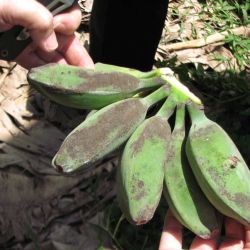
Freckle disease of banana on bananas.
© Queensland Government
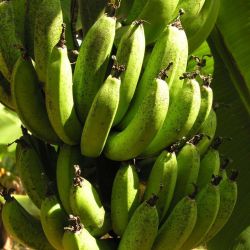
Freckle disease of banana on banana bunch.
© Queensland Government
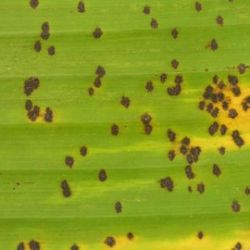
Leaf affected by Cavendish strain of freckle disease of banana. Note: It is not possible to differentiate the strain of freckle disease of banana on visual symptoms alone. If there are freckle lesions on Cavendish bananas, then it is likely to be caused by the Cavendish strain.
© Queensland Government
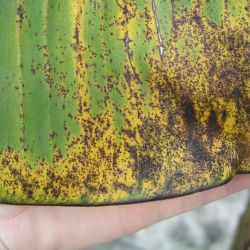
Leaf affected by freckle disease of banana.
© Queensland Government
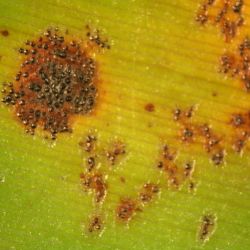
Close up of leaf with freckle disease of banana.
© Queensland Government
Freckle disease of banana causes characteristic 'sandpapery feeling' spots on leaves and fruit. Plant health, productivity, and fruit quality and appearance can be adversely affected. A number of species of the fungus Phyllosticta can cause these symptoms on banana, and some are exotic to Australia.
In 2022, freckle disease of banana detected in dwarf Cavendish bananas in the Northern Territory was found to be caused by a race of Phyllosticta cavendishii that is exotic to Australia. A nationally coordinated eradication program was implemented until December 2024, when eradication was deemed not technically feasible. The response then transitioned to a management approach, which concluded in 2026. Ongoing management of the disease is now in place, supported by official control requirements administered by the Northern Territory Government.
Freckle disease of banana is a serious threat to the Queensland banana industry, with around 94% of Australia's bananas grown within the state.
Scientific name
Phyllosticta and Guignardia spp. pathogenic on banana other than P. maculata
Cause
Freckle disease of banana on Cavendish bananas is caused by the fungus Phyllosticta cavendishii. Races of this species that affect Cavendish bananas are exotic to Australia.
There are other species of Phyllosticta that cause freckle disease of banana overseas, for example, P. musarum. P. musarum has not been detected in Australia.
Some species of Phyllosticta that cause freckle disease of banana are found in Australia, for example P. maculata. P. maculata does not affect Cavendish bananas.
Other names
- Banana freckle
- Cavendish competent banana freckle
- Cavendish banana freckle
Description
Symptoms
- 'Sandpapery feeling' spots, predominantly on leaves and fruit.
- Spots can be very small to large (1–4mm) and dark brown to black in colour.
- The spots can run together to form streaks.
- Sometimes the centre of the larger spots is lighter in colour.
- Spots can also appear on the midrib of the leaf, bunch stalks and flower bracts.
- The spots have a sandpapery feel when touched because the fungal structures protrude through the plant surface.
- Severe infection results in yellowing of the leaf, which can wither and die.
Plant stage and plant parts affected
Freckle disease of banana can affect a banana plant at all stages of the production cycle. It mainly affects leaves and fruit.
May be confused with
A closely related species, Phyllosticta maculata, causes similar symptoms on bananas, and is present in Australia. In Queensland, it can be found on islands in the Torres Strait, on Cape York Peninsula and in Far North Queensland. Freckle disease of banana caused by P. maculata is very uncommon in Queensland.
If you suspect freckle disease of banana on any banana variety, don't hesitate to report it. Diagnostic testing is required to tell them apart.
Distribution
Freckle disease of banana that can affect Cavendish bananas was previously eradicated from the Northern Territory in 2019. In May 2022, freckle disease of banana was detected on dwarf Cavendish bananas in the Northern Territory and a nationally coordinated eradication program was delivered until its transition to management was completed in 2026. The Northern Territory Government continues to deliver an ongoing program to control freckle disease of banana.
Freckle disease of banana is known to occur in parts of Asia, including Bangladesh, Bhutan, China, India, Indonesia, Malaysia, Myanmar, Nepal, Pakistan, the Philippines, Sri Lanka, Taiwan, Thailand and Vietnam. The disease is also present in Fiji, Hawaii, New Zealand, Papua New Guinea, Samoa, Solomon Islands and Tonga.
Freckle disease of banana is not present in Queensland.
Hosts
Freckle disease of banana is only known to cause disease in banana plants (Musa spp.), including sweet and cooking varieties.
Life cycle
The freckle spots contain fungal fruiting bodies (perithecia and pycnidia). When it rains or following heavy dew, fungal spores such as ascospores and conidia are released. Conidia, in particular, play an important part in the infection cycle. They can be spread by raindrops or water splashed onto or across leaves and fruit. The spores germinate, penetrating the host and multiplying within and between cells, creating new spots in the superficial layers of the host plant tissue.
The incubation period can be as little as 20 days in hot, humid weather.
Plants affected
- Banana
Impacts
Freckle disease of banana is a serious threat to the banana industry. The disease decreases plant health and productivity by reducing the amount of healthy leaf area, and affects fruit quality and appearance. Blemished fruit may not be marketable. Production costs may increase as a result of the additional costs of fungicide sprays and removal of infected leaves. Some of these increased costs might be passed on to consumers.
Home gardeners would also be affected as banana is a common backyard plant in Queensland.
Eating quality is not affected, and there is no risk to human health from eating bananas infected with this disease.
How it is spread
Freckle disease of banana is a 'wet spore' organism. It generally moves short distances by water droplet splash and wind-driven rain. The fungus is spread over larger distances by people moving infected fruit, leaves and suckers used for planting.
Monitoring and action
Inspect your banana plants regularly for the presence of exotic pests and diseases.
Look for small spots 1–4mm in diameter that have a sandpapery feel when you touch them. The spots may join together to form streaks.
If you suspect freckle disease of banana on any banana variety, report it using 1 of these methods:
- Report online.
- Phone Biosecurity Queensland on 13 25 23.
- Phone the Exotic Plant Pest Hotline on 1800 084 881.
Further information about banana crop monitoring can be found in the Farm biosecurity manual for the banana industry (PDF, 1.4MB).
Prevention
Banana plants propagated from tissue culture under the Quality Banana Approved Nursery (QBAN) scheme are recommended as the safest disease-free source of planting material. QBAN plants are now widely available for both commercial and backyard use.
The Biosecurity Code of Practice for sourcing and planting of banana plants in an area where serious pests are present (PDF, 1.4MB) provides detailed guidance to growers on the use of planting material. It also outlines reasonable and practical steps to minimise associated biosecurity risks and protect the industry.
Banana best management practices for on-farm biosecurity and the Banana industry biosecurity guideline (PDF, 620KB) have been developed to provide guidance to growers about preventing and minimising biosecurity risks on their farms.
These resources also give advice on protecting your farm from plant pests and diseases such as freckle disease of banana:
- Plant Health Australia fact sheet: Banana freckle (Cavendish race) (PDF, 145KB)
- Protecting your farm from plant pests and diseases
- On-farm biosecurity
- Farm biosecurity.
Control
Freckle disease of banana cannot be cured and infected plants must be destroyed to manage the biosecurity risk.
Legal requirements
Freckle disease of banana (Phyllosticta and Guignardia spp. pathogenic on banana other than P. maculata) is prohibited matter under the Biosecurity Act 2014.
Under Queensland legislation, if you suspect the presence of freckle disease of banana, you must report this within 24 hours using 1 of these methods:
- Report online.
- Phone Biosecurity Queensland on 13 25 23.
- Phone the Exotic Plant Pest Hotline on 1800 084 881.
If you think you have found the disease, you must take all reasonable and practical steps that are under your control to minimise any associated risks. This is part of your general biosecurity obligation.
To protect the Queensland banana industry from exotic pest threats, restrictions apply for moving plant material or related items such as soil and equipment into and within Queensland. A biosecurity certificate is required.
Your compliance with these legal requirements will prevent the introduction and spread of serious pests and diseases that could threaten our valuable agricultural industries.