
Witchweed
Alert
Be on the lookout for witchweed species and report any sightings immediately.
Reporting options
- Report online.
- Phone Biosecurity Queensland on 13 25 23.
- Phone the Exotic Plant Pest Hotline on 1800 084 881.

Purple witchweed flowers
© Jayesh Pail Creative Commons

Red witchweed
© Ton Rulkens Creative Commons
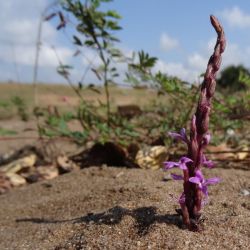
Cowpea witchweed
© Ton Rulkens Creative Commons
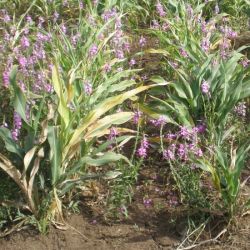
Striga in sorghum
© ICRISAT Creative Commons
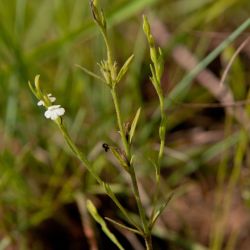
Striga white flower
© Bahamut Chao Creative Commons
'Witchweed' is the common name loosely applied to up to 30 different species in the genus Striga. These species are native to semi-arid and tropical Africa, and are recorded in more than 40 countries.
All witchweed species are small parasitic herbs. Three species are major pests of grain crops in Africa, where they cause an estimated $7 billion in damage each year. Witchweed species rank as some of the world's worst agricultural weeds.
Non-native witchweed species are currently not found in Australia but have the potential to become costly invasive species in Queensland. They are prohibited invasive plants under the Biosecurity Act 2014.
Scientific name
Striga spp.
Other names
- Parasitic witchweeds
Similar species
Description
- The herbs grow to about 30cm tall.
- Leaves are 6–40mm long and 4mm wide, with tapered pointed tips.
- Flowers are 5–8mm long.
- Flowers can be red, pink, white, yellow, orange or purple.
- Capsule fruit are 5-sided, 4mm long and 2mm wide.
- Seeds are very small and can persist for 15 years.
3D model
- View the 3D model of red witchweed to help you identify this plant. You can magnify the image and manipulate the view to inspect the plant from every angle.
Habitat
- Prefer semi-arid savannas and grasslands, generally in tropical areas but sometimes in subtropical and warm temperate areas.
- Grow on roots of other plants.
Distribution
- Non-native Striga species are currently absent from Queensland but have the potential to affect significant areas.
Life cycle
- Seeds only germinate when close to roots of a suitable host.
- Some species only emerge from below ground to flower (hence the name 'witchweed').
- Seeds remain viable in soil for up to 15 years.
Plants affected
- Grain crops
- maize
- millet
- legumes
- rice
- sugar cane
- sorghum
Impacts
Economic
- Heavy infestations can reduce grain crop yields by up to 70%.
- Infestation can lead to export grain being rejected.
- The pests affect maize, millet, legume crops, rice, sugar cane and sorghum.
- Witchweed species have the potential to become serious pests if introduced or cultivated as ornamentals.
- The United States has spent more than $250 million on eradication from the Carolinas.
How it is spread
- Seeds spread by wind, water, soil movement, feet, fur or feathers.
- Seeds can also spread via imports such as contaminated grain/pasture seeds and soil that has adhered to imported machinery.
Prevention
- Find out how farmers can prevent weed spread.
- Find out how gardeners and outdoor enthusiasts can prevent weed spread.
Control
- Before undertaking any preventative or control actions, contact us online, by phone or in person.
Legal requirements
- Witchweed species are prohibited invasive plants under the Biosecurity Act 2014. You must not:
- keep them
- move them
- give them away
- sell them
- release them into the environment.
- You must not take any action that is reasonably likely to exacerbate the biosecurity threat posed by witchweed species.
- You must take any action that is reasonably likely to minimise the biosecurity threat posed by witchweed species.
- You must report any sightings immediately using 1 of these methods:
- Report online.
- Phone Biosecurity Queensland on 13 25 23.
- Phone the Exotic Plant Pest Hotline on 1800 084 881.
If you do any of these, penalties may apply.
Further information
- Contact us online, by phone or in person.
- Check the red witchweed identification guide (PDF, 1.3MB).
- Read the witchweed risk assessment (PDF, 1.2MB).
- Learn how to come clean, go clean.
- Find out about on-farm biosecurity.
- Read more about red witchweed.
- View the red witchweed 3D model.