
Redwood
Alert
Be on the lookout for redwood and report any sightings within 24 hours.
Reporting options
- Report online.
- Phone Biosecurity Queensland on 13 25 23.
- Phone the Exotic Plant Pest Hotline on 1800 084 881.
- Contact your local government.
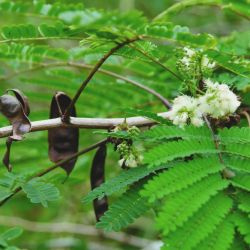
Redwood flowers, leaves and pods
© Queensland Government
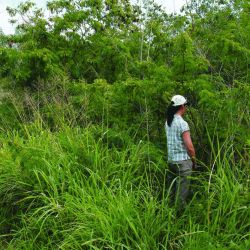
Redwood plant form
© Queensland Government
Native to the Caribbean and tropical South America, redwood is a bushy shrub. Originally imported and planted in northern Queensland as a cattle feed, redwood escaped cultivation and invaded surrounding land. It forms dense thickets that replace native vegetation.
Scientific name
Acaciella glauca
Other names
- Wild dividivi
Description
- Bushy shrub 1.5–6m tall.
- Flowers are white, oblong, on a short spike.
- Leaves are green, 4.5–13cm long, consisting of 3–9 pairs of opposite primary segments, each with 18–24 pairs of leaflets.
- Branches are deep red.
- Seed pods are oblong, 6cm long, 1–1.5cm wide.
- Pods contains 5–8 seeds.
- Seeds are dark brown, 3–5mm long, 3mm wide.
Habitat
- Prefers open (disturbed) habitats in tropical rangelands.
Distribution
- Found in small populations around Ingham and Proserpine.
Life cycle
- Flowering occurs throughout most of the year in northern Queensland.
- Reproduces from seeds.
Plants affected
- Native plants
Impacts
Environmental
- Invades open tropical rangelands, especially along roadsides.
- Forms dense thickets, replacing native vegetation.
How it is spread
- Seeds spread by cattle, wind and floodwater.
Prevention
- Find out how farmers can prevent weed spread.
- Find out how gardeners and outdoor enthusiasts can prevent weed spread.
Control
- Before undertaking any preventative or control actions, contact us online, by phone or in person.
Legal requirements
- Redwood is a category 2, 3, 4 and 5 restricted invasive plant under the Biosecurity Act 2014. You must not:
- move it
- keep it
- give it away
- sell it
- release it into the environment.
If you do any of these, penalties may apply.
- You must take all reasonable and practical measures that are under your control to minimise the biosecurity risks associated with dealing with redwood. This is part of your general biosecurity obligation.
- You must report any sightings within 24 hours using 1 of these methods:
- Report online.
- Phone Biosecurity Queensland on 13 25 23.
- Phone the Exotic Plant Pest Hotline on 1800 084 881.
- Contact your local government.
- Each local government must have a biosecurity plan that covers invasive plants in its area. This plan may include actions to be taken for redwood. Some of these actions may be required under local laws. Contact your local government for more information.
Further information
- Contact us online, by phone or in person.
- Read the redwood fact sheet.