
Paperbark thorn
Alert
Be on the lookout for paperbark thorn and report any sightings immediately.
Reporting options
- Report online.
- Phone Biosecurity Queensland on 13 25 23.
- Phone the Exotic Plant Pest Hotline on 1800 084 881.
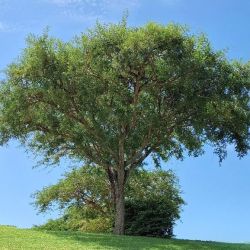
Paperbark thorn growth habit
© Queensland Government
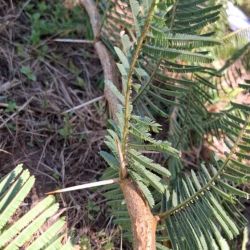
Large sharp spines and bipinnate leaves of paperbark thorn
© Queensland Government
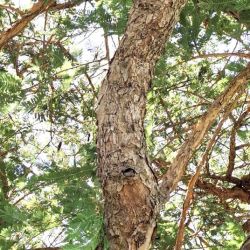
The bark pattern on the trunk of paperbark thorn
© Queensland Government
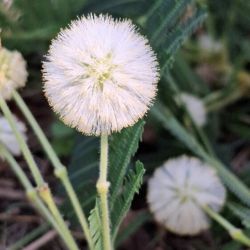
A ball-shaped flower of paperbark thorn
© Queensland Government
Native to southern and western Africa, paperbark thorn is a quick-growing tree with yellow-white flowers and large spines. It can form dense thickets that can replace pasture and native species. The leaves and pods of paperbark thorn contain prussic acid, which can poison livestock.
Paperbark thorn has been detected in gardens in Queensland. If it escapes cultivation and spreads, it could become a costly pest of grazing land across substantial areas of Queensland.
A related species, prickly acacia (Vachellia nilotica), has infested more than 6 million hectares and costs Queensland's grazing industry over $5 million per year in lost production and management costs. There is an opportunity to eradicate paperbark thorn and prevent it from becoming a major problem like prickly acacia.
Scientific name
Vachellia sieberiana
Similar species
Description
- This quick-growing tree can grow up to 17m tall.
- It has a spreading flattened to rounded crown.
- The bark is rough and cream-tan to red-brown. The outer layers peel away in thin papery flakes to reveal a yellowish inner layer.
- The flaky, papery bark looks like that of native melaleuca paperbarks.
- Leaves are bipinnate, with 8–20 pairs of pinnae and 13–45 pairs of leaflets per pinna.
- Leaflets are up to 2.8mm long and 0.9mm wide.
- Young shoots may be densely covered with golden yellow velvety hairs.
- Spines are white, straight, strong and arranged in pairs.
- Flowerheads are yellow-white and spherical. They can be single or clustered on slender stalks.
- Pods are thick, flattened, straight to slightly curved and up to 15cm long.
Habitat
Prefers riparian areas, grasslands, woodlands and savannas in tropical and subtropical areas.
Distribution
Currently restricted to gardens but could spread over large areas of tropical and subtropical savannas of Queensland if it escapes cultivation.
Life cycle
- Plants reproduce from seeds.
- Seeds are protected by a hard seed coat.
- Flowers are pollinated by insects.
Impacts
Environmental
- Trees form dense thickets that could replace native plants and pastures.
- Long-lived seeds make this plant difficult to control once established.
- The species is invasive in its native range, where it can encroach on grassland habitat and lead to a loss of grassland habitat and pasture.
Economic
- Trees can form dense, thorny thickets in rangelands.
- Leaves and pods contain prussic acid, which can poison livestock.
How it is spread
Seeds are spread by animals (including livestock) and water.
Prevention
- Find out how farmers can prevent weed spread.
- Find out how gardeners and outdoor enthusiasts can prevent weed spread.
Control
Before undertaking any preventative or control actions, contact us online, by phone or in person.
Legal requirements
Paperbark thorn is a prohibited invasive plant under the Biosecurity Act 2014. You must not:
- keep it
- move it
- give it away
- sell it
- release it into the environment.
If you do any of these, penalties may apply.
- You must not take any action that is reasonably likely to exacerbate the biosecurity threat posed by paperbark thorn.
- You must take any action that is reasonably likely to minimise the biosecurity threat posed by paperbark thorn.
- You must report any sightings immediately using 1 of these methods:
- Report online.
- Phone Biosecurity Queensland on 13 25 23.
- Phone the Exotic Plant Pest Hotline on 1800 084 881.
Further information
- Contact us online, by phone or in person.
- Read the paperbark thorn alert.