
Reviewing the Burnett Basin water plan
Water plan review status
Step 2: We review feedback and use technical assessments to develop the draft new water plan.
The process to review and replace the current Burnett Basin water plan is underway.
The water plan must be reviewed and updated to ensure the sustainable management of water resources based on the best available science and extensive consultation and to support the region’s unique environment, cultural values and economic growth opportunities.
To give us enough time to do this work, the current Burnett Basin water plan’s expiry date has been extended to 19 April 2027.
Read the:
- Water plan (Burnett Basin) (postponement of expiry) notice 2024
- Impact analysis statement about this postponement.
About the Burnett Basin water plan area
The Burnett Basin water plan area (map) (PDF, 1MB) covers approximately 38,370km2. It is a highly developed region and is home to many environmentally significant plants and animals including the Australian lungfish.
Rivers and creeks in the area are seasonal which means water volume and flow naturally change throughout the year. Major waterways include:
- Burnett River
- Barker Creek
- Barambah Creek
- Boyne River
- Stuart River
- Auburn River
- Three Moon Creek
- Kolan River
- Elliott River
- Gregory River
- Isis River.
Water in the plan area supports towns, industry, tourism and agriculture (including sugarcane and macadamia production) and grazing. It also supports habitat for 5 species of freshwater turtle, platypus and many fish species.
The Burnett Basin contains a number of protected areas of conservation and ecological significance, including Coalstoun Lakes, which is listed in the national directory of important wetlands.
Use the Queensland Globe water plan map (use Google Chrome for best results) to explore the Burnett Basin and its surrounding water plan areas.
How we manage water
As part of the review, we have a chance to reconsider how we manage water in the area.
The Burnett Basin water plan sets the rules for allocation and use of:
- surface water in watercourses (rivers, streams, creeks etc), lakes and springs
- overland flow water
- groundwater.
Public consultation
The first round of public consultation on our list of key topics closed on 28 June 2024.
We asked people to read about the Burnett Basin water plan, along with the below main topics we are considering and reviewing.
-
The water plan includes outcomes which are specific things set out for us to achieve.
We will consider how effective the current plan outcomes are in achieving the strategies of the water plan.
Outcomes will be reviewed by our team and improved using best available science, including updated hydrological modelling and feedback from the community.
We will develop cultural outcomes that reflect the local Aboriginal peoples and Torres Strait Islander peoples’ values, aspirations and uses of water with First Nations’ representatives.
-
Measures and strategies are the details we use to guide water management.
The water plan includes strategies for managing water across 19 subcatchments in the basin. This includes:
- 5 water supply schemes operated by Sunwater
- overland flow water in the Coastal Burnett overland flow area
- groundwater in 6 groundwater management areas.
We will be considering what measures and specific actions we should include in the new plan to improve how water is managed.
-
Objectives and performance indicators set the boundaries for acceptable water management changes.
They include:
- water allocation security objectives
- environmental flow objectives.
Performance indicators are statistics generated by a hydrological model for the objectives. Any water management changes must meet the objectives.
We will review objectives and performance indicators to meet updated, relevant environmental outcomes and water management arrangements.
-
To develop the new plan, we will complete new:
- ecological assessments
- socioeconomic assessments
- engagement with First Nations peoples
- climate change assessments.
Accumulated scientific knowledge on the water requirements of ecosystems will be used to inform the new water plan. We will complete new hydrologic assessments of surface water and groundwater.
We will consider climate change information in developing the new plan. This will tell us how water availability has changed and evaluate possible future impacts of climate change to water availability in the region.
Read in detail how we manage climate change risks.
View the projected climate change impacts in the Burnett Basin by reading Queensland's water plans in a variable and changing climate report (PDF, 19MB).
Eight key themes that consider the major scientific areas required for sustainable management and allocation of water resources for water planning science are detailed in our Water planning science plan (PDF, 9.9MB) and our storymap.
-
First Nations peoples have a significant and deep connection to land and waters.
With this comes a wealth of cultural knowledge that can be used to better protect and manage natural water resources across the plan area.
During the water plan review, we are engaging with First Nations peoples to ensure we have a better understanding of cultural water needs, and social and economic aspirations. This engagement will enable the development of appropriate water plan outcomes, measures and strategies.
The Reframing relationships with First Nations peoples – Our plan for being and working together 2023-2026 (PDF, 17MB) is our commitment and path forward to how we will reframe and build stronger relationships with Aboriginal peoples and Torres Strait Islander peoples.
-
The Queensland water legislation administers a range of water entitlements and authorisations which are important to consider in the review. In the Burnett Basin, these entitlements include water licences and water allocations.
Entitlement type Number of entitlements Volumes (ML) Surface water licences 593 34,605* Underground water licences 318 44,166 Supplemented surface water allocations 4,810 502,249 Unsupplemented surface water allocations 442 48,456 Unsupplemented underground water allocations 835 62,406 Interim water allocation 157 19,528 *Around 272 entitlements require amendment to state a volume.
Water licences
A water licence is an authority to take water and/or interfere with the flow of water (for example a weir interferes with a watercourse). It is usually attached to a parcel of land and subject to an expiry.
Water allocations
A water allocation authorises the holder to take a certain volume of water from a particular water source, such as a watercourse or aquifer. Allocations have a separate title, similar to a land title, and they can be bought and sold on the water trading market. They can also be used as a mortgageable asset.
Water allocations provide long-term security because:
- they do not have an expiry date
- they specify a nominal volume of water that can be taken which is considered as the allocation’s long-term water share.
We will consider the options for converting existing entitlements to water allocations in various locations such as:
- the Three Moon Creek water supply scheme
- Avondale Water Board area of the Bundaberg water supply scheme
- part of the Coastal Burnett groundwater management area (PDF, 1.2MB) ('Area B' in this map)
- parts of the Elliott, Gregory and Isis subcatchments.
Many water licence holders in the Burnett Basin take water directly from the watercourses (their water is not supplied by Sunwater). This is called unsupplemented water use. We will consider changing these unsupplemented water licences so they state a volume, rate of take and purpose for the water use.
Licences with a volume, rate of take and purpose provide improved transparency and management of water by establishing clearly defined shares of the available water resource. They also provide improved security, equity and certainty for water users.
-
Water sharing rules are used in water supply schemes, surface water management areas, and 2 groundwater management areas (Barambah Creek and Coastal Burnett). These rules are used to provide transparency to water users about how water is shared in these areas. This can also include defining and announcing the percentage of entitlement available that can be taken in a water year.
Water trading allows:
- current water users to buy and sell water to suit their business
- new businesses to buy water.
In Queensland, water can be traded either permanently or temporarily on a seasonal basis (called a 'seasonal assignment').
This is a chance to review current water sharing and trading rules.
-
Each water plan includes unallocated water. This means that water is available to meet future demand without affecting the water available for current water users, cultural values or the environment.
The Burnett Basin water plan currently includes 3 types of unallocated water reserves:
- 2,000 megalitres (ML) held as a general reserve for any purpose
- 2,000ML held as a strategic reserve for State or Indigenous purposes
- 25,845ML held as strategic water infrastructure reserve to support specific water infrastructure projects.
During this review, we will assess the demand for additional water supplies in the region. We will look at what:
- volumes
- reserve types
- arrangements or conditions
for unallocated water are needed. We want to make water available for the future that support cultural outcomes, economic growth and town water supply.
Timeline
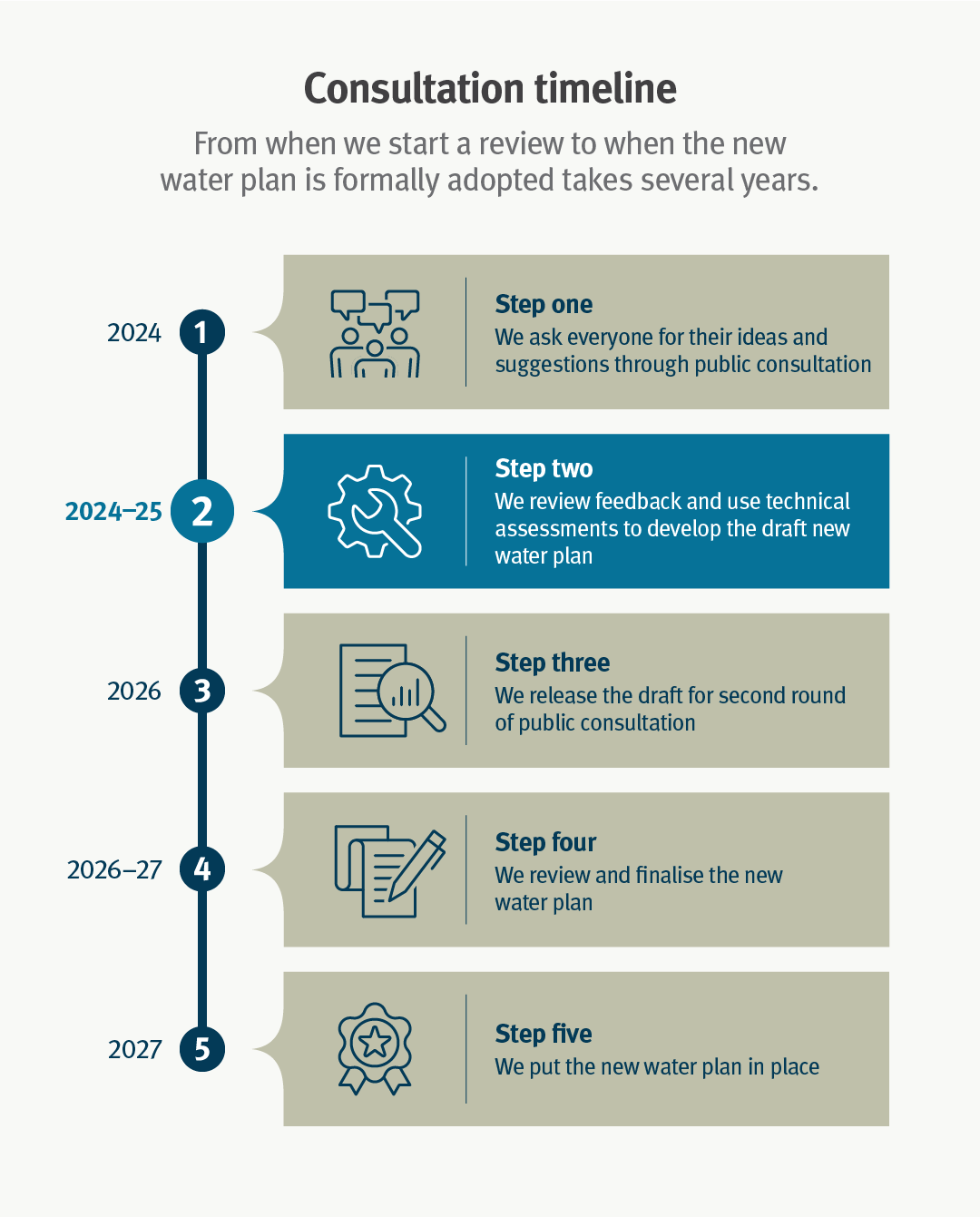
From when we start a review to when the new plan is formally adopted takes several years.
Learn more about the 5 steps of the water plan review process.
Current status
The status of this review is step 2. To help us draft a new water plan, we are:
- reviewing feedback received from the public consultation
- continuing consultation
- doing technical assessments.
What’s next
Step 3: We'll release the draft water plan for a second round of public consultation anticipated in 2026.
Step 4: We'll review feedback received in step 3 and finalise the replacement water plan anticipated in 2026-27.
Step 5: The new water plan will be in place after appropriate approvals which is anticipated in 2027.
Enquiries
- Phone: 1800 131 531 (toll free)
- Email: WaterPlanningBurnett@dlgwv.qld.gov.au
Also consider…
- Understand the process to review and replace a water plan.
- Watch our What is a water plan? video.
- Read the latest Minister's performance assessment report (PDF, 6MB).
- Read the current rules for water management:
- Water plan to be read in conjunction with the Burnett transitions from ROP to water plan (PDF, 7MB)
- Water management protocol (PDF, 763KB)
- Water supply scheme operations manuals.