
Express your interest in Burdekin Basin general reserve unallocated water
Current status
We are preparing to release unallocated water in December 2026 to support agriculture and other industries in the Belyando-Suttor subcatchment.
We are seeking feedback during September and October 2026 to help shape the release process.
Following the expression of interest (EOI) process, we are preparing to release 130,000ML of general reserve unallocated water within the Belyando-Suttor subcatchment E (see map below) of the Burdekin Basin water plan. The water may be used for any purpose permitted under the plan.
We encourage you to apply early when water is released in December. Applications will be assessed as they are received. Successful applicants will receive an offer, and earlier applications may allow for water to be granted sooner.
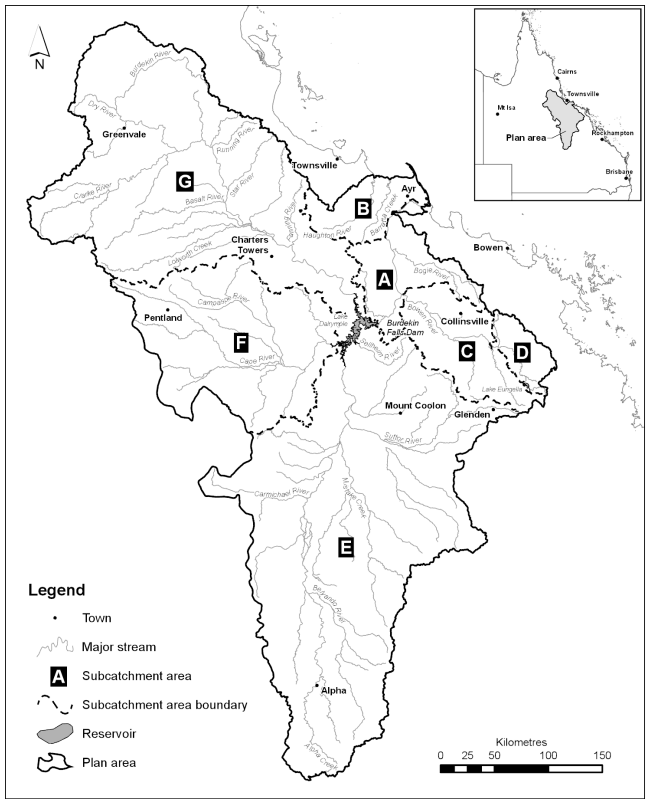
Map of Burdekin Basin water plan area showing subcatchment areas.
Provide feedback on the release
We're seeking feedback on the proposed release of unallocated water and the water products that may be offered. Your feedback will help inform the final release process.
We will hold online information sessions in late September and face-to-face sessions in October, where you can learn more about the proposed release process and provide input on draft water products.
If you have expressed interest in new water or are an existing entitlement holder, we will email you with information about upcoming sessions.
You can still express your interest in new water. Complete the online form to stay informed about engagement opportunities and the upcoming water release.
We encourage all landholders with an interest in new water to get involved. If you are unable to, you can still have your say. Email uaw.north@dlgwv.qld.gov.au and we'll contact you to discuss your interest and answer any questions.
Water products to be made available
Based on demand identified through the EOI process, water will be available as:
- watercourse water (with a passing flow condition)
- and
- overland flow water.
Volume limits will apply to water products and catchments within the Belyando-Suttor subcatchment to provide all interested parties with a fair opportunity to apply for a share of the water being released.
Check approvals and authorisations
Before applying for unallocated water, understand what other approvals or authorisations may be required.
Watercourse determinations
To identify which water product you can apply for, you'll need to know if your proposed location of take is a watercourse or a drainage feature.
The watercourse identification map will help you to search for your property, the location of take and identify the water feature(s) at that location. It will help you distinguish between:
- watercourse water—from features mapped as a 'watercourse'
- and
- overland flow—from features mapped as a 'drainage feature'.
If the watercourse identification map does not specify if the feature is a watercourse or drainage feature, email WaterServicesNorth@dlgwv.qld.gov.au to request a watercourse determination from us as soon as possible.
Development approval
In addition to obtaining a water licence to take water, you may also require development approval for works associated with water take activities, including:
- construction of new overland flow storages
- alterations to existing overland flow storages.
Read more about development assessment for water-related operational works.
Vegetation management approvals
Under the Burdekin Basin water plan, if you are applying for unallocated water to irrigate land, you are required to demonstrate that you have the availability of land without remnant vegetation.
The Department of Natural Resources and Mines, Manufacturing and Regional and Rural Development (DNRMMRRD) are responsible for vegetation management information, advice, and how to obtain vegetation approvals. Contact DNRMMRRD via:
- phone 13 58 34
- email vegetation@nrmmrrd.qld.gov.au.
Waterway barrier work approvals
If you are proposing to construct a dam on a drainage feature, you may trigger an approval under the waterway barrier works legislation.
The Department of Primary Industries (DPI) is responsible for waterway barrier works information, advice, and approval requirements. Recent updates have been made to the accepted development requirements. Contact DPI via:
- phone 13 25 23
- email planningassessment@dpi.qld.gov.au.
General approvals advice
The State Assessment and Referral Agency (SARA) can act as a centralised contact to provide free information and advice on relevant legislative requirements specific to your project.
We recommend you request free pre-lodgement advice from SARA on relevant approvals if these are triggered. Contact the relevant SARA office based on your local government area:
- Barcaldine Regional Council, Isaac Regional Council, Whitsunday Regional Council
- Mackay, Isaac and Whitsunday Regional SARA Office
Level 11, 44 Nelson Street, Mackay
Phone: (07) 4898 6888
Email: MIWSARA@dsdilgp.qld.gov.au
- Mackay, Isaac and Whitsunday Regional SARA Office
- Charters Towers Regional Council
- North and North West Queensland Regional SARA Office
Level 11, 445 Flinders Street, Townsville
Phone: (07) 4758 3423
Email: NQSARA@dsdilgp.qld.gov.au
- North and North West Queensland Regional SARA Office
Council approvals
If you are considering applying for unallocated water, we also strongly encourage you to consult with your local council to determine whether any planning or statutory approvals are required for your project.
Enquiries
- Email: uaw.north@dlgwv.qld.gov.au
- Phone: 1800 822 100
Also consider...
- Learn more about unallocated water.