
Asian green mussel
Alert
Asian green mussel has been detected in Weipa, Far North Queensland. Surveillance activity is underway to determine the extent of the outbreak.
Be on the lookout for Asian green mussel and report any unusual clusters of mussels or unfamiliar marine organisms immediately.
Help stop the spread of this pest by thoroughly cleaning and drying boats, equipment and gear after use.
Reporting options
- Report online.
- Call Biosecurity Queensland on 13 25 23.
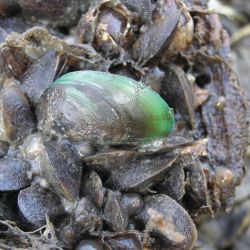
Asian green mussels
© Queensland Government
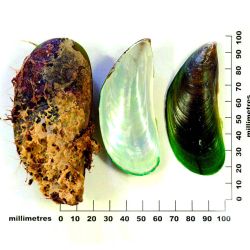
Asian green mussels with a size scale
© Queensland Government

A cluster of Asian green mussels
© Queensland Government
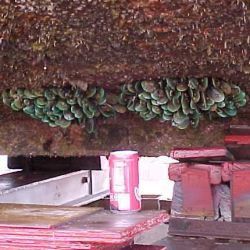
A cluster of Asian green mussels
© Queensland Government

Eight Asian green mussels of different sizes with a size scale
Northern Territory Government
Asian green mussel is an invasive and prohibited marine pest. It is on the National priority list of exotic environmental pests, weeds and diseases and the Australian priority marine pest list.
Although Asian green mussel has been detected in Weipa, eradication and surveillance activities are ongoing to prevent it becoming established in the environment. The pest is considered exotic to Australia and early detection is critical to stopping its spread.
Asian green mussel can be introduced via a ship's ballast water, as biofouling on boat hulls and through internal seawater systems. These invasive mussels can spread rapidly, outcompete native species and disrupt delicate ecosystems. They are fast-growing, able to tolerate a wide range of conditions and form dense populations of up to 35,000 individuals per square metre on a variety of hard marine structures.
Scientific name
Perna viridis
Similar species
- Septifer bilocularis , Perna canaliculata (New Zealand green mussel)
Description
- These large mussels often grow to 10cm and occasionally 18cm long.
- Juveniles have bright-green shells.
- Adults tend to retain the green colour along the growing edge only, developing an olive or brown colouration nearer to the attachment point.
- The shell exterior is smooth with concentric growth rings and a finely pitted ridge for ligament attachment.
- The shell interior is smooth and iridescent pale blue to green.
- The shell beak has interlocking teeth (1 in the right valve, 2 in the left).
- The posterior is wavy, and the adductor muscle is large and kidney-shaped.
Habitat
- Prefers warm estuarine (salty) waters.
- Can survive for short periods in cool or less salty waters.
- Prefers hard surfaces.
- Settles mostly in depths of 0–10m.
Distribution
- Localised incursions detected in the port of Weipa and surrounding waterways.
- Not yet considered established in Queensland.
Life cycle
- Fertilised eggs form larvae, which can exist in plankton for up to about 2 weeks before settling.
- Adults develop after settling and live for 2 to 3 years.
Impacts
Environmental
- Outcompetes native species.
- Fouls hard surfaces, including vessel hulls, seawater systems, industrial intake pipes, wharves, artificial substrates and buoys.
- Accumulates high concentrations of toxins and heavy metals.
Economic
- Fouls hard surfaces, including vessel hulls, seawater systems, industrial intake pipes, wharves, artificial substrates and buoys.
Social
- Accumulates high concentrations of toxins and heavy metals, which can cause shellfish poisoning if eaten by humans.
Control
- Slipway operators, vessel inspectors and vessel owners should thoroughly check, clean and, where possible, dry vessel hulls and niche areas such as internal seawater systems.
- Thoroughly clean and dry equipment and gear after use.
- If you see anything that looks out of place, such as clusters of mussels or unusual marine organisms, report it online or phone Biosecurity Queensland on 13 25 23.
Legal requirements
- Asian green mussel is a prohibited marine animal under the Biosecurity Act 2014. You must not import or in any way deal with Asian green mussel.
- You must report any sightings of Asian green mussel to Biosecurity Queensland immediately.
- By law, everyone has a general biosecurity obligation to take all reasonable and practical steps to minimise the risks of invasive animals such as Asian green mussel. If you suspect you have seen this pest, take steps to minimise its spread until you receive advice from an authorised officer.
Further information
- Read the Asian green mussel fact sheet.
- Find out more about the Asian green mussel outbreak and response.
- Contact us online, by phone or in person.