
Step 1 – Start your workforce planning
Workforce planning can help you accomplish your short- and long-term business goals. That could be to grow or sell your business or simply achieve another successful year of operation.
Our workforce planning resources were designed to guide you through the process without assistance, but if you need further advice, speak to your business advisor or contact an Industry Workforce Advisor.
Quick facts
- Workforce planning can be successful without being complicated.
- The process is the same for any size business in any industry.
- Start with the end in mind. Be clear about what you want to achieve.
- Collecting data (information) doesn’t have to be complex.
- A workforce plan is not a static document. Once implemented, you can and should update and monitor it regularly.
View the 4 stages of workforce planning.
About workforce planning
Workforce planning is about planning to achieve your business goals by having the right people, with the right skills, in the right roles, at the right time and at the right cost.
The purpose of workforce planning is not to decide what you will do in the future, it is about determining what you can do now to be best prepared for the future.
Small businesses often rely on the knowledge and skills of a small number of employees. If an employee leaves, it can result in a loss of productivity and important business knowledge. New business opportunities can also require your workforce to change.
Find more general information about workforce planning.
The workforce planning process
There are 5 key steps in workforce planning:
- Identify your business goals
- Know your current workforce
- Forecast your future business needs
- Develop strategies and actions to address your workforce gaps
- Create your workforce plan.
A good workforce plan will:
- give you a solid understanding of your current workforce and how to prepare your workforce for the future
- help you retain staff and compete for the workforce you need now and, in the future
- help you manage your workforce risk and focus your energy on the right things.
Where to start
Undertaking workforce planning for the first time can feel daunting, but it doesn’t have to be. In fact, you may already be doing some workforce planning.
Firstly, you’ll need to consider:
- the timeframe you’re planning for (e.g. 1 month, 12 months, 3 years)
- who to include in the process.
Resources
Use the checklist workforce planning inventory: am I ready? to decide if you’re ready to start the workforce planning process.
You can also find guidance in the:
- Workforce Planning Connect toolkit for small- to medium-sized businesses
- Workforce Planning Connect workbook for micro businesses and small enterprises. This workbook has also been translated
Who to include in workforce planning
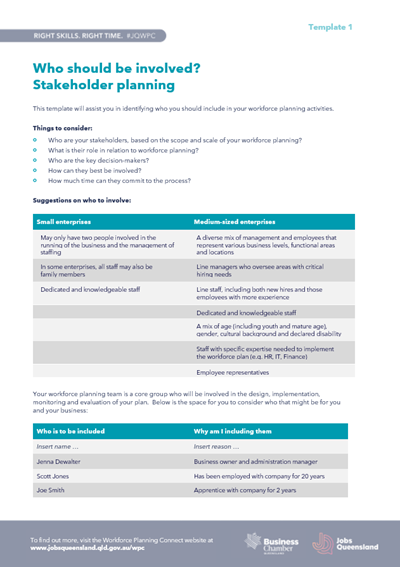
Your workforce planning team is a core group who’ll be involved in designing, implementing, monitoring and evaluating the workforce plan.
If you’re a micro business, this may only be 2 people. If you’re a larger organisation, this could include senior leaders or the human resources (HR) team.
When deciding who to include, consider:
- Who are your stakeholders, based on the scope and scale of your workforce planning?
- Why are you including them? What is their role in workforce planning?
- Who are the key decision-makers?
- How can they be best involved and what time can they commit?
- Will they be committed to supporting and implementing the actions of the workforce plan?
Consider including:
- a diverse mix of management and employees that represent various business levels, functional areas and locations
- line managers who oversee areas with critical hiring needs
- line staff, including both new hires and those employees with more experience
- a mix of age (including youth and mature age), gender, cultural background and declared disability
- dedicated and knowledgeable staff
- staff with specific expertise needed to implement the workforce plan (e.g. HR, IT, finance etc)
- union representatives.
Resource
Complete the template who should be involved (template 1) to help you identify who to include in your workforce planning activities.
Workforce planning and your business plan
To maximise the benefits of workforce planning, you should integrate it into your business planning.
Your business plan can include a workforce plan covering:
- employee skills/occupations
- number of employees
- training and development
- location
- workforce costs.
Integrating your workforce plan into your business planning can help you:
- know who is in your workforce, what they do, the skills they have and the skills they need to develop or improve
- identify where you are most at risk of losing productivity and continuity
- plan for future workforce requirements
- know if you need to improve your retention strategies
- engage your workforce, increase job satisfaction and create goodwill through improved employee relations
- build workforce skills to support business activities and achieve your business goals
- plan for new and emerging skills or roles through specific recruitment, training activities or collaboration with other businesses
- respond quickly and strategically to change
- link your workforce initiatives to your financial and business planning
- improve efficiency and productivity.
Get started checklist
- I understand what workforce planning is.
- I know why workforce planning is important.
- I know who I should include when undertaking a workforce plan.