
Step 2 – Gather the information for your workforce plan
A clear and well-thought-out workforce plan will support your current and future business goals. Gathering relevant workforce information and data will help you create an effective workforce plan.
This section will help you identify the information you need and where to find it. It follows the first step of the Workforce Planning Connect guided process – get started with workforce planning.
Collecting the information
Collecting workforce information and data doesn’t have to be complex, and workforce planning can be successful with limited information.
You likely already have access to a lot of useful information. For example, you can find most of the basic data in your payroll system – but consider the quality and reliability of the information if you use it to base your workforce planning decisions on.
If you’re not confident about the quality and reliability, you can:
- make a start with what you have
- develop a plan to increase the accuracy and integrity of data collection.
Quantitative and qualitative data
Quantitative data may include:
- number of positions that are filled, vacant and budgeted for
- number of resignations
- number of positions you've recruited for (categorised by type of role and reason it was needed)
- the diversity of your workforce in terms of
- age (including youth and mature age)
- gender
- cultural background
- declared disability.
Qualitative data may include:
- learning and development needs
- level of employee engagement
- work-life stage of employees (new to the workforce, close to retirement, etc)
- employees’ career aspirations
- employees’ intentions to stay or leave.
Identify your business goals
To be in the best position to have the right combination of people, skills and employment types across your workforce, think about your business goals and how you will achieve them.
Consider the timeframe of your workforce plan when setting your goals.
Business goals tend to relate to one of the following:
- growth
- decline
- maintain
- diversify.
Each goal has its own challenges and obstacles to success.
Resource
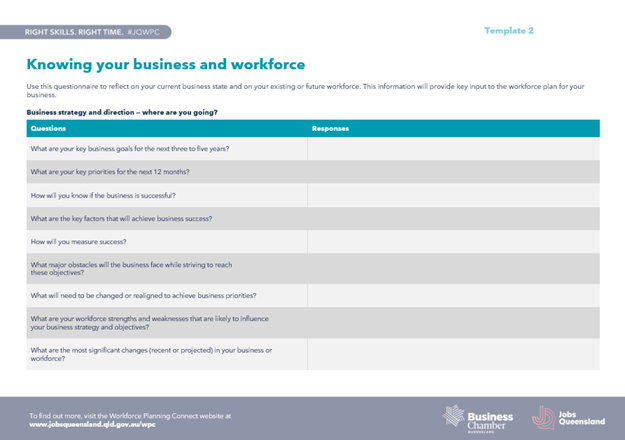
Complete the questionnaire on knowing your business and workforce (template 2) to explore your business goals and how you’ll reach them.
What your workforce looks like now
Using the most recent information you have, workforce planning can help you create a picture of your workforce supply—the size and make-up of your current and future workforce. It considers employee turnover through resignations and retirements, and how these affect the size of your workforce over time.
You may already have information and data that allows you to answer the following questions:
- What are your workforce segments based on? For example
- roles, or job families (groups of roles that perform similar tasks)
- employment status (full-time, part-time, casual)
- business unit.
- What are your employees’ key skills, occupations or qualifications?
- How many staff do you have? For example
- permanent – full-time or part-time (e.g. 0.6)
- temporary – casual, on contract, or employed through a labour hire agency.
- What is your workforce turnover rate? Look at
- resignations (anticipated turnover based on previous resignation rate)
- retirements (workers approaching 60+ years).
- What are your current work practice arrangements? For example
- hours of work are fixed or flexible, or work is done in shifts
- type of leave offered (e.g. annual, sick or other types of leave).
- What is the demographic profile of your workforce? Look at
- occupation/position
- location (if your business has more than one location)
- length of service
- diversity statistics including
- gender
- age (including youth and mature age)
- cultural background
- declared disability.
- What is the current workforce cost? This includes
- fixed costs, such as
- wages/salary (including superannuation, leave loading, etc)
- overhead costs
- variable costs (e.g. training).
- fixed costs, such as
Resources
- Read the fact sheet on calculating your current turnover to learn how to calculate workforce turnover and why it’s important to monitor your turnover. You can also use our staff turnover ratio calculator.
- Use the current workforce data and profile template (template 3) to capture the key data and information.
What your future workforce needs to look like
The answer to this question may not be what you expect. The workforce planning process can help you estimate the number and types of employees you’ll need to reach your business goals. A workforce plan will enable you to answer the following key questions:
- What types of skills will be required?
- How many jobs will be required?
- How many people will be required for each role?
- What roles
- will be hard to fill?
- are essential?
- require skills that can take a long time to develop?
You may already have information and data that allows you to answer the following questions:
- What factors will drive your future workforce needs? One or more of these scenarios may fit your business plan
- Business growth – increase in demand for products and services
- What skills/occupations will be needed?
- When will these skills/occupations be needed? Will there be a continuous need or a need to cover peaks and troughs (e.g. leave)?
- What locations will they be needed in?
- How many of these skills/occupations will be needed?
- Maintaining current business size and operations
- Which skills/occupations will be needed?
- Will there be any changes to these skills/occupations?
- Business downsizing or shift into new areas – a decrease in product line or service
- Which skills/occupations will be affected?
- How many employees will be affected?
- What is the timing of the impact?
- What locations will this occur at?
- Business growth – increase in demand for products and services
- What skills and capabilities that will be required
- When skills need to change?
- What will the impact on affected roles will be?
- Do you need to recruit new staff? And what should their employment status be? For example
- permanent – full-time or part-time (e.g. 0.6)
- temporary casual, on contract, or employed through a labour hire agency.
- Can you train existing staff?
- To maintain adequate skills and capabilities?
- Should the level of skills need to increase, decrease or remain stable?
- When new ways of working are required (e.g. introduction of new technology)?
- Is it required across the whole business?
- Is a specific role affected?
- When skills need to change?
- What are the volumes and timings of these impacts?
- What is the availability of these skills/occupations in the existing and external workforce?
- Are they difficult to find?
- Do you expect that they will be harder to find in future?
- What are the expected workforce costs? This includes
- fixed costs, such as
- wages/salary (including superannuation, leave loading, etc)
- overhead costs
- variable costs (e.g. training).
- fixed costs, such as
Resource
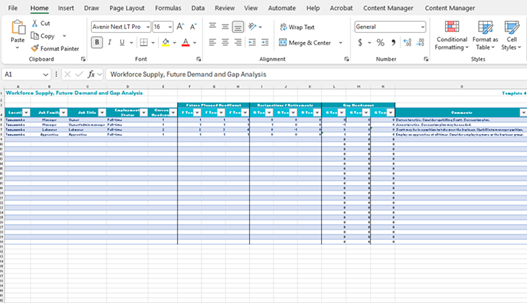
Use the template for workforce supply, future demand and gap analysis (template 4) to capture the key data and information and analyse your future skills gaps.
What to do with this data
Once you’ve gathered your workforce data and information, you can:
- compare your current workforce and skills supply to your future demand
- identify your workforce and skills gaps
- start to identify strategies and put actions in place to close your workforce and skills gaps.
Information gathering checklist
- I understand what I need to do to prepare to do workforce planning.
- I have thought about my business direction and workforce considerations.
- I have completed my current workforce profile.
- I know how to calculate workforce turnover, and why it’s important to monitor it.