
Step 1 – Prepare your business for change
On this page
Turn on this option to focus on essential topics and actions in this step and hide optional parts.
- Introduction to change
- Prepare yourself for change
- Prepare yourself for change – using the personal business model canvas
- Personal business model canvas
- Prepare your team
- Storytelling canvas
- Prepare your business
- Prepare your business for change – using the business model canvas
- Business model canvas
Change in the world around your business can happen quickly and without warning. It can be time-consuming and expensive to adapt your operations once you realise your business is no longer meeting the needs of your customers and has fallen behind your competitors. That's why it's critical to prepare for, understand and know how to manage change.
Start by understanding where you are today – both for yourself personally as a business owner, and for your business. You'll be better prepared to adapt your business in the smartest possible way if you clearly understand how you and your business operate right now.
This step will help you understand:
- the role you play in your business
- how to better understand your business operations.
Introduction to change
Essential
-
Always look for ways to adjust and develop your business in response to change.
When the external environment around your business changes, you'll need to adapt the internal elements of your business as well. These elements make up your business model.
If you can successfully respond to these external trends with internal changes, you will create value for your customers, and in turn for your business and yourself.
-
The 2 main forces that affect change are:
- external factors, like an economic downturn, new competition and changing customer demand
- internal factors, such as staff development, systems and processes.
Change can also be:
- proactive, where you make the decision to change something you can control, such as your products and services
- reactive, where you are forced to respond to something unforeseen, such as a new regulation in your industry.
-
To best manage change in your business, you must feel confident to make decisions during uncertainty.
This means taking control of the things you can change (internal factors) and accepting there will be things you can't change (external factors).
Planning ahead and researching trends can help you to control how change affects your business.
Why your business might need to change
Changes in the world around you can affect many areas of your business. Consider what your business would do in these scenarios.
-
A global pandemic has hit, and your business storefront needs to close temporarily. Your customers can't access your products and services.
- How can you make sure your customers can still access your products and services?
- How can you retrain and redeploy your staff so they can still support you, and you don't have to let anyone go?
- Can you develop new products and services to meet changing needs and demands of your customers?
-
Your customers are increasingly conscious of the environmental impacts of what they buy. You notice new, successful competitors emerging that focus on providing sustainable products and services.
- How can you make sure your products are meeting the expectations of your customers?
- Are there other areas of your business you can adapt to introduce sustainable practices (e.g. lowering your water and power usage, or managing your levels of waste)?
- How can you better promote the benefits of your products to your customers?
- Do all of your customer segments have the same values, needs and expectations?
-
Your key customer group is university students, but you find out the local campus is closing. Without the university nearby, it's unlikely your regular customers will need to visit your local area anymore.
- What other customer groups live in or visit your local area?
- Will these other customer groups have a need for your products?
- How can you shift your products and services to appeal to new customer groups?
- How will you need to change your communication channels to access different customer groups?
- How can you find out what the university site will be used for next? Is there potential to start developing new products and services for a new market that might use the site's planned facilities?
Prepare yourself for change
Preparing yourself as a business owner or leader is just as important as preparing your team or preparing your business. You must have a pro-change attitude to succeed.
Make the change personal and focus on yourself first. Consider why you're in business, and where you want to go as you work through your change journey. Work out what skills you have and the personal values you bring to your business – this will help you to work out what’s missing and what to focus on.
Watch our video to learn how to complete the personal business model canvas and find out the value you bring to your business.
-
Two. Prepare for change.
In the same way that you might plot your destination into a GPS before setting off on a new journey, preparing for change is a similar process.
Getting your business ready for change starts with preparing yourself for where you want to go, preparing your team and preparing your business.
Start by preparing yourself for change.
How willing are you to shift your own attitude towards being pro change? This is an essential key to success.
To set yourself up for success, it helps to make the change personal by considering why you are in business in the first place and where you want to go.
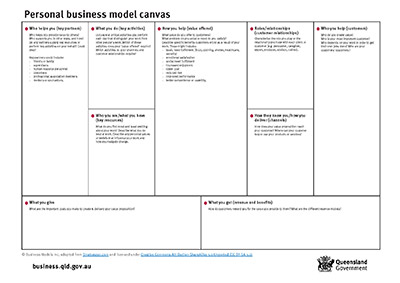
The personal business model canvas is a great tool to help you understand your value and the skills you have to work through change. It will also help you determine your personal goals in a simple and structured way.
The personal business model canvas can help you consider the reason you went into business in the first place.
Use this template to describe who you are. It will help you explore what being in business really means to you.
Work through each of the boxes to answer questions about, one, who you are and what you're good at.
Two, what you do and what's different about your work compared to others.
Three, who you help or who you give value to.
Four, how you help others and what problems you solve for people.
Five, how people know you and how you deliver what you do.
Six, what role or responsibility you play with different clients or customers.
Seven, who you can call on to help you.
Eight, what you get for your work, whether it's a salary or other benefits.
Nine, what you give or what it costs you to deliver your value to others.
Take a moment now to download and complete this tool.
Complete your personal business model canvas
The personal business model canvas will help you:
- understand the skills and values you bring to your business
- determine your personal goals in a simple and structured way.
Download the personal business model canvas template.
This tool is adapted from strategyzer.com and licensed under Creative Commons Attribution-ShareAlike 3.0 Unported (CC BY-SA 3.0).
Prepare your team
Once you're clear on your personal objectives, plan how you're going to prepare your team for change.
Your team could find change to be confronting and intimidating, or exciting and rewarding. It's important to communicate and work together to effectively manage changes as a team.
A positive attitude towards change from you and your team will make your business more resilient and give you a greater chance of success.
To do this, start by explaining:
- the reasons for the change
- the benefits or aim of the change
- how you expect the change process to work
- what you want to achieve.
Complete your storytelling canvas
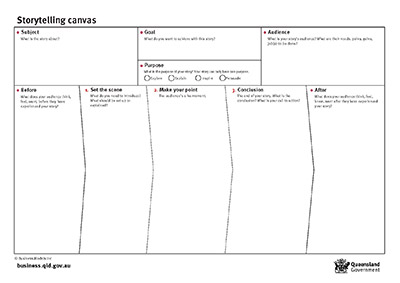
The storytelling canvas will help you:
- prepare your team for change
- construct a story to share knowledge and information that your team can understand and care about
- design your change story in your own time, or collectively with your team, using visual and engaging elements.
Download the storytelling canvas to fill out and save for future reference:
This tool was created by Business Models Inc in the book Design a Better Business (Van Der Pijl, P., Lokitz, J., Solomon, L., Van der Pluijm, E., & Van Lieshout, M. (2016). Wiley.).
Prepare your business
Essential
Prepare your business for change by using the business model canvas. The canvas is a popular tool used by businesses of all sizes around the world and will demonstrate how your business works, and how it might be impacted by change.
Watch our video to learn how the business model canvas can help you explore how your business operates.
-
Three. Business model canvas.
Businesses around the world use the business model canvas to understand, change and improve their operations.
Regardless of the size or industry sector of your business, it provides a 1 page overview of how your business works.
To better understand this tool, let's look at how it works with a business example we can all understand.
This is Penny, and her business is a lemonade stand.
Penny knows that being open to change will build the resilience of her business, whether she's proactively changing or reacting to something unexpected.
Listening to her team and talking with them will help her develop better ideas on adapting her business.
Prepare your business for change by using the business model canvas.
This tool helps you capture how your business currently works, what changes might be needed, how these changes might impact your business model.
A business model is simply a plan for how your business makes money and how all the components of your business work together.
Let's understand Penny's current business model using the business model canvas.
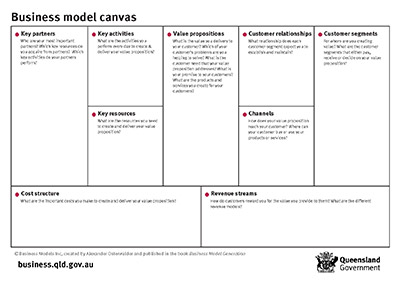
The business model canvas is essentially a 1 page business plan. It's made up of 9 areas that describe who your customers are, how you provide products or services and how you create revenue.
Let's take a closer look at Penny's business.
First up, customer segments, which is a list of all the people or groups your business aims to reach and serve. In this case, neighbours, passers-by and friends.
The value proposition describes what value you provide to each of the customers you've identified. Penny's value proposition is refreshing lemonade.
Channels describe how customers access your products or services and how you deliver your value proposition. Penny sells to her customers using a booth or lemonade stand.
Customer relationship describes how your business establishes and maintains a lasting relationship with your customers. Penny plans to sell to passers by and personal contacts of her and her friends whom she's recruited to help her.
Revenue streams describe the way your business will make money. Penny's revenue stream is charging 1 dollar per cup of lemonade.
Key resources describe the most important assets you'll need to make your business work. Penny's got a lemon tree in the front yard, she's also got her dad's secret recipe. With a table and chairs, some cups and some friends, she's got the key resources she needs.
Key activities describe the most important things you must do to make your business model work. In other words, what do you do every day to run your business? Making lemonade is a key activity, so is operating the lemonade stand and putting up posters around the neighbourhood.
Key partners are the network of suppliers that make the business work. Key partners are other businesses that allow your business to do what it does without having to develop or own everything. For Penny, the sugar, ice and cups come from a supermarket.
Costs describe the underlying expenses to run your business, including the key resources, activities and partners. Penny gets free lemons from her tree, but will have to buy sugar, ice and cups, which is a cost. She will have to split her profits with her helpers.
Download and complete your business model canvas now. Consider each of the sections of the canvas and document how your business currently works.
Complete your own business model canvas
The business model canvas is a template with 9 interconnecting sections that describes how your business works. It captures who your customers are, how you provide products or services and how you create income.
Use the canvas to learn about:
- the customers you serve
- what products and services (value propositions) are offered through what channels
- how your business makes money.
You can use the business model canvas to understand your own business model or one of a competitor.
Download the print-optimised versions of the business model canvas to fill out and save for future reference:
- A4 business model canvas template
- A3 business model canvas template
- Example completed business model canvas.
You can also use our interactive business model canvas.
This tool was created by Alexander Osterwalder and published in the book Business Model Generation (Osterwalder, A., & Pigneur, Y. (2010). John Wiley & Sons.).
What's next
Once you've completed your business model canvas to show how your business runs today (and your own personal business model canvas) you can better understand how your business can change.
In step 2 we'll explore how you want your business to develop, how change might impact your operations, and how you can respond to change now and in the future. This process is called business model innovation.
You'll be invited to return to your original business model canvas to review how the changes you're planning might affect other segments on your canvas.
- What might need to change in your business model over the next 1, 3 or 5 years?
- What improvements could you make to each of your business model segments?
- Are there elements in your business model that are making change difficult?
- Can you decrease costs by bringing on a key supplier or partner?
- Can you add new channels to access different customer segments?
Think through each segment to identify where you can innovate and create a stronger and more resilient business. In the next step, you'll learn how to make sure your business model innovation has the highest chance of success.
Before you consider making changes to your business, make sure it's operating efficiently.
Take our business health check to find your business's strengths and areas for improvement.