
How water is managed in the Georgina and Diamantina water plan area now
This review is a chance to reconsider how we manage water in the Georgina and Diamantina water plan area.
The current water plan sets the rules for allocation and use of:
- surface water in watercourses (rivers, streams, creeks etc), lakes and springs
- overland flow water
- groundwater that is closely linked or connected to surface water.
A total of 6,108ML of this water is allocated through 6 entitlements (water licences).
Water in watercourses, lakes and springs
Most entitlement holders in the Georgina and Diamantina take their water directly from the watercourses. This is called unsupplemented water use.
There are no major water storages (dams) that supply supplemented water for urban use, agriculture or mining activities in the water plan area.
People do not need a water entitlement to take water if:
- their land parcel is next to or intersected by a watercourse (these are called riparian landholders), and
- they use water for domestic or stock purposes.
This type of water access is authorised in Queensland under the Water Act 2000 (the Act).
Overland flow
Overland flow is water that runs across the land after rainfall, either before it enters a watercourse, after it leaves a watercourse as floodwater, or after it rises to the surface naturally from underground.
The current water plan allows for the taking of overland flow water without a water entitlement, if the water is being taken:
- for stock or domestic purposes
- to satisfy the requirements of an environmental authority issued under the Environmental Protection Act 1994, for example, to manage contaminated agricultural runoff.
Taking overland flow water for other purposes would require a water entitlement in the form of a water licence.
The draft Georgina and Diamantina water plan proposes changes to the taking of overland flow water without a water entitlement.
Overland flow water is taken using ‘works’ such as pumps, dams and/or tanks.
If you’re building a storage to capture overland flow water, you’ll need to check if the works are assessable or accepted development. Phone us on 1800 822 100 during business hours or email NorthWPS@dlgwv.qld.gov.au for more information.
Groundwater
Groundwater (also called underground water) is the water beneath the earth's surface that occurs in pore spaces and fractures of rock formations called aquifers.
In the Georgina and Diamantina region, groundwater is managed in 3 ways:
- the water plan manages underground water in aquifers that connect with surface water
- the Water Regulation 2016 manages underground water in aquifers located within the 2 declared areas—the Greater Western and the Upper Georgina underground water areas (PDF, 1.1MB)—that are not part of the Great Artesian Basin (GAB)
- underground water in GAB aquifers is managed under the Great Artesian Basin and other regional aquifers) water plan.
In this map of Queensland, you can see that the GAB lies under most of the Georgina and Diamantina catchment area.
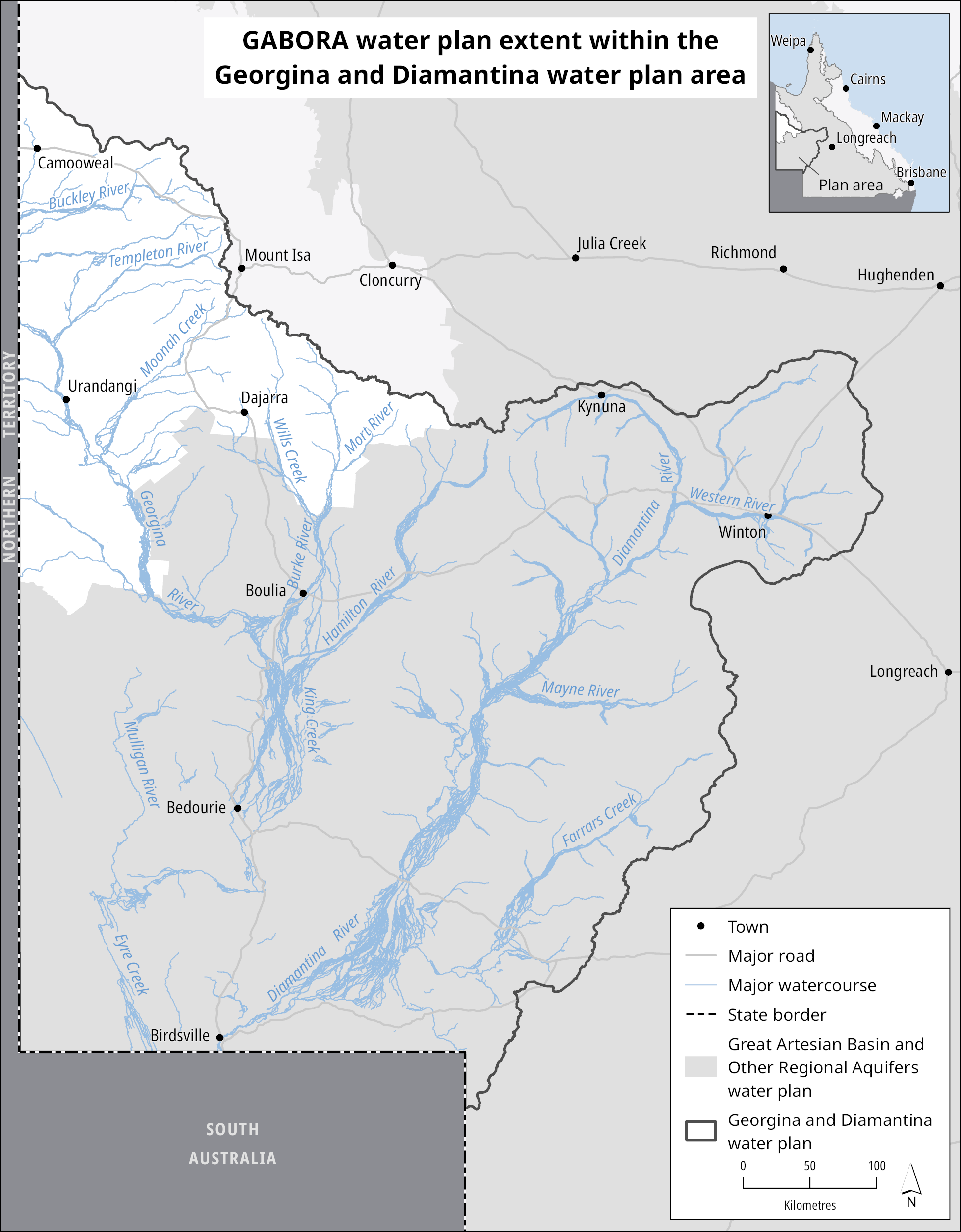
Find out more about the full extent of Queensland’s portion of the GAB.
In some parts of the Georgina and Diamantina, groundwater connects with surface water. Because these water resources are so closely interconnected, we manage them in the same way.
This means that if you take water from an aquifer that is connected to surface water, you must have a licence. This rule does not apply for water used for stock or domestic purposes.
We are running scientific assessments to give us more information about groundwater hydrology in the plan area. We will use this information to better manage groundwater resources.
For more information about groundwater, read: