
White spot disease
Alert
White spot disease is prohibited matter.
Under Queensland legislation, if you suspect White spot disease in any crustacean you must either:
- phone Biosecurity Queensland on 13 25 23
- complete the online reporting form
- phone the Emergency Disease Hotline on 1800 675 888.
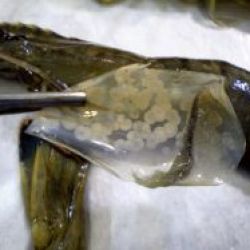
A prawn shell fragment from a prawn affected by white spot disease
© Queensland Government

A whole prawn affected by white spot disease
© Queensland Government
White spot disease is a highly contagious viral infection that affects crustaceans such as prawns, yabbies and crabs. When found in high-intensity production areas, such as prawn farms, white spot disease results in the rapid mortality of prawns.
The virus that causes white spot disease does not pose a risk to food safety or human health, so prawns are safe to eat.
Cause
White spot disease (WSD) is caused by the white spot syndrome virus (WSSV).
Description
WSD is a serious viral infection that affects decapod crustaceans, spreading rapidly and causing significant losses in high-production areas such as prawn farms.
WSD does not pose any risk to food safety or human health, and prawns remain safe to eat.
Distribution
Queensland
WSD was first detected in 2016 on several prawn farms in South East Queensland's Logan River region.
The disease has since been identified in wild-caught prawns and crabs in Moreton Bay.
New South Wales
Detections in northern New South Wales prawn facilities and wild populations of school prawns have led to temporary restrictions on the movement of uncooked prawns from the Clarence River, Richmond River and Evans Head control zones.
Genetic testing showed the strain of virus detected in New South Wales is different from all Queensland samples.
Worldwide
WSSV is found in countries of Asia, the Middle East, Americas, Oceania, and the Mediterranean, where it has caused severe losses on prawn farms.
Animals affected
- Decapod crustaceans, which include prawns, lobsters, crabs, saltwater yabbies
- Marine worms are potential carriers of the virus
Clinical signs
Prawns:
- Loose shells
- White spots (0.5–2.0mm in diameter) visible on the inner shell surface
- Pink to red discolouration
- Unusual mortality or erratic swimming behaviour
- Congregation at the water's edge
Other species:
- Crabs and other crustaceans can carry the disease without visible signs.
- Finfish are not affected and cannot carry WSD.
- White spot disease in aquarium fish ('ich') is not related to WSD.
Impacts
WSD poses a significant biosecurity risk to Australia's prawn aquaculture industry by disrupting production and farm operations, such as:
- threats to Queensland's $210 million prawn-farming industry
- the forced closure of 7 prawn farms in South East Queensland for nearly 2 years during a major outbreak.
WSD can also impact commercial fishing and supply chains due to movement and trade restrictions, community access to fishing grounds and high-risk species in regulated areas.
How it is spread
WSD spreads primarily through the movement of infected animals or contaminated water.
The disease might also be spread by:
- animals feeding on and moving infected animals (e.g. birds).
- contaminated vessels, machinery, equipment, and clothing.
Monitoring and action
If you suspect WSD:
- take a photo of the affected animal
- collect and refrigerate a sample
- report it to Biosecurity Queensland.
Report suspected disease
You must either:
- Complete the online reporting form
- Phone Biosecurity Queensland on 13 25 23
- Phone the Emergency Disease Hotline on 1800 675 888.
Legal obligations
Under Queensland legislation, if you suspect WSD in any crustacean, you must report it.
If you own, treat or manage crustaceans, you have a general biosecurity obligation to take all reasonable and practical measures to prevent or minimise the effects of biosecurity risks such as WSD. This means you are legally required to reduce the risk of WSD and limit its spread when dealing with possible carriers.
Surveillance
Queensland monitors the spread of WSD through annual surveillance.
Control
Control measures aim to minimise the risk of spreading WSD, including:
- movement restrictions in regulated areas
- fishing restrictions near high-risk prawn farms
- decontaminating equipment and vessels when moving between areas
- using bait responsibly and disposing of it correctly
- implementing strong biosecurity practices on aquaculture farms.