
Liriomyza leafminers
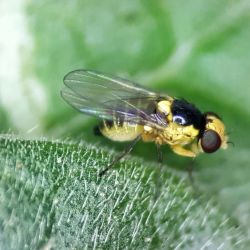
Vegetable leafminer adult
© Dr Elia Pirtle, Cesar Australia
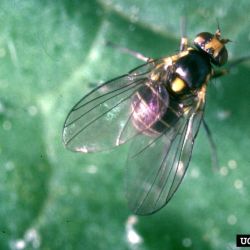
Serpentine leafminer adult
© Central Science Laboratory, Harpenden, British Crown, Bugwood.org
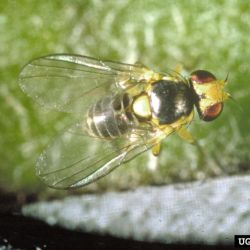
American serpentine leafminer adult
© Central Science Laboratory, Harpenden, British Crown, Bugwood.org
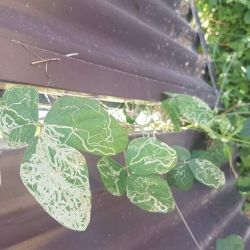
Vegetable leafminer damage on siratro, Far North Queensland
© Dr Elia Pirtle, Cesar Australia
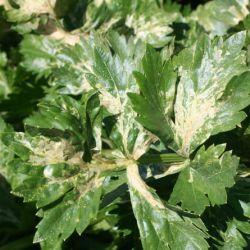
Serpentine leafminer damage on celery, Darling Downs, Queensland
© Queensland Government
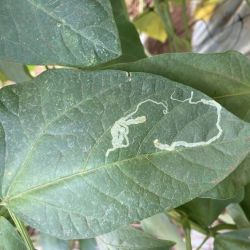
American serpentine leafminer damage on snake beans, Coastal Plains region, Northern Territory
© Queensland Government
Liriomyza leafminers are small black-and-yellow flies whose larvae feed internally on plant tissue, particularly leaves, causing distinctive 'mining' damage.
These leafminers pose a significant threat to Australia's agricultural and nursery industries because they feed on many types of plants. They affect more than 400 plant species from across 28 plant families, including a wide range of common horticultural crops and ornamental plant species. Vegetable leafminer is a priority pest in Queensland.
Scientific names
- Liriomyza sativae (vegetable leafminer)
- Liriomyza huidobrensis (serpentine leafminer)
- Liriomyza trifolii (American serpentine leafminer)
Common names
- Vegetable leafminer: tomato leafminer, serpentine vegetable leafminer, American leafminer, melon leafminer
- Serpentine leafminer: pea leafminer, South American leafminer, Liriomyza, potato leafminer
- American serpentine leafminer: serpentine leafminer, broad bean leafminer, celery leafminer, chrysanthemum leafminer, Californian leafminer
Description
Adults
- Adults are small flies, 1–2.5mm long.
- They are black with a yellow head and a yellow spot on the thorax.
Eggs
- Eggs are slightly translucent to off-white.
- They are tiny, barely visible to the naked eye.
- They are laid under the leaf surface, usually on the underneath side of the leaf.
Larvae
- Larvae are transparent when they first hatch but turn pale yellow-orange as they mature.
- Larvae are maggots and live in tunnels under the leaf surface.
- They develop inside leaf tissue and vary in size but can grow up to 3.2mm long.
- They form irregular circuitous mines, which may be restricted by leaf veins.
Pupae
- Pupae are oval and slightly flattened.
- Their colour varies from pale yellow-orange to dark brown.
- Pupation occurs externally to the leaf, usually in the soil below the plant but sometimes on the leaf surfaces or stems of leafy vegetables.
- They are adversely affected by high humidity and drought.
Plant stage and plant parts affected
Host plants of any age and stage of growth can be infested, but young plants are most susceptible.
The leafminers mainly affect leaf tissue but can mine the stems of leafy vegetables such as silverbeet and celery.
Plant damage
Feeding sites or puncture wounds (made by flies laying eggs) are the first signs of leafminer activity in a crop, though they are very easy to overlook. These are white and oval-shaped and have a distinct hole towards one end.
The first signs usually noticed are mines in the surface of leaf tissue. Leaf mines are usually white or pale-green 'squiggles' with black and dried brown areas. They are typically serpentine or irregular in shape and increase as the larvae mature.
Mining activity by the larvae causes loss of healthy leaf tissue, affecting the plant's ability to photosynthesise. Also, the damage from mining and egg-laying can introduce disease-causing fungi and bacteria. In severe infestations, leaves can wilt and die, leading to defoliation.
May be confused with
Adults and larvae can be very similar in appearance to other fly pests. Damage caused by other leafminer insects can be superficially similar to that caused by Liriomyza leafminers.
Distribution
Vegetable leafminer
Vegetable leafminer is originally from South America. It has spread across the world into Africa, North America, Central America, Asia and some Pacific islands.
Between 2008 and 2015, this leafminer was detected on a number of islands in the Torres Strait. It was detected on the Australian mainland in a remote community on the tip of Cape York Peninsula in 2015. Since that time, its known distribution has remained unchanged.
Serpentine leafminer
Serpentine leafminer originated in Central America and South America. It has spread to Africa, Asia, Europe and North America.
It was first detected in New South Wales and Queensland in November 2020 and has been confirmed as far north as Bundaberg. It is also now present in Victoria.
American serpentine leafminer
American serpentine leafminer is thought to have originated in North America. It has spread to Africa, Asia, Central America, South America and Europe.
Since March 2021, there have been multiple detections in the Torres Strait, in Far North Queensland (Northern Peninsula Area of Cape York Peninsula), and in Kununurra, northern Western Australia. It is currently confirmed on the Atherton Tableland and suspected in the Bowen region. It has also been confirmed in South East Queensland and is therefore considered widespread in Queensland.
Hosts
There is much overlap in hosts for these 3 leafminers. They affect a wide range of common horticultural crops and ornamental plant species.
Vegetable leafminer has been found in squash, okra, pea, tomato, bean, cabbage, turnip, potato, tobacco, cotton, radish, spinach, watermelon, beet, pepper, alfalfa, clover, vetch and plantain.
Serpentine leafminer has seriously affected solanaceous crops (such as potato) as well as certain crops in the Cucurbitaceae family (such as zucchini) and the Fabaceae family (such as green bean). Other severely affected hosts are celery, silverbeet and baby leaf spinach.
American serpentine leafminer attacks a similar range of crops to serpentine leafminer. However, in Australia it has been found in potato, mung bean, green bean, sunflower, sunn hemp, okra, tomato, eggplant, capsicum and various cucurbits grown under protected cropping structures.
Life cycle
Female flies pierce the leaf surface to lay eggs inside the leaf. Eggs hatch in 2 to 5 days, depending on the temperature, and larvae mine the leaf tissue.
There are 3 larval growth stages (instars). The larvae mine the leaf for 3 to 14 days, depending on the temperature—the warmer it is, the faster the larvae grow.
The larvae leave the plant to pupate. Pupation also varies depending on the season and temperature, and can range from 6 days to 24 days.
Adult flies emerge from the pupae and are most active at sunrise and during the morning. They mate within 2 days of emerging. An adult can lay over 150 eggs in their lifetime and several generations may be produced in a year.
Impacts
Damage caused by these leafminers reduces the growth and development of seedlings and young plants, which can lead to plant death. Damage also reduces crop yield and marketability, resulting in economic losses to growers, particularly for leafy vegetables.
Once these leafminers are established in a horticultural production area, its domestic and export market access may be disrupted. Also, costly additional control measures may be required.
Home gardeners can also be affected by plant damage and reduced yield.
How it is spread
The greatest risk of spread is by people moving infested plant material, soil or associated packaging.
Adults may also hitchhike in vehicles, machinery or aircraft.
The adults are not very strong flyers. They usually walk quickly over leaves and fly short distances to move between leaves or nearby plants. Strong winds may help them fly further afield.
Monitoring and action
Inspect your plants regularly for the presence of leafminers. Look for leafminer damage on a variety of plant species and for unusual or severe leafminer damage.
If you see leafminer damage that is unusual or severe, unusually widespread or on plant species where you have not previously observed it, please report a biosecurity pest. Upload photographs of the damage on individual plants and the general area, ensuring that the photographs are in focus.
Alternatively, you can report by phoning:
- Biosecurity Queensland on 13 25 23 or
- the Exotic Plant Pest Hotline on 1800 084 881.
Prevention
Use these resources to help protect your farm from plant pests and diseases:
- Potato growers' biosecurity manual (PDF, 2.9MB)
- Biosecurity manual for the nursery production industry (PDF, 3.1MB)
- Biosecurity induction manual for Bundaberg horticultural farms (PDF, 1.3MB)
- Protecting your farm from plant pests and diseases
- My property biosecurity
- Farm biosecurity.
Control
For established leafminers (American serpentine leafminer and serpentine leafminer), integrated pest management options are likely to be more effective than chemical suppression. Relying on pesticides has led to insecticide resistance and tends to be ineffective.
Read more about the management of Liriomyza flies (PDF, 5.1MB).
Legal requirements
- Serpentine leafminer and American serpentine leafminer are widespread in Queensland and you do not need to report their presence.
- You must report vegetable leafminer if you suspect you have detected it outside the far northern biosecurity zones (PDF, 334KB).
- There are other species of Liriomyza leafminers that are not present in Australia. If you suspect that you have detected an exotic species, you must report it.
- Options for reporting are:
- Report online (and upload in-focus photographs).
- Phone Biosecurity Queensland on 13 25 23.
- Phone the Exotic Plant Pest Hotline on 1800 084 881.
Further information
- Read about the management strategy for serpentine leafminer.
- Find out about managing pesticide resistance in serpentine leafminer.
- Watch a video about exotic leafminers.
- Learn more about vegetable leafminer (PDF, 2.4MB).
- Find out how to protect Queensland from pests and diseases while travelling in Cape York and the Torres Strait.