
Root-knot nematode
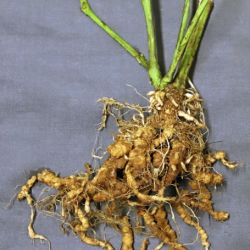
Heavily galled tomato roots
© Queensland Government
Root-knot nematodes are microscopic worm-like animals that are very common in soils throughout Queensland. They are plant parasites and are the most important nematode pest in horticultural crops. As their name suggests, they give infected roots a lumpy, knotted appearance.
Cause
Root-knot nematodes are in the genus Meloidogyne. There are over 100 species worldwide, but less than 10 are found in Australia. Meloidogyne javanica and M. incognita are the most widespread species in Queensland.
A new species, M. enterolobii (known as guava root-knot nematode), was first detected in Queensland in 2022. This species has the potential to be a severe pest of many common crops.
Symptoms
Above-ground symptoms
- Root-knot nematodes do not produce any specific above-ground symptoms.
- Affected plants have an unthrifty appearance and often show symptoms of stunting, wilting or chlorosis (yellowing).
- Symptoms may be particularly severe if plants are infected soon after planting.
- Nematode populations usually build up over the growing season and plants may appear normal until they reach maturity.
- Wilting and dieback may occur at flowering, reducing fruit set and fruit development.
- Affected plants will often be in patches, as nematodes usually have an uneven distribution in the soil.
Below-ground symptoms
- Below-ground symptoms of root-knot nematodes are quite distinctive.
- Lumps (galls) ranging in diameter from 1mm to 10mm develop all over the roots.
- In severe infestations, heavily galled roots may rot away, leaving a poor root system with a few large galls.
How it spreads
Nematodes are basically aquatic animals—they move in water films around soil particles.
Juvenile root-knot nematodes hatch from eggs, move through the soil and invade roots near the root tip. Once inside the roots, most juveniles develop into females, which then start to feed.
This stimulates the surrounding root tissues to enlarge and produce the galls typical of root-knot nematode infection.
Mature female nematodes lay hundreds of eggs on the root surface, which hatch to continue the life cycle. They can only move relatively small distances by themselves, so are spread between properties and districts in infested soil and plant material by human activities.
Crops affected
Most root-knot nematodes have very wide host ranges, and they cause problems in many annual and perennial crops and ornamentals. Some crops that are commonly affected are:
- tomato
- capsicum
- potato
- sweetpotato
- carrot
- eggplant
- pumpkin
- cucumber
- melons
- zucchini
- lettuce
- beans
- celery
- ginger
- strawberry
- pineapple
- papaya
- banana
- sugarcane
- grape
- stone fruit
- carnation
- gardenia
- chrysanthemum
- rose.
Control
On-farm biosecurity
Good on-farm biosecurity practices help to reduce the risk of new nematode pests entering a farm or garden and spreading within a property. Root-knot nematodes and most other soilborne pests and diseases are microscopic—you will not see them. Always assume that anything moving soil and plant material onto or around your property could be infested.
Resistant varieties
A few vegetable crops (such as tomato, capsicum and potato) have varieties that are resistant to root-knot nematode. Resistant root stocks are also available for some perennial crops (such as grapes).
Ask your planting material suppliers about the availability and suitability of these resistant varieties.
Crop rotation
Root-knot nematode problems increase, and control becomes more difficult, when susceptible crops are grown without a break.
Rotation with a resistant crop (or having a bare fallow period) can significantly reduce root-knot nematode populations in the soil and so reduce losses when a susceptible crop is replanted.
It is important to eliminate any susceptible plants (including weeds) during the rotation/fallow period, as these will help nematodes carry over to the next crop.
Organic amendments
Increasing soil carbon and soil organic matter by adding organic amendments (such as composts and crop residues) can also reduce root-knot nematode populations. These organic amendments encourage predators and parasites of plant-parasitic nematodes.
Chemical treatments
Check the Australian Pesticides and Veterinary Medicines Authority database for chemicals registered or approved under permit to treat this pest on the target crop in your location. Always follows the instructions on the label and observe withholding periods.