
Foot-and-mouth disease information for veterinarians
Foot-and-mouth disease is prohibited matter under the Biosecurity Act 2014.
FMD outbreaks are common in Asia, the Middle East, South America and parts of Africa. In May 2022, an outbreak of FMD was reported in cattle in Indonesia and in July 2022 in Bali.
International outbreaks are a reminder that animal diseases can spread quickly and do not respect international borders.
FMD is not present in Australia. In the event of an outbreak early detection and reporting would be critical to rapidly contain this disease.
Be vigilant and look for signs of foot-and-mouth disease in livestock.
Under Queensland legislation, if you suspect the presence of this disease in any species of animal, you must report it to Biosecurity Queensland on 13 25 23 or contact the Emergency Animal Disease Hotline on 1800 675 888.
Foot-and-mouth disease (FMD) is a highly contagious animal disease that would have a severe impact on both the livestock industry and the Australian economy should an outbreak occur.
Australia is currently free from FMD. Veterinarians play a key role in recognising and reporting suspected cases of FMD.
This guide:
- provides an overview of FMD
- describes the clinical signs of FMD and how to diagnose it (including photo galleries by species)
- explains how to report and respond to suspected cases of FMD
- outlines ways to prevent FMD.
What is foot-and-mouth disease?
Foot-and-mouth disease (FMD) is a serious, highly contagious viral disease affecting cloven-hoofed animals. Animals affected include:
- livestock such as cattle, pigs, sheep and goats
- deer
- camelids such as camels, llamas and alpacas.
Horses are not susceptible to infection with the FMD virus.
FMD can cause blistering in the hooves and mouths of infected animals, which may result in lameness, fever and excessive salivation. FMD may be fatal in young stock.
An FMD outbreak could cause major production losses and seriously affect Australia's international livestock trade. It has been estimated that a large, multi-state FMD outbreak could cost Australia more than $80 billion in lost revenue over 10 years.
FMD has not occurred in Australia since 1872, but is common in some countries in Asia, the Middle East, Africa and some parts of South America. Increased globalisation through increased movements of people and products raises the likelihood of FMD entering Australia. Recent detections of FMD virus fragments in meat confiscated at Australian airports by the federal Department of Agriculture, Fisheries and Forestry highlight the very real possibility of pathogen entry through passenger and luggage movements.
Foot-and-mouth disease overview
Cause
Foot-and-mouth disease (FMD) is caused by a picornavirus.
The virus has 7 distinctive serotypes. Immunity to one serotype provides little to no protection against other serotypes.
Signs
FMD is clinically characterised by vesicles and erosions:
- in the mouth and nostrils
- on teats
- on skin between the claws and at the coronary band.
A variety of other signs also appear in cattle, pigs, and sheep and goats.
Incubation period
FMD's incubation period is highly variable and changes according to the:
- virus strain
- virus dose
- transmission route
- animal species involved
- conditions in which animals are kept
The incubation period is typically 2–14 days. For the purposes of the World Organisation for Animal Health, the FMD incubation period is 14 days.
Large numbers of animals in a group may be infected by the FMD virus simultaneously. However, they may display differing clinical signs depending on how long each individual animal has been infected.
For the purposes of the World Organisation for Animal Health, the FMD incubation period is 14 days.
Transmission
FMD is one of the most contagious animal diseases known. Animals may be infectious before clinical signs develop.
Infected animals excrete virus in:
- fluid from ruptured vesicles
- exhaled air
- saliva
- milk
- semen
- faeces
- urine.
The main transmission method within herds or flocks is by direct contact or via respiratory particles and droplet.
Cattle (indicator species) are highly susceptible to aerosol infection and readily display clinical signs. Sheep (maintenance species) are equally susceptible to aerosol infection but are less infectious and may not show obvious clinical signs. Pigs (amplifying species) are less susceptible to aerosol infection, but are potent amplifiers and excretors of the virus, especially in their breath. They serve as a significant source of virus to susceptible animals. Pigs frequently show obvious clinical signs.
The spread of FMD between properties and areas is often due to the movement of:
- infected animals
- contaminated vehicles, equipment, people and animal products.
Under certain weather conditions, infected aerosols can spread the virus many kilometres by wind.
Virus persistence
FMD virus can remain infective in the environment for several weeks and possibly longer:
- in the presence of organic matter, such as soil, manure and dried animal secretions
- or
- on chemically inert materials, such as straw, hair and leather.
In carcasses that have undergone normal post-slaughter acidification, the virus is inactivated within 3 days. However, the virus can remain viable for months in chilled lymph nodes, bone marrow, viscera and residual blood clots.
The virus may be shed in milk from infected animals up to 4 days before the onset of clinical signs and for up to 3 weeks afterwards.
Experimentally, FMD can be transmitted by insemination with infected semen. FMD virus has been found in bull semen 4 days before, during and up to at least 37 days after the appearance of clinical signs. It has also been found in bovine semen stored at -50°C for 320 days. FMD virus has also been found in pig semen and is likely to occur in sheep and goat semen. The virus enters semen as a result of viraemia or lesions around the preputial orifice. Some ruminants may remain long-term FMD carriers, but their role in starting new infections in susceptible animals has not been demonstrated.
Clinical signs of foot-and-mouth disease in cattle
A range of clinical signs may indicate the presence of foot-and-mouth disease (FMD) in cattle.

Steer with FMD tongue lesions. © UK DEFRA.
Typical clinical signs of FMD in cattle include:
- pyrexia (up to 41°C)
- anorexia
- in dairy animals, reduced milk production.
Vesicles develop on the buccal and nasal mucous membranes and/or between the claws and coronary band. These may lead to:
- smacking of lips
- bruxism
- drooling
- lameness
- stamping or kicking of feet.
Vesicles frequently also develop on the mammary glands.
Vesicles rupture, leaving erosions 24 hours later.
Cattle generally recover from FMD within 8–15 days, but complications may include:
- tongue erosions
- secondary infection of lesions
- hoof deformations
- mastitis and permanent impairment of milk production
- abortion
- permanent weight loss.
Young animals may die from viral myocarditis.
No results were found
Also consider...
- Read more about the signs and transmission of FMD.
Clinical signs of foot-and-mouth disease in sheep and goats
A range of clinical signs may indicate the presence of foot-and-mouth disease (FMD) in sheep and goats.
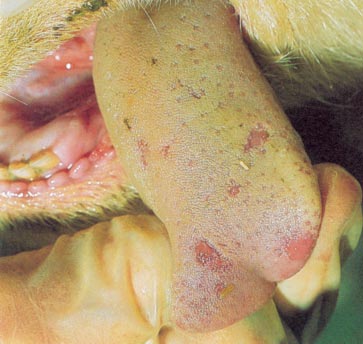
Sheep with FMD tongue lesions. © UK DEFRA.
In sheep and goats, the disease is usually mild with few lesions, however, clinical signs can include:
- pyrexia
- lameness and oral lesions, which are often mild
- foot lesions along the coronary band or interdigital spaces, and lesions on the dental pad, but these may go unrecognised
- agalactia in milking sheep and goats
- death of young stock without clinical signs.
Severely affected animals can succumb to sudden, severe lameness affecting 1 or more feet.
The mild or sub-clinical expression of the disease in sheep is a significant risk factor for the spread of the disease.
No results were found
Also consider...
- Read more about the signs and transmission of FMD.
Clinical signs of foot-and-mouth disease in pigs
A range of clinical signs may indicate the presence of foot-and-mouth disease (FMD) in pigs.
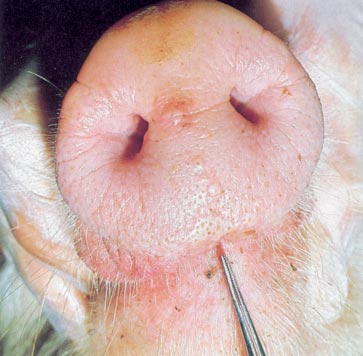
Pig with FMD snout lesions. © UK DEFRA.
Typical clinical signs of FMD in pigs include:
- pyrexia, though this clinical sign is inconsistent
- severe foot lesions and lameness, with detachment of the claw horn, especially when housed on concrete
- vesicles on pressure points of limbs, especially along the carpus, resulting in knuckling
- vesicular lesions on the snout
- abortion.
No results were found
Also consider...
- Read more about the signs and transmission of FMD.
Diagnosing foot-and-mouth disease
The clinical signs of foot-and-mouth disease (FMD) are similar to those of a number of other animal diseases.
Diseases that are clinically indistinguishable from FMD include:
- vesicular stomatitis
- swine vesicular disease
- vesicular exanthema.
Other differential diagnoses include:
- senecavirus A
- rinderpest (now eradicated)
- bluetongue
- peste des petits ruminants
- mucosal disease
- bovine papular stomatitis
- bovine ulcerative mammalitis
- pseudocowpox
- bovine malignant catarrh
- contagious ecthyma ('scabby mouth')
- infectious bovine rhinotracheitis/infectious pustular vulvovaginitis
- scalding, wetting, contact dermatitis, photosensitisation
- photosensitisation
- mouth lesions in pigs from hot feed
- laminitis, hoof abscess, footrot (e.g. from bad floors, new concrete, mud).
FMD can only be confirmed or ruled out through laboratory testing of samples taken from infected animals. Biosecurity Queensland staff will advise you on how to correctly collect, decontaminate and submit samples for testing. You may be asked to collect samples of:
- vesicular fluid
- epithelial tissue tags
- pharyngeal scrapings
- sera.
Samples must be submitted to the Biosecurity Sciences Laboratory in Coopers Plains, Brisbane. The Biosecurity Sciences Laboratory tests the samples in parallel with the Australian Centre for Disease Preparedness in Geelong, Victoria.
All suspected cases of FMD must be investigated. If you suspect an animal has FMD, you must call Biosecurity Queensland on 13 25 23. Biosecurity staff will advise you about biosecurity measures, sampling, and testing.
Also consider...
- Complete free online FMD training for veterinarians and veterinary paraprofessionals.
Responding to a suspected case of foot-and-mouth disease
If you suspect an animal has foot-and-mouth disease (FMD), follow these steps:
- Immediately report the suspected case to Biosecurity Queensland on 13 25 23 or to the Emergency Animal Disease Hotline on 1800 675 888. FMD is prohibited matter under Queensland legislation.
- Collect as much relevant history and clinical and epidemiological information as possible. Using this information, Biosecurity Queensland will be able to undertake likelihood and risk assessments to help inform the next steps.
- Apply enhanced biosecurity measures. This may include working with livestock owners to implement the following:
- Immediately isolate affected animals and keep them away from the edge of the property. Prevent people who have been in contact with the suspected stock from coming into contact with other at-risk animals. Do not allow animals such as dogs, cats and poultry to have contact with stock, as they may act as vectors to transmit the virus.
- Prevent animals being moved to or from the property.
- Prevent movement from the property of vehicles, clothing, animal feed, waste material or anything that has been in contact with the suspect stock.
- Prevent visitors or vehicles entering the property. A 'NO ENTRY' sign may be used on farm gates and other access points.
- Prevent people leaving the property. Anyone who must leave for emergency reasons must shower first, leave all farm clothes on the property and take special care to ensure footwear is particularly clean, with no dirt or faeces left on the soles or on any remaining clothing.
- Appropriate sampling and testing will be required to confirm or rule out FMD. Biosecurity Queensland officers will provide relevant advice.
Biosecurity Queensland officers will provide further information and support in relation to managing the property while laboratory testing is in progress. If FMD is confirmed, a range of biosecurity measures will be applied to contain and eradicate the disease on the property.
Also consider...
- Do free online FMD training for veterinarians and veterinary paraprofessionals.
Controlling foot-and-mouth disease in Australia
Australia is currently free from foot-and-mouth disease (FMD). However, if FMD were to occur, the aim would be to eradicate the disease in the shortest possible time while minimising socio-economic impacts.
The Australian Veterinary Emergency Plan (AUSVETPLAN) Disease Strategy – Foot-and-mouth disease outlines Australia's FMD control and eradication strategy. It is important for veterinarians, industry and the community to understand the actions government would take in the event of an FMD outbreak in Australia. Governments would also communicate regularly with you regarding veterinarians' responsibilities and any actions you need to take.
The AUSVETPLAN strategy includes:
- minimising disease spread by implementing strict biosecurity and movement controls over animals, animal products, and fomites in declared areas
- stopping the movement of all susceptible livestock, initially for a period of 72 hours, to allow time to assess the epidemiological situation
- tracing and surveillance to identify infected animals and animals in contact with infected animals
- valuing and destroying infected animals and animal products and disposing of them in a sanitary way
- decontaminating facilities, products, equipment and objects to limit the spread of the virus
- running public awareness campaigns
- enabling relief and recovery programs to minimise animal and human welfare issues.
Pre-emptive destruction of livestock and emergency vaccination will also be considered as additional disease control measures.
Preventing foot-and-mouth disease
An outbreak of foot-and-mouth disease (FMD) in Australia is most likely to be caused by:
- the importation of food contaminated with FMD virus
- the feeding of food contaminated with FMD virus to pigs.
Preventing these illegal activities is the best way to prevent an outbreak of FMD in Australia
Keep illegal food products out of Australia
Australia's quarantine laws and border surveillance restrict the importation of FMD-susceptible animals and products, including salted and cured meats.
To help keep Australia FMD-free, travellers entering Australia must declare:
- all food, plant material and animal products to ensure they are free from pests and diseases
- if they have visited a farm while overseas.
FMD virus fragments have been detected in meat and meat products confiscated at Australian airports by the Australian Government Department of Agriculture, Fisheries and Forestry. Australian Border Force officials can cancel visas and refuse entry to Australia for serious biosecurity breaches.
Measures such as the use of detector dogs and enhanced screening have also been deployed at Australia's international mail centres.
You can help keep FMD out of Australia by sharing this information with any international travellers you know and ensuring family and friends know not to send parcels containing items that may pose a biosecurity risk to Australia.
Prohibited feed for pigs (swill)
All Australian states and territories have laws against supplying and feeding prohibited feed to pigs. This applies to all pigs, including pet pigs and pigs owned by hobby farmers. Significant penalties apply for supplying or feeding prohibited feed to pigs.
You can help prevent FMD by informing any pig owners you know about the risks of feeding prohibited feed to pigs. If you suspect that prohibited feed (swill) is being supplied to pig owners, or pigs are being fed prohibited feed (swill), then report it to Biosecurity Queensland on 13 25 23.
Also consider...
- Find out more about laws against supplying and feeding prohibited feed to pigs as well as foods that can and cannot be fed to pigs.
- Visit our playlist of community education FMD videos.
- Do free online FMD training for veterinarians and veterinary paraprofessionals.
- Download a fact sheet about foot and mouth disease.
- Download a fact sheet for pig owners about what to feed pigs.
- Download a fact sheet about anti-swill feeding for food outlets (also available in Chinese and Vietnamese).
Foot-and-mouth disease online training for veterinarians and veterinary paraprofessionals
Biosecurity Queensland has developed 2 online training courses to increase Queensland's preparedness for foot-and-mouth disease (FMD):
- FMD training for veterinarians and veterinary paraprofessionals
- FMD awareness training for the livestock industry and wider community.
FMD training for veterinarians and veterinary paraprofessionals
If you are a veterinarian or veterinary paraprofessional, this training package will help further your understanding of FMD and notification requirements. It covers:
- susceptible species and transmission mechanisms
- how to properly complete an FMD investigation
- FMD case definition and differential diagnoses in Queensland
- notification requirements under the Biosecurity Act 2014
- interim measures to take if you suspect FMD on a premises
- sample collection and management, including packaging
- on-farm biosecurity measures, including personal decontamination
- role of animal health professionals in an FMD incident.
The course:
- takes about 3–4 hours to complete
- is presented in modules and can be completed on a module-by-module basis
- allows you to log in and out without losing your progress
- is recognised by the Australian Veterinary Association and you will earn 3 continuing education points on completion.
You can download a certificate of completion after completing all the modules.
Accessing the online course
The FMD awareness training course works best when opened using Google Chrome (preferred option) or Mozilla Firefox.
The course is hosted on the Animal Health Australia (AHA) Biosecurity Online Training (BOLT) portal.
To register as a learner (you only need to do this once), complete the following steps:
- Access the AHA Learning System.
- Click on the 'Register' link in the log-in panel and fill in your details.
- Click on the 'Sign Up' link at the bottom.
- An email will be sent to you with a link. Click on the link in the email—this will take you to a page where you can enter your own password.
- You'll be taken to the Learning home page.
- Click on your name to edit your details and attach a profile photo if you like.
- You have now registered in the AHA Learning System.
Once you have registered, you can enrol in a range of courses, including FMD training for Queensland veterinarians and veterinary paraprofessionals:
- Log in to the AHA Learning System.
- Click on 'Browse Learning'.
- Scroll down to find the FMD course titled FMD training for Queensland veterinarians and veterinary paraprofessionals and click on it.
- This will open the front page of the course.
- Click on the 'Enrol' button at the top right of the page.
- Once enrolled, click on the 'Launch' button for Module 1.
- This will open the course. Click 'Start' to start the course.
- Completing Module 1 will unlock the remaining modules, which you can then complete in any order you like.
If you experience issues accessing the course, contact us online, by phone or in person.
Also consider...
- Access the downloadable FMD veterinary training resources.
- Watch our YouTube videos about entry and personal decontamination and exit and personal decontamination.
- Find out more about laws against supplying and feeding prohibited feed to pigs.
- Visit our playlist of community education FMD videos.
- Read the National guidance document on the engagement of private veterinarians during an emergency animal disease response.
FMD alert (nested)
Foot-and-mouth disease is prohibited matter under the Biosecurity Act 2014.
FMD outbreaks are common in Asia, the Middle East, South America and parts of Africa. In May 2022, an outbreak of FMD was reported in cattle in Indonesia and in July 2022 in Bali.
International outbreaks are a reminder that animal diseases can spread quickly and do not respect international borders.
FMD is not present in Australia. In the event of an outbreak early detection and reporting would be critical to rapidly contain this disease.
Be vigilant and look for signs of foot-and-mouth disease in livestock.
Under Queensland legislation, if you suspect the presence of this disease in any species of animal, you must report it to Biosecurity Queensland on 13 25 23 or contact the Emergency Animal Disease Hotline on 1800 675 888.
© The State of Queensland 1995–2026